
Worth it? For one kind of buyer, yes, and I mean exactly one kind: a side or combination sleeper who wants a bouncy, medium-soft pillow and is actually willing to use the loft exchange instead of just living with the wrong height. On cost per year it is not a bargain. Do the math and $179 over a 3.5-year life comes out at about $51 a year. Double a Brooklinen Marlow. Level with the other premium latex pillows at list price, though. Not a rip-off. Not a deal either.
What is in this article, then? The GelFlex Grid specs. The three lofts. Whatever firmness and cooling data actually exists, which is not much. And a price-per-year comparison against the competing pillows, because that is the number that decides it. Brocia analyzes products from specs and published research, not hands-on testing, and where a number does not exist I say so instead of filling the gap.
Purple Harmony at a glance
| Verdict | Worth it for one buyer: a side or combination sleeper who wants a bouncy, medium-soft pillow and will use the loft exchange |
| Cost per year | About $51 at $179 over a 3.5-year life. Level with premium latex, about double a Marlow |
| Cooling | Not proven. The only hands-on tester slept warm most nights, and there is no lab cooling number |
| Loft | Medium 6.5 in fits most side sleepers; Low 5.5 in is too tall for stomach sleepers |
| Skip if | You sleep hot, sleep on your stomach, or want the lowest cost per year |
What are the Purple Harmony Pillow’s specs?
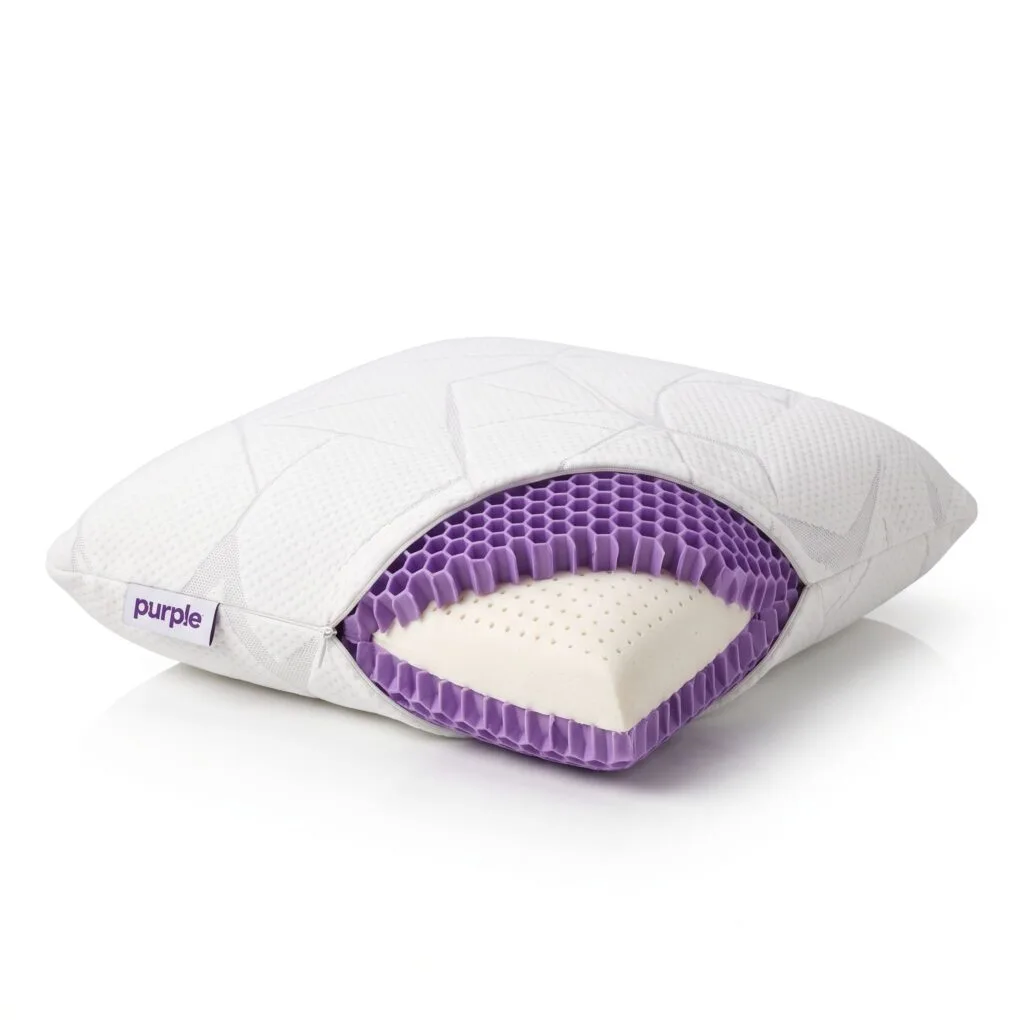
The Harmony wraps a ventilated Talalay latex core in a honeycomb layer of Purple’s GelFlex Grid, a hyper-elastic polymer, inside a stretch-knit cover. Here is what the maker and retailers list.
| Spec | Detail |
|---|---|
| Core | Ventilated Talalay latex |
| Outer layer | 360-degree honeycomb GelFlex Grid (hyper-elastic polymer) |
| Cover | 92% nylon, 8% spandex, moisture-wicking |
| Airflow | Over 2,000 open air channels in the Grid Hex |
| Standard size | 26 by 17 inches (28 by 17 in the tall loft) |
| King size | 36 by 17 inches |
| Care | Cover machine washable; core and Grid spot clean only |
| Warranty | 1 year |
| Trial | 30 nights |
Over 2,000 open air channels, yet the only hands-on tester slept warm most nights. The channels are real. The cooling is not proven.
Mattress Firm’s Harmony listing for sizes and the 2,000-channel figure, Mattress Firm for the cover fabric, and Tom’s Guide for care, warranty, and trial terms.
Tom’s Guide describes the Grid Hex as gel-like and says the pillow ships in plastic but not vacuum sealed, so there is no waiting for it to expand. Want the feel of it, the day-to-day living with it? That lives in my Purple Harmony pillow review. This article? Numbers only. Specs, prices, and the arithmetic.
What are the loft and weight options?
The Harmony comes in three listed heights, and the weights rise with them. These figures come from Mattress Firm.
| Loft | Listed height | Standard size | Standard weight | King weight |
|---|---|---|---|---|
| Low | 5.5 in | 26 by 17 in | 4.2 lb | 6 lb |
| Medium | 6.5 in | 26 by 17 in | 5 lb | 6 lb |
| Tall | 7.5 in | 28 by 17 in | 5 lb | 7 lb |
These are unloaded heights from the maker. I found no independent measurement of how far the pillow compresses under a head, so the height you feel at night is unknown. AARP measures sinkage for some pillows, for instance 4.5 inches under a 45-pound kettlebell for the Luxome LAYR, but its pillow testing did not include the Harmony.
Compare the listed heights with expert guidance. AARP’s orthopedic pillow guide gives its own numbers, and they are blunt: side sleepers, up to around 5 inches. Back sleepers, about 3 to 5. Stomach sleepers, generally under 3. There it is, no hedging. And then AARP’s general pillow guide says something else entirely, high-loft pillows upwards of 5 inches often suit side sleepers best, so the two pages do not quite agree with each other, which leaves room, awkwardly, for pillows in the 5 to 7 inch range if you have broad shoulders.
Read both pages together and the Medium at 6.5 inches and the Tall at 7.5 inches land where they should: on side sleepers with broader frames. That part is straightforward. The Low loft? It sits above the back-sleeper range before you even lie on it. And none of the three, not one, is thin enough to count as a stomach-sleeper pillow on listed height. That is the awkward truth of this lineup. Purple still markets the Low loft for stomach and back sleepers anyway. Marketing. If you sleep face-down, read the flat versus ultra-flat comparison before you spend money on any 5.5-inch pillow, because 5.5 inches is not a stomach-sleeper height no matter what the box says.
Worth a comparison: the competing latex pillows run lower, the Saatva Latex roughly 4 to 5 inches standard or 6 to 7 high, the Brooklyn Bedding Talalay Latex 4 or 5 inches, both per AARP. The Harmony sits tall next to them.
How firm is the Purple Harmony Pillow?
Medium-soft. One firmness. That is it, there is nothing else to choose from. Tom’s Guide lists the firmness as medium-soft and names the single firmness level as a reason to avoid it. Its reviewer, a side sleeper who prefers firmer pillows, found it softer than ideal but supportive, rated it above the Pillow Cube for support, and described it as jiggly yet somewhat firm.
I went looking for a numeric firmness rating. Nothing. No number anywhere for the Harmony, which is annoying when you are trying to compare it properly. Other pillows do publish one, though. AARP reports the Nectar Tri-Comfort at about 7 out of 10 with both zippers closed. A real number, from a real test. But that scale belongs to a different product and a different test, so do not, please do not, compare it to the Harmony. Apples and oranges. Worse, actually.
What you can compare is adjustability. Nothing inside the Harmony adjusts, so you change feel only by swapping lofts through the exchange Tom’s Guide describes. The Coop Original and Brooklinen Marlow let you adjust at home, which makes the Harmony the least flexible pillow in this comparison.
How does it handle heat?
Purple’s own copy leads with cooling, but the independent evidence is thin and mixed. There is no AARP cooling number for the Harmony. Tom’s Guide says the pillow is not a cooling pillow per se and that its tester still slept warm most nights despite the mesh cover, ventilated latex, and grid. Flipping it gave temporary relief, and the reviewer often woke with a sweaty head and neck.
AARP’s cooling test measures heat retained after a tester lies on a pillow for one minute, and a lower number is better. The Marlow retained 6.5 degrees, the Saatva Latex 7.5, the Buffy Cloud 7.6, the Nectar Tri-Comfort 7.9, the Luxome LAYR 12.1, the Brooklyn Bedding Talalay 12.6, and the Coop Original 13.6. The average across pillows AARP has tested is about 9.52 degrees. The Harmony is the one premium latex pillow here without a lab number.
Hot sleeper? Then read how cooling pillows actually cool you and whether gel-infused foam is a gimmick first. Before you pay a premium for a cooling claim that might not cool anything.
What does the Harmony cost, and what does it cost per year?
The price depends on where you buy. I found the standard size at $139.99 to $159.99 in Costco warehouses, $159 at Purple in the Tom’s Guide listing, $179 at TechRadar, $194 at Amazon, and $229 at Mattress Firm, Target, and Kohl’s. Tom’s Guide lists the MSRP at $209 for standard and $249 for king. Purple has also changed its terms: the trial was cut from 100 nights to 30.
The comparison below runs on my planning lifespans, taken from the pillow lifespan guide, and here they are: 3.5 years for latex, 2.5 for memory foam, 1 year for polyester. My numbers, my responsibility. Those are rounded from independent ranges, and no source tests how long a GelFlex Grid pillow lasts, so I used the latex number for the Harmony. Treat its cost per year as an estimate.
| Pillow | Price | Fill | Planning life | Cost per year |
|---|---|---|---|---|
| Purple Harmony (low street price) | $159 | Talalay latex, GelFlex Grid | 3.5 years | $45.43 |
| Purple Harmony (TechRadar price) | $179 | Talalay latex, GelFlex Grid | 3.5 years | $51.14 |
| Purple Harmony (MSRP) | $209 | Talalay latex, GelFlex Grid | 3.5 years | $59.71 |
| Brooklyn Bedding Talalay (list) | $172 | Solid Talalay latex | 3.5 years | $49.14 |
| Brooklyn Bedding Talalay (discounted) | $129 | Solid Talalay latex | 3.5 years | $36.86 |
| Saatva Latex | $165 | Shredded latex, microdenier | 3.5 years | $47.14 |
| Coop Original | $89 | Cross-cut memory foam, microfiber | 2.5 years | $35.60 |
| Buffy Cloud | $50 | Recycled polyester fiberfill | 1 year | $50.00 |
| Brooklinen Marlow | $65 | Memory foam, polyester | 2.5 years | $26.00 |
Prices for the Marlow, Saatva, Coop, Buffy, and Brooklyn Bedding come from AARP’s orthopedic pillow list, published October 16, 2026. AARP gives $172 as the Brooklyn Bedding list price and says discounts bring it to around $129. The $89 Coop is a queen size.
Two results stand out. First, at $179 the Harmony costs about the same per year as the Saatva and the Brooklyn Bedding Talalay at list price, so it is priced like its latex peers and not above them. Second, it costs about twice a Marlow and about $15 more per year than a Coop Original.
The Buffy row is a warning against judging by sticker price. A $50 polyester pillow that lasts a year costs as much per year as the Harmony. At the upper end of Sleep Foundation’s polyester range, 2 years, the Buffy drops to $25. Lifespan swings the result more than price does.
How long must the Harmony last to match its rivals?
Divide the Harmony’s price by a rival’s cost per year to get the break-even life.
| Rival (cost per year) | Harmony at $159 | Harmony at $179 | Harmony at $209 | Harmony at $229 |
|---|---|---|---|---|
| Brooklyn Talalay, list ($49.14) | 3.2 years | 3.6 years | 4.3 years | 4.7 years |
| Saatva Latex ($47.14) | 3.4 years | 3.8 years | 4.4 years | 4.9 years |
| Brooklyn Talalay, discounted ($36.86) | 4.3 years | 4.9 years | 5.7 years | 6.2 years |
| Coop Original ($35.60) | 4.5 years | 5.0 years | 5.9 years | 6.4 years |
| Marlow ($26.00) | 6.1 years | 6.9 years | 8.0 years | 8.8 years |
To match the Saatva at $179, the Harmony needs about 3.8 years, which is plausible for latex, since independent guides put latex at 3 to 5 years and Sleep Foundation at 2 to 4. To match the Marlow it would need almost 7 years, which no independent source supports for a pillow of this type.
So the cost case holds against other premium latex and fails against the value picks. Buy the Harmony near $159 and it sits in the middle of the premium group. Pay $229 and it needs nearly 5 years to match a Saatva.
What do owners and reviewers say?
Satisfaction is solid but not unanimous. Tom’s Guide, as of June 2025, reported a 4.2 out of 5 rating from over 48,000 reviews at Purple and 4.3 from over 6,000 at Amazon. Those ratings sit on the seller’s own site and a retailer’s, so treat them as indicative.
Side sleepers are the biggest fans, per the same review. The most common complaints are neck pain that owners attribute to the wrong height, a short-lived plastic smell for some buyers, and warmth. Tom’s tester also found small pulls in the mesh cover and said that after 30 days the pillow had largely kept its shape, with a few uneven spots near the edges that were easy to fix.
The takeaway: loft choice drives satisfaction more than any spec. That is why the exchange matters, and why the 30-night window is worth using in full.
Contrarian reality: three lofts do not make it a pillow for every sleeper
The claim: with low, medium, and tall options, the Harmony suits stomach, side, and back sleepers alike. The menu is real, but it skews tall.
The lowest option is 5.5 inches. AARP’s orthopedic guide puts stomach sleepers generally under 3 inches, and even the Saatva Latex, whose testers gave it some of the best stomach-sleeping scores on that list, is 4 to 5 inches in its standard loft. The Harmony has no way to remove fill to go lower, unlike the Coop Original, whose range starts near 1 inch.
For side sleepers the picture is better. The Harmony’s Medium at 6.5 inches matches Saatva’s high loft of 6 to 7 inches, which Saatva recommends for side sleeping, and the Tall at 7.5 inches goes beyond it. Whether you need that depends on your shoulders. Guide to pillows for broad shoulders shows how to measure the gap.
My read: the Harmony fits a side or combination sleeper of medium to large build best, which matches Tom’s Guide’s loft guidance. Do not fit that profile? Then you are paying a premium for a design that was never matched to you in the first place. Your money, your call, but know what you are buying.
Should you buy it? A decision table
Use your situation, not the spec sheet, to decide.
| If you are | Verdict | Why |
|---|---|---|
| A side or combination sleeper wanting a plush, bouncy feel | Worth it at $159 to $179 | Best fit for the design, with exchange as a safety net |
| A hot sleeper | Skip | The only hands-on report slept warm, and no cooling test exists |
| A stomach sleeper | Skip | Lowest loft is 5.5 in, taller than thin-pillow guidance |
| Watching cost per year | Skip | About twice a Marlow, and above the Coop |
| Someone who likes to adjust firmness | Skip | One firmness, no adjustable fill |
| Wanting long warranty cover | Consider rivals | Purple offers 1 year, while Coop and Tempur-Pedic cover 5 |
Tom’s Guide points to the Tempur-Pedic Cloud Breeze as a roughly equal-priced alternative with a five-year warranty, and to the Coop Original and Purple’s own TwinCloud as cheaper ones. For premium options compared spec by spec, luxury pillow comparison and latex pillow guide list the numbers side by side. If you want to know why the Harmony’s ventilated core feels bouncy, Talalay versus Dunlop explains the process.
How to buy the Harmony without overpaying
Four steps protect your money.
- Pick the loft before the price. Match the height to your position using the guidance above, and check best pillows by position if you are unsure.
- Shop around. Seriously. I found listings from about $140 at Costco all the way up to $229 at several retailers, which is an $89 spread on the same pillow, so yes, check more than one store.
- Confirm the current trial and return terms. The trial has changed before, so read it at checkout. AARP says the companies on its list offer trials from 30 to 365 nights, which puts 30 nights at the short end.
- Use the full trial. Sleep on it for the whole 30 nights before judging, and exchange the loft if your neck complains.
That is what Brocia is built around, this kind of thing, a spec-and-price comparison with every source named, so you can check each figure yourself instead of taking my word for it. Need a number to justify the purchase to yourself, or to someone else? Each one in this article links to the page it came from. Go look.
Questions about the Purple Harmony Pillow
Is the Purple Harmony Pillow worth $179?
For a side sleeper who wants a plush, bouncy pillow? Yes. Especially if you can find it near $159, which turns it from a fair price into a genuinely good one. On cost per year, it is level with other premium latex and about double a Marlow. At 3.5 years of use it costs about $51 a year.
Which Purple Harmony loft should I buy?
Match it to your position. Purple recommends Low for stomach and back sleepers, Medium for side and combination sleepers, and Tall for side sleepers with larger frames, and Tom’s Guide gives the same breakdown. The exchange lets you change.
Is the Harmony a cooling pillow?
Not reliably. Tom’s Guide says it is not a cooling pillow per se and that its tester slept warm most nights. I found no independent cooling test of the pillow.
How long does the Purple Harmony Pillow last?
No independent source tests this. Independent guides put latex pillows at 2 to 5 years, and Tom’s Guide found the Harmony largely kept its shape after one month. Purple’s warranty is 1 year, which is short next to the five years some rivals offer.
Is the Harmony hypoallergenic?
Purple describes the Talalay core as hypoallergenic. A retailer listing adds that the latex goes through a five-stage washing process, one that removes most of the surface proteins linked to latex allergies. Most, not all. Note the word. Got a latex allergy? Ask your clinician before buying. Seriously, ask. This article is product guidance, not medical advice, and it cannot clear you.
What if I pick the wrong loft?
Exchange it. Purple lets you swap lofts, and the 30-night trial is the window to do it in. Sleep on it the full 30 nights before you decide. Neck pain often means the wrong height, not a bad pillow.