
The Purple Harmony Pillow markets itself as “The Greatest Pillow Ever Invented.” That is a claim worth taking apart before spending $167-$249 on a standard-size pillow.
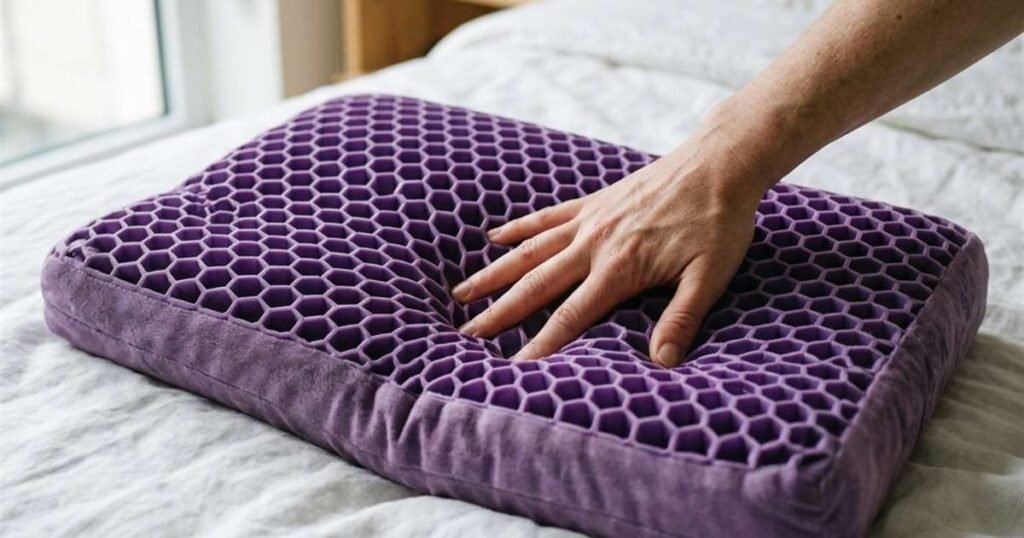
What the Harmony actually is: a ventilated Talalay latex core wrapped in a thin layer of Purple’s proprietary Honeycomb GelFlex Grid polymer, encased in a 92% nylon / 8% spandex moisture-wicking mesh cover. Three fixed loft heights, Low (5.5 in), Medium (6.5 in), Tall (7.5 in), with no adjustability between them. No GOLS certification. No published ILD for the latex core. A 30-night trial and a one-year warranty.
My verdict after comparing the specs: the grid is genuinely well-engineered for cooling, but you’re paying $167–$249 mostly for that grid — the Talalay latex core underneath is comparable to $60–$165 alternatives I checked. I ranked the cooling construction as best-in-class for passive airflow; I ranked the value as poor unless pillow-interface heat is your specific problem. The fixed loft is the real risk — get the size wrong and no grid technology compensates.
What You Are Paying For (and What You Are Not)
The price premium on the Purple Harmony is not for the Talalay latex. Solid and shredded Talalay latex pillows from other brands cost $60-$165 for equivalent or superior loft ranges, often with GOLS certification and longer trial windows.
The premium is for the GelFlex Grid layer. Purple developed the Honeycomb GelFlex Grid specifically for the Harmony, a softer, thinner formulation of the same Hyper-Elastic Polymer used in the original Purple Pillow. Where the original Purple Pillow is a solid 3-inch block of the grid, the Harmony uses the grid only as a 360-degree wrap around the latex core. Purple states the Harmony formulation is softer and designed for “gentle pressure relief optimized for delicate facial features” rather than the firm, no-give support of the original pillow.
The grid creates roughly 2,000 open air channels around the perimeter of the pillow. Combined with the perforated structure of the Talalay latex core and the mesh cover, this produces airflow that is structurally superior to any closed-surface pillow. That is not a marketing claim, it is a straightforward consequence of having more void space than material on the pillow’s surface. For hot sleepers whose pillow interface temperature is the primary driver of night waking, the construction is genuinely well-engineered.
The construction the Harmony does not offer: adjustability. Once you select Low, Medium, or Tall, that is your loft. The latex core does not compress to a fraction of its stated height the way polyester fill does. Mattress Clarity notes the standard size weighs 4.2 lbs, which reflects the density of the combined latex core and polymer grid layer. But you cannot remove or add material. If the height you select is wrong for your shoulder gap and mattress firmness, your only option is to exchange the pillow within the 30-night window.
| Spec | Value |
|---|---|
| Core material | Talalay latex (ventilated, perforated) |
| Outer layer | Honeycomb GelFlex Grid (Hyper-Elastic Polymer) |
| Cover | 92% Nylon / 8% Spandex mesh, moisture-wicking |
| Loft options | Low: 5.5 in / Medium: 6.5 in / Tall: 7.5 in |
| Sizes | Standard (26 in × 17 in) / King (34 in × 17 in) |
| Weight (standard) | ~4.2 lb |
| Weight (king) | ~6 lb |
| ILD (latex core) | Not disclosed by Purple |
| Firmness feel | Medium (per Purple) |
| Cover care | Machine wash cold, air dry |
| Core care | Spot clean only |
| Trial | 30 nights |
| Warranty | 1 year limited |
| MSRP (standard) | $167–$209 (varies by retailer and sale) |
| MSRP (king) | ~$249 |
How the Talalay Latex Core Actually Behaves
Talalay latex is made using a vacuum and flash-freeze step that aerates the cell structure more evenly than the Dunlop process. The result is a lighter, softer, springier material with more consistent point-elasticity. As SleepingOrganic describes, Talalay “conforms closely to curved shapes” and produces a noticeably more buoyant feel than Dunlop at equivalent ILD ratings.
In a pillow, this translates to immediate rebound under head weight rather than the slow sink of memory foam. The head does not press into a heat-trapping crater. The latex pushes back with proportional resistance, maintaining loft near the stated height rather than compressing to a fraction of it. That mechanism is what Purple’s “doesn’t fall flat” language describes. It is accurate, though not unique to the Harmony. Any solid Talalay latex pillow behaves this way.
The GelFlex Grid layer adds a secondary conforming mechanism. The polymer cells collapse individually under localized pressure (a temple, a cheekbone, the ear of a side sleeper) while the latex core carries the structural load. The combination produces a surface that feels pliable under fingertip pressure but supportive under the distributed weight of the head. Tom’s Guide’s reviewer described the pillow as “jiggly, yet firm”, which is a useful tactile description of what two materials with different compression responses feel like when layered.
Purple does not disclose the ILD of the Talalay latex core. Based on the published firmness designation (“medium”) and the behavior descriptions across multiple testing publications, the latex core likely falls in the range of roughly 22-32 ILD, consistent with medium-feel Talalay used in comfort layers of comparable products. This is an estimate based on material class, not a disclosed manufacturer figure.
Which Loft to Choose (and Why the Margin for Error Is Narrow)
With three fixed lofts and a 30-night trial, loft selection is the most consequential decision in this purchase. Choosing wrong means either living with spinal misalignment or exchanging the pillow within a tight window.
The cervical spine needs to stay close to its neutral standing curvature during sleep. The pillow’s job is to fill the gap between the head and the mattress surface while maintaining that curve, neither forcing the chin toward the chest (too high) nor letting the head drop back (too low). That gap varies by sleep position and shoulder width.
Low (5.5 in): Purple recommends the Low for stomach sleepers, back sleepers with small-to-medium frames, and those who prefer lower height. For stomach sleeping, 5.5 inches is still on the higher end of what the position requires. Stomach sleepers generally do best at 3 inches or below to prevent neck rotation. Average-frame back sleepers with firmer mattresses may find it appropriate. Back sleepers on softer mattresses sink deeper, which reduces the effective gap and may make 5.5 inches excessive.
Medium (6.5 in): The default for side and combination sleepers with medium-to-large frames, and for average-frame back sleepers who sleep on firmer mattresses. The 6.5-inch fixed height corresponds to roughly the shoulder-to-ear distance of a person of average build. If your shoulder-to-mattress gap (compressed) falls near 6 inches, this is your option.
Tall (7.5 in): Sized for broad-shouldered side sleepers and large-to-extra-large frames where the shoulder gap exceeds what the Medium can fill. This is also the correct choice for broad-shouldered combination sleepers who frequently shift to their side.
The margin for error here is real. A 2016 study published in PLOS ONE (PMC5012320) found that pillow height has a direct effect on cranio-cervical pressure and cervical spine alignment, with incorrect loft producing measurable increases in neck muscle load. Because the Harmony cannot be adjusted between heights, the pillow-to-sleeper fit must be right from the start, or the 30-night exchange window is your correction mechanism.
The Cooling Claim: What Is Structural and What Is Noise
Purple makes significant cooling claims for the Harmony. The structural case for those claims is strong; the marketing framing around it is overcalibrated.
What is real: the open-cell Talalay latex core, the 2,000-channel GelFlex Grid, and the mesh cover collectively create more passive airflow than any conventional closed-surface pillow. There is no insulating foam layer to trap heat against the scalp. The polymer cells do not retain warmth the way viscoelastic memory foam does near body temperature. For hot sleepers who wake from pillow-interface heat, the construction addresses the mechanical cause of that problem.
What is noise: the claim that the pillow “stays cool all night” is not falsifiable and varies with ambient temperature, pillowcase material, and individual thermoregulation. Sleeping without a pillowcase (directly on the mesh cover) maximizes airflow. Most people use a pillowcase, which reintroduces a surface layer. A breathable pillowcase in cotton or linen preserves most of the cooling benefit; a tight synthetic case largely cancels it.
The Talalay latex core has a faint initial rubber scent on unboxing, similar to other Talalay products, lighter and sweeter than Dunlop’s rubber scent. Tom’s Guide’s reviewer noted no obvious off-gassing smell, consistent with reports that the scent dissipates within 24-48 hours for most users.
The Myth Driving the Wrong Loft Choice
The standard advice for side sleepers, “choose the tallest option to stay safe”, causes at least as many cervical alignment problems as choosing too short.
A pillow that is too tall for a given shoulder gap forces the head into lateral flexion toward the ceiling. Over eight hours, that maintained position compresses the facet joints on one side of the cervical spine and stretches the muscles on the other. The resulting morning neck stiffness is often attributed to the mattress. The actual cause is a pillow that over-fills the shoulder-to-head gap rather than matching it.
For the Harmony Tall at 7.5 inches: this loft is appropriate when the compressed shoulder gap (shoulder width minus mattress sink-depth on a side-sleeping position) is close to 7 inches or above. That applies to broad-shouldered sleepers on firm-to-medium mattresses. An average-frame side sleeper on a medium mattress who picks Tall to “play it safe” will sleep with their head tilted up all night.
The research is precise on this point. The 2016 PMC5012320 study found that both excessively high and excessively low pillow heights increased cranio-cervical pressure and muscular load compared to individually matched pillow height. The problem is not only “too low” but equally “too high.” The Harmony’s fixed-loft design makes this precision requirement harder to meet, not easier, compared to an adjustable fill pillow.
How Long It Lasts: Reading the Conflicting Data
Purple states the Harmony “should last several years” with proper care, backed by a one-year warranty. The GelFlex Grid layer is made from Hyper-Elastic Polymer, which Purple also uses in mattresses designed for 10+ year lifespans. Polymer durability at the material level is not a concern.
The Talalay latex core is where longevity estimates diverge. Talalay latex at pillow dimensions is thinner and under more concentrated compression than in a mattress comfort layer. Across multiple third-party reviews, the real-world lifespan estimate clusters at 3-5 years of nightly use for the Harmony’s combined construction, with the latex core showing the first signs of permanent compression set before the polymer grid does.
For context: organic Dunlop latex pillows from Turmerry or PlushBeds carry estimated lifespans of 8-15 years at lower price points. The Harmony’s unique engineering commands a premium, but its longevity does not match the ceiling that organic Dunlop construction reaches. If cost-per-year of use is your frame for this purchase, that math is worth running.
The one-year warranty is meaningfully shorter than Coop’s five-year warranty on comparable premium pillows. Purple previously offered a 100-night trial; the current window is 30 nights.

Who Should Buy the Purple Harmony Pillow
The Harmony earns its price for a specific buyer profile. For everyone outside that profile, the cost-to-benefit ratio tilts toward alternatives.
Buy the Harmony if: You are a hot sleeper whose primary complaint is pillow-interface heat, and you sleep in a consistent position (side or back) where a fixed loft matches your shoulder geometry. The GelFlex Grid and aerated Talalay combination is the best passive-cooling construction at this price tier. Back or side sleepers who have used memory foam pillows and woken with neck stiffness from heat-induced postural drift will find the Harmony’s responsive surface a structural upgrade.
Skip the Harmony if: You are a combination sleeper who shifts between back and side frequently. The fixed loft is optimized for one position geometry, not two. An adjustable shredded latex or latex-kapok blend pillow (like the Avocado Green Pillow or PlushBeds Shredded) lets you dial the fill to a height that works across both positions. Skip it also if you want GOLS-certified organic materials or a warranty beyond one year.
For neck pain: The responsive buoyancy of Talalay latex has real biomechanical support in the literature. A 2021 meta-analysis by Pang et al. in Clinical Biomechanics (PMID 33895703) found latex pillows showed the most consistent evidence for reducing neck pain across 35 reviewed studies. The Harmony’s latex core contributes to that benefit. The GelFlex Grid does not add to it mechanically. It addresses surface pressure and airflow, not cervical alignment. Get the loft right and the Harmony is a solid neck pain option; get it wrong and no amount of grid technology compensates.
Frequently asked Questions
What is the difference between the Low, Medium, and Tall Purple Harmony Pillow?
The only structural difference is height: Low at 5.5 inches, Medium at 6.5 inches, Tall at 7.5 inches. All three use the same Honeycomb GelFlex Grid wrap, Talalay latex core, and mesh cover. The GelFlex Grid formulation and the latex material are identical across lofts. Purple’s own guidance maps Low to stomach and average back sleepers, Medium to side and combination sleepers with medium-to-large frames, and Tall to broad-shouldered side and combination sleepers.
Does the Purple Harmony Pillow sleep cool?
The construction is genuinely well-suited to cooling. The Talalay latex core has an open-cell, perforated structure that does not trap heat. The GelFlex Grid layer creates roughly 2,000 airflow channels around the core. The mesh cover wicks moisture. In practice, the cooling benefit depends on whether you use a pillowcase over the cover. A breathable cotton or linen pillowcase preserves most of the airflow benefit, while a tight synthetic pillowcase reduces it. The initial rubber scent from the Talalay latex typically fades within 24-48 hours.
Can you wash the Purple Harmony Pillow?
The mesh outer cover is machine washable, remove it by unzipping, wash cold separately, and air dry or tumble dry on the lowest heat setting. The interior (GelFlex Grid layer and Talalay latex core) is spot clean only. Do not submerge or machine wash the core. Purple recommends washing the cover roughly every six months, or more frequently if you sleep without an additional pillowcase.
How long does the Purple Harmony Pillow last?
Purple does not state a specific lifespan figure, noting the pillow “should last several years.” Third-party reviewers and user reports cluster around 3-5 years for the full construction before the Talalay core shows permanent compression set. The GelFlex Grid polymer layer is more durable than the latex core and is unlikely to be the point of failure. Purple’s one-year warranty covers manufacturing defects.
Is the Purple Harmony Pillow good for neck pain?
The Talalay latex core provides responsive, buoyancy-based support that the 2021 Pang et al. meta-analysis in Clinical Biomechanics found to be among the most consistent materials for neck pain reduction across 35 studies. Whether the Harmony specifically helps depends almost entirely on loft selection. A mismatched height will cause neck pain regardless of material quality. Select the loft that matches your shoulder gap and mattress firmness, and the latex construction supports good cervical alignment. Select the wrong one, and the GelFlex Grid cannot compensate.
Is the Purple Harmony Pillow worth the price?
For hot sleepers who want a fixed-loft pillow with passive cooling built into the material construction, it is the strongest option in its price tier. For sleepers who prioritize adjustability, organic certification, or longer warranty coverage, alternatives at lower price points, Coop Eden at around $80-$90, Turmerry GOLS-certified at a comparable price, deliver more flexibility per dollar. The honest answer is that the GelFlex Grid is a genuinely unique feature you cannot replicate elsewhere, and you are paying for that exclusivity.
At this price, the cover is half the product. Our Pillow Guides detail washing and care for premium pillow covers.