
The most common mistake people make when comparing Talalay and Dunlop latex pillows is treating one as the premium option and the other as the budget version. The price difference is real Talalay typically costs more but attributing it to quality is wrong. Both processes start from the same raw material: Hevea brasiliensis rubber tree sap. The difference is entirely in manufacturing, and that difference produces two materially distinct products that each work better for specific sleep positions and priorities. Calling one superior without naming the use case is like calling a firm pillow universally better than a soft one. It depends on what job the pillow needs to do.
How the Manufacturing Process Determines the Feel
Both Talalay and Dunlop begin identically. Liquid latex sap is harvested from rubber trees, whipped into a froth to aerate it, and poured into a mold. From that point the processes diverge completely.
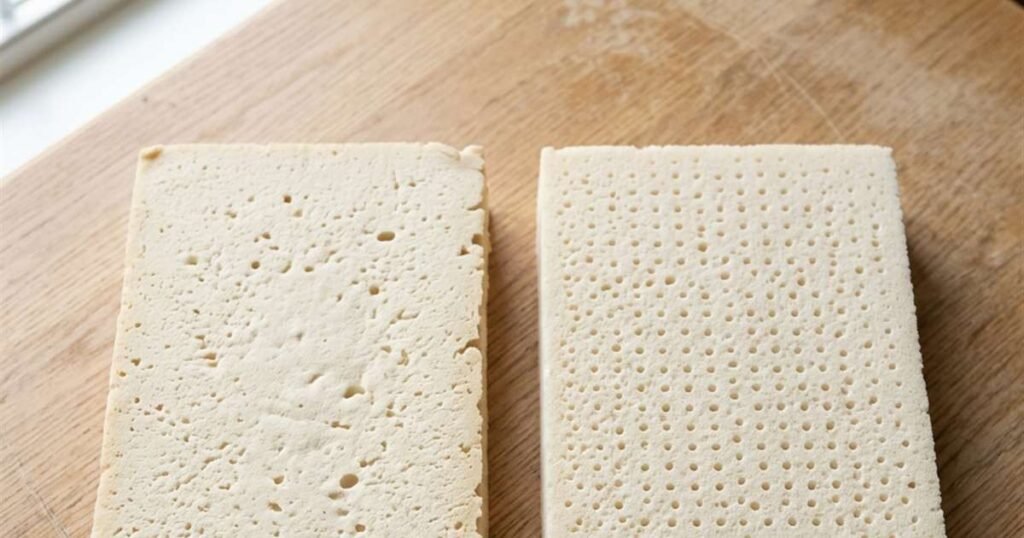
Dunlop goes directly from the pour into a vulcanizing oven where the latex cures with heat. The process has not changed substantially since it was developed in 1929. Because the latex is poured in a single continuous layer and baked without interruption, heavier particles and sediment settle toward the bottom of the mold during curing. The resulting block is denser and heavier at the base than the top a natural density gradient. This is why Dunlop feels more grounded and less springy than Talalay at the same stated ILD rating: it is not evenly distributed through the block.
Talalay adds two steps before vulcanization. After the partial pour, the mold is vacuum-sealed, which causes the latex to expand and fill every corner of the mold uniformly. The mold is then flash-frozen before heat curing. These two steps-vacuum expansion and flash-freezing-produce a foam with an even, open-cell structure throughout the entire block, with no density gradient from top to bottom. The extra steps account for the higher manufacturing cost. Talalay takes roughly 5 hours per pillow to produce compared to around 2 hours for Dunlop, and the equipment required for vacuum-sealing and flash-freezing is significantly more capital-intensive.
The Sleep Foundation’s breakdown of latex manufacturing processes confirms the structural outcome: Talalay’s uniform cell structure makes it more breathable and consistent, while Dunlop’s denser structure makes it more durable at equivalent thickness.
Most of the published comparison between Talalay and Dunlop addresses mattresses, where the two are often layered together – Dunlop as a support core, Talalay as a comfort layer. Pillows are a different context. A pillow is a single layer working at a much smaller scale, and the properties that matter for a 4-to-6-inch pillow are not identical to those that matter in a mattress stack.
For pillows specifically, four spec differences drive real-world performance:
Density (PCF pounds per cubic foot): Natural Dunlop latex typically runs roughly 4.5-5.5 PCF. Talalay latex typically runs roughly 4.0-4.5 PCF. The lower density of Talalay is a direct result of the uniform aeration from the vacuum-expansion step – more air per unit volume means lighter, more responsive foam. The higher density of Dunlop means more material per inch of loft, which is why it holds its shape more reliably over time.
ILD (Indentation Load Deflection): ILD measures the force in pounds required to compress a 4-inch sample of foam by 25%. Both Talalay and Dunlop are manufactured across a range of ILD values. Avocado’s Pure Talalay Luxury Pillow, for example, discloses two firmness options: a medium at 28 ILD and a soft at 24 ILD these are manufacturer-disclosed figures for a solid Talalay core. Dunlop pillows at comparable loft tend to run toward higher ILD values because the base-heavy density gradient produces more resistance. An important nuance: at the same ILD, Talalay feels softer and more responsive because its uniform cell structure distributes pressure more evenly. Dunlop at the same ILD feels firmer and more grounded because of the density gradient and thicker cell walls.
Lifespan: Dunlop’s higher density gives it a durability advantage. Dunlop latex pillows typically hold their structural properties for roughly 10 to 12 years. Talalay’s lower density means somewhat faster mechanical fatigue Talalay pillows typically reach the end of useful life at around 8 to 10 years. Both figures far exceed any synthetic fill.
Breathability: Talalay’s uniform open-cell structure allows more airflow through the foam than Dunlop’s denser, less evenly aerated structure. Dunlop still runs cooler than memory foam latex in general does not trap heat the way viscoelastic polyurethane does but Talalay has a measurable breathability advantage over Dunlop at equivalent ILD.
| Property | Talalay | Dunlop |
|---|---|---|
| Typical Density | ~4.0-4.5 PCF | ~4.5-5.5 PCF |
| Feel at Same ILD | Softer, more responsive, lighter | Firmer, more grounded, heavier |
| Density Gradient | None (uniform throughout) | Yes – denser at base |
| Typical Lifespan | ~8-10 years | ~10-12 years |
| Breathability | Higher | Moderate (still cooler than memory foam) |
| Manufacturing Cost | Higher (vacuum + freeze process) | Lower (single pour, direct bake process) |
| GOLS Organic Certification | Available, less common | Widely available |
Which Process Fits Which Sleep Position
The correct answer here is not “Talalay is better for side sleepers” as an absolute statement it is that Talalay’s softer, more uniform feel suits the pressure-relief demands of side sleeping, while Dunlop’s denser, more grounded structure suits the different demands of stomach and certain back sleeping profiles.
Side sleepers need a pillow that bridges the shoulder-to-ear gap while simultaneously contouring to the curves of the head, neck, and shoulder. The pressure points for a side sleeper are real and specific: the ear and the lateral side of the shoulder take the most load. Talalay’s uniform cell structure distributes that load more evenly and allows the head to sink into a consistent surface rather than a denser base. For side sleepers, Talalay at a medium-firm ILD (roughly 24-32 ILD for most adult frames) performs better than Dunlop at the same loft because the contouring is more responsive across the full surface. For side sleepers with broader shoulders who need more loft, pairing Talalay’s responsiveness with the correct loft target from the calculator is the most reliable approach.
Back sleepers need support for the cervical lordosis the gentle forward curve of the neck without pushing the chin toward the chest. Either process works at the right loft. Dunlop’s firmer, denser structure can work well for back sleepers with larger frames who need more resistance under the head. Talalay works well for back sleepers who want a more responsive surface that adjusts naturally to position shifts through the night. The deciding variable for back sleepers is ILD and loft, not Talalay vs Dunlop specifically.
Stomach sleepers need minimal loft and enough resistance to prevent the head from sinking too far toward the mattress, which would increase cervical rotation. Dunlop’s denser structure and higher ILD range makes it the better fit here: a firm Dunlop pillow at low loft holds its height without the head compressing through it the way a soft Talalay would. The density gradient in Dunlop denser at the base also provides a consistent floor of resistance that stomach sleepers benefit from.
Combination sleepers generally do better with Talalay. The responsive, uniform surface adjusts more fluidly to position changes than the grounded Dunlop feel. A medium ILD Talalay (around 24-28 ILD) handles the transition between side and back lying without the pillow feeling too different in each position.
| Sleep Position | Better Process | Reason |
|---|---|---|
| Side sleeper | Talalay (medium-firm, 24-32 ILD) | More uniform pressure distribution at shoulder and ear contact points. |
| Back sleeper | Either, based on loft/ILD | Position matters more than process; Dunlop may suit larger frames needing more support. |
| Stomach sleeper | Dunlop (firm, low loft) | Denser structure maintains height with less compression and resists sinkage. |
| Combination sleeper | Talalay (medium, 24-28 ILD) | More responsive to position changes with a softer surface for mixed sleeping positions. |
The Certification Question: GOLS and Why It Matters Here
Both Talalay and Dunlop can be produced from natural or synthetic latex the manufacturing process does not determine the raw material content. A “Talalay latex pillow” may contain natural latex, synthetic latex (styrene-butadiene rubber, a petroleum-derived material), or a blend of the two. The same applies to Dunlop. The only way to verify that a latex pillow contains genuinely natural, organically sourced rubber is a GOLS certification.
GOLS — the Global Organic Latex Standard, administered by Control Union — requires that certified products contain at least 95% certified organic raw material by total weight. It covers the entire supply chain: from the plantation practices (no toxic pesticides or chemical fertilizers on the rubber trees) through the manufacturing process and final product. If purity is a priority, browsing GOLS-certified organic pillows is the only way to ensure the claim is independently verified rather than self-declared.
GOLS-certified Dunlop is widely available because the simpler Dunlop process is easier to certify across the supply chain. GOLS-certified Talalay exists but is less common the additional processing steps (vacuum, freeze) create more points in the chain that must meet certification criteria. If organic certification matters to you, Dunlop is the more accessible option. If you want Talalay specifically and organic status matters, verify the certification on the specific product, not the brand.
Most Dunlop pillow marketing describes the product as “firmer and more supportive.” Both of those descriptors are accurate in aggregate, but they obscure the density gradient issue that matters specifically in a pillow context.
Because heavier particles settle during baking, a Dunlop pillow is not uniformly firm throughout its depth. The base is measurably denser than the top layer. In a mattress support core, this is largely irrelevant the body never compresses through to the base layer. In a pillow, the head may compress through to the denser base layer during sleep, creating a sensation of sleeping on a harder surface than the stated ILD implies at the top. This is not a defect it is the natural behavior of the Dunlop process. But it is the reason Dunlop pillows often feel firmer in practice than a Talalay pillow at the same stated ILD, and why the ILD number alone does not give a complete picture of what sleeping on a Dunlop pillow actually feels like.
Talalay’s uniform structure means the firmness you feel at the surface is consistent with the firmness throughout the pillow. What you press on in the store is what you sleep on. Dunlop’s gradient means the pillow firms progressively as the head compresses deeper.
Frequently Asked Questions
Which lasts longer, Talalay or Dunlop?
Dunlop. The higher density of Dunlop (roughly 4.5-5.5 PCF vs Talalay’s roughly 4.0-4.5 PCF) means thicker cell walls and more material per unit volume, both of which resist mechanical fatigue better over time. Dunlop pillows typically hold their structural properties for roughly 10 to 12 years. Talalay typically reaches end-of-life at around 8 to 10 years. Both figures far exceed any synthetic fill.
Is Talalay latex better for side sleepers than Dunlop?
Talalay latex generally provides a plusher, more cradling feel that side sleepers prefer for pressure relief. The manufacturing process creates a lighter, less dense cellular structure compared to Dunlop. However, if you have very broad shoulders, the heavier density of Dunlop might offer better neck support.
Do Talalay and Dunlop latex pillows actually keep you cool?
Latex naturally sleeps cooler than traditional memory foam because its open-cell structure allows for better airflow. Both Talalay and Dunlop variants dissipate body heat effectively. Some hot sleepers still experience mild sweating, especially if the pillow uses a thick, non-breathable polyester cover instead of cotton.
Should I choose solid or shredded latex for neck pain?
Solid latex blocks offer consistent, uniform support that prevents your head from shifting during the night. Shredded latex feels softer and allows you to adjust the loft by removing filling. If you struggle to maintain cervical alignment, a solid contour shape usually yields more reliable results than shredded fill.
The process changes everything about the latex. Our Pillow Materials guides put Talalay and Dunlop specs side by side.