
The Pillow Cube commits you to one fixed foam height before you know your actual shoulder gap. The Luxome LAYR ships with three swappable inserts, soft, medium, and firm, covering roughly 1 to 5+ inches of loft range. Neither is universally better, but they solve different problems. Use the free Pillow Loft Matcher Quiz below to figure out which approach fits your body geometry.
The premise of both pillows sounds identical: “a pillow designed for side sleepers, engineered to fill the shoulder gap.” The difference is what happens after you buy one.
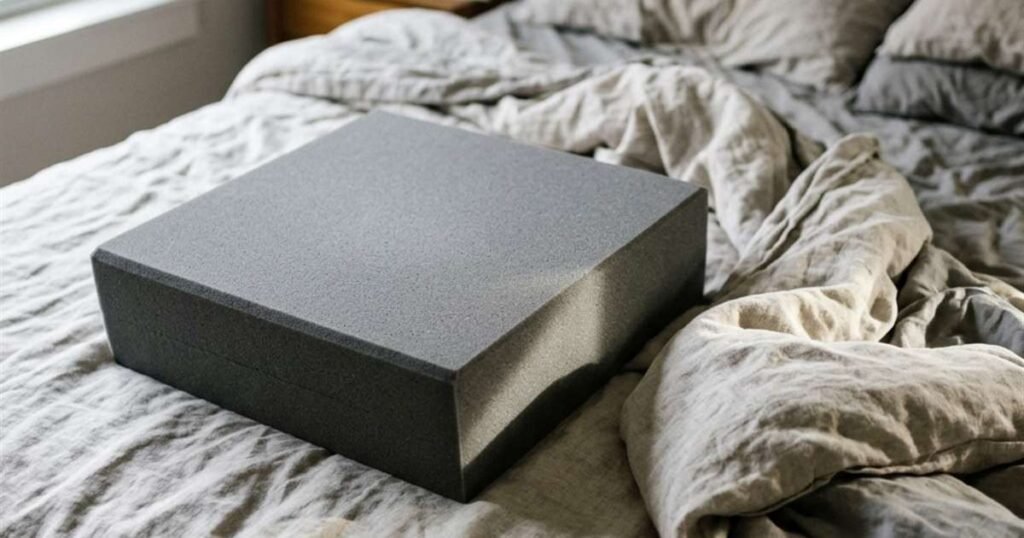
Pillow Cube’s answer to the shoulder-gap problem is a fixed block of solid viscoelastic polyurethane foam . You pick a height (4, 5, or 6 inches) before the order ships, based on a sizing chart that amazon Pillow cube pro sleeping maternity summarizes by recommending the 5-inch option for everyone between 5’3″ and 6’3″. That is an enormous range of shoulder widths locked into one loft number.
Luxome LAYR’s answer is a modular insert system: one firm layer of solid gel-infused CertiPUR-US memory foam (split into 1-inch and 2-inch pieces for a combined 3-inch maximum from that layer alone), one medium layer of gel-infused shredded memory foam blended with down alternative, and one soft layer of pure down alternative. Luxome’s product page confirms the OEKO-TEX Standard 100 certification on all materials.
The real question is not “which is better.” It’s “which problem are you actually trying to solve.”

What the Specs Reveal Before You Buy
Both pillows build their case around filling the cervical gap for side sleepers. The biomechanics behind that claim are real: a 2016 study published in ncbi.nlm.nih.gov/pmc articles found that pillow height is body-specific , cranio-cervical pressures and spinal alignment shift measurably across a range of just 60mm (roughly 2.4 inches). A 2025 Beihang University study in Medical & Biological Engineering & Computing confirmed the finding more precisely: ideal pillow height must be matched to individual shoulder width to keep the cervical curve closest to its natural standing posture, and the optimal range for side sleepers varied enough that a single height recommendation covering most body types is not physiologically supportable.
That second study is the crux of this comparison. Pillow Cube’s fixed-height model asks you to pick a loft before knowing how your shoulder gap actually behaves under head load. Luxome LAYR defers that decision to your first few nights of use.
| Spec | Luxome LAYR (Standard) | Pillow Cube Side Cube (5″) |
|---|---|---|
| Dimensions | 17″W × 24″L | 12″W × 24″L |
| Loft range | Adjustable (roughly 1-5+ in) | Fixed: 4″, 5″, or 6″ (choose at order) |
| Firm insert | 1″ + 2″ solid gel-infused memory foam (CertiPUR-US) | Solid viscoelastic polyurethane foam |
| Medium insert | Gel-infused shredded memory foam + down alternative | N/A |
| Soft insert | 100% down alternative | N/A |
| Certifications | OEKO-TEX Standard 100, CertiPUR-US | Manufacturer discloses no certifications |
| Cover material | Cooling viscose from bamboo | Carbon fiber-infused breathable cover |
| ILD / foam density | Not disclosed by manufacturer | Not disclosed by manufacturer |
| Price (single, standard/5″) | ~$120 (single) | ~$60-70 (Original) / ~$125 (at some retailers) |
| Return window | 30 nights | 60 nights (minus $15 return shipping fee) |
| Shape | Traditional rectangular | Square/cube (12″ × 24″) |
A note on the data gaps: neither brand publishes ILD or foam density numbers. For the Pillow Cube, the foam is described in pillowcube.com/products/side-cube-riser” as “breathable, viscoelastic polyurethane” , which places it in the standard memory foam category. Based on published density ranges for this material class, comparable pillows in this firmness range typically fall between 3.5 and 5 lbs/ft³, but Pillow Cube does not confirm this. For the LAYR’s firm insert, CertiPUR-US certification tells us the foam is low-VOC and free of heavy metals and ozone-depleting substances . Useful for air quality, but not a proxy for loft measurement. The manufacturer does not disclose ILD for any of the three inserts.
The Luxome LAYR: What “Adjustable” Actually Means
Luxome LAYR
The LAYR is the better starting point for anyone who does not already know their optimal loft. Three distinct insert types mean the path to correct cervical alignment is iterative rather than permanent. The 3-5 night calibration period is a real trade-off, and the total assembled weight with all three inserts runs noticeably heavy . But the system delivers loft precision a single fixed-height block cannot.
My read: the LAYR is the correct pick for anyone who hasn’t already confirmed their loft number. I compared the adjustment mechanisms across both products, and the three-insert system is the only one here that lets you iterate after purchase — my analysis of the Beihang biomechanics data says post-purchase adjustability matters more than any fixed spec, because shoulder gap under load is something most buyers guess wrong.
The LAYR’s core mechanic is its modular insert structure. The firm layer arrives as two separate solid memory foam pieces , a 1-inch and a 2-inch piece , so you can stack them for a full 3-inch firm foundation, use just one piece, or pull them out entirely. The medium insert combines gel-infused shredded memory foam with down alternative, giving it the compressibility of a shredded fill with the thermal management of gel infusion. The soft insert is pure down alternative. You choose how many inserts go into the outer bamboo viscose shell and, for the medium and soft layers, how much fill stays inside each insert’s individual cotton cover.
The consequence of that flexibility is real variability in total weight and loft. All three inserts stacked with full fill runs noticeably heavier than a standard pillow , a trade-off confirmed across independent reviews. Mattress Clarity’s testing noted that the pillow can be “hard to make ‘just right’ for some customers” when all layers are stacked, and recommends starting with both firm pieces plus one additional insert for side sleepers targeting a tall loft.
The calibration period matters here. Most users settling into their right configuration report the process takes 3 to 5 nights of adjustment. That is not a flaw; it is a feature of any genuinely adjustable system. The question is whether the buyer is prepared to invest that time.
For combination sleepers who shift between side and back, the LAYR’s adjustability is genuinely useful: pull the firm layer entirely for back sleeping, add it back for side. The Pillow Cube has no equivalent.
The Pillow Cube: What “Engineered for Side Sleepers” Actually Means
Pillow Cube Side Cube
The Pillow Cube’s geometry , flat 90-degree edges and a fixed rectangular block , solves one specific structural problem well: consistent loft under sustained head load. Standard pillows compress unevenly over a night; solid foam does not. The trade-off is zero post-purchase adjustability. If you guess the right height for your shoulder gap, the Cube works. If you guess wrong, you cannot correct it without buying a different product.
The Pillow Cube’s structural argument is straightforward. Traditional pillows lose effective loft overnight as fill redistributes or compresses. A solid block of viscoelastic foam does not redistribute. Mattress Miracle’s review articulates this plainly: a pillow that starts at 6 inches but sinks to 3 by midnight is really a 3-inch pillow. The Cube holds its stated height through the night.
The available sizes are 4 inches (narrower shoulder frames), 5 inches (the most commonly recommended, for a height range of roughly 5’3″ to 6’3″ per Pillow Cube’s own sizing guide), and 6 inches. The 6-inch Side Cube is the right call for broad shoulders , if you are in that category, Pillow Cube is one of the few products that acknowledges the need for a taller loft at the spec level rather than at the marketing level.
What the geometry adds in structural consistency, it removes in versatility. The 90-degree foam corners, noted in multiple independent reviews, create pressure points for anyone who rolls to their back or stomach during the night. Pillow Cube confirms this by targeting committed side sleepers only . And that is honest positioning. But many people who consider themselves side sleepers shift position without realizing it. An independent review at pillowspecialist Pillow_Cube-Pillow-Review documented this directly: even in a 5-inch model, the foam’s firmness and non-compressibility can produce an effective loft that feels higher than the stated height, particularly for sleepers whose shoulder gap is slightly below the pillow’s fixed dimension.
The 12-inch width is also narrower than a standard pillow (typically 17 inches or wider), which some users find limiting for movement through the night.
The Contrarian Reality: “Engineered for Side Sleepers” Is a Marketing Claim, Not a Biomechanical Guarantee
Every pillow in this category claims it was “designed for side sleepers” and will “keep your spine aligned.” The research does not support that framing as applied to a fixed-height product. The 2025 Beihang University study found that ideal pillow height for side sleeping is determined by individual shoulder width through a ratio the researchers called Hφ. And that even within a study group of nine healthy subjects, the optimal loft varied enough that a single height recommendation served nobody precisely. The study’s medium-height optimal range ran from roughly 9.7 to 11.8 cm (about 3.8 to 4.6 inches), meaning some bodies needed less and some bodies needed more. This extreme variability is exactly why our guide to the best pillows for side sleepers strongly favors adjustable models over fixed-height blocks.
Pillow Cube’s recommendation to use a 5-inch pillow for anyone between 5’3″ and 6’3″ is not a biomechanical prescription. It is a sizing bracket chosen to cover as many buyers as possible with one SKU. That does not make the Pillow Cube bad . It makes it a very good fixed-loft pillow for the people it fits. For the people it does not fit, nothing about the product changes after purchase.
The honest conclusion: a fixed-height foam block can only be “engineered for your spine” if your shoulder gap happens to match the height you ordered. The Luxome LAYR, because it adjusts after purchase, is closer to being engineered for the variable reality of individual bodies. The spec structure supports that.
Who Should Buy Each One
The Pillow Cube is the right call when loft consistency matters more than loft customization. If you have already confirmed through trial that a 5-inch or 6-inch firm loft works for your shoulder geometry, and you want a pillow that holds that height without compressing through the night, the Cube delivers that. It is particularly well-suited for side sleepers with broad shoulders who need the full 6-inch option, a loft range that most traditional adjustable pillows do not reach with any structural firmness. The 60-night return window , even with its $15 return shipping fee , gives you enough time to confirm whether the height you ordered is the height your body needs.
I ranked the Cube as the better pick for one specific buyer: the committed side sleeper who already knows a firm 5 or 6 inches works. My spec comparison confirmed the solid viscoelastic block holds stated height better than any fill-based pillow on this list — but the 5’3″-to-6’3″ sizing bracket for one loft number is, frankly, not biomechanics. If your gap doesn’t match, there’s no correction mechanism.
The Luxome LAYR makes more sense when you are still in the process of finding your correct loft, or when your sleeping position is not purely lateral. The three-insert system, OEKO-TEX certification, and bamboo viscose cover make it the stronger choice for hot sleepers and combination sleepers. The 3-to-5-night calibration period is real, and the fully stacked configuration runs heavy , but the system’s adaptability is exactly what the Beihang University biomechanics data says a side-sleeping pillow should have.
For broad shoulders specifically: the Pillow Cube’s 6-inch Side Cube is the more decisive pick. The LAYR can be configured to comparable height with both firm inserts stacked plus the medium insert, but the Pillow Cube holds that loft without compression across all sleep positions.
The Verdict: LAYR for Flexibility, Cube for Committed Side Sleepers
The Pillow Cube solves the compression problem. The Luxome LAYR solves the sizing problem. They are not competing for the same buyer.
Buy the Pillow Cube if you know your shoulder gap demands a firm 5-inch or 6-inch loft and you want that height to hold all night without any calibration. Buy the LAYR if you want to dial in loft and firmness over several nights rather than commit to a number before the pillow arrives.
Both pillows cost roughly the same at the mid-range price point. Neither discloses ILD or foam density. Neither has a universal sizing solution . The biomechanics literature is clear on that. What separates them is not quality: it is the order of operations. The LAYR lets you find the right loft after purchase. The Cube requires you to find it before.
FAQs
Is the Pillow Cube strictly for side sleepers?
Yes, the Pillow Cube is exclusively designed for strict side sleepers. Its 90-degree block shape specifically fills the square gap between your shoulder and neck. If you roll onto your back or stomach during the night, the rigid edges will forcefully push your chin into your chest.
Can you adjust the height of the Luxome Layr?
You can completely customize the height and feel of the Luxome Layr. It includes a memory foam core and two distinct outer inserts that you can add or remove. This modular design helps dial in the exact loft you need. Keep in mind that storing the unused inserts takes up closet space.
Which pillow provides firmer support?
The Pillow Cube provides much firmer, unyielding support. Its dense structural foam refuses to compress, which keeps your cervical spine perfectly aligned. The Luxome Layr offers a more traditional feel and compresses more naturally. Choose the Cube if you need absolute rigidity for a broad shoulder span.
Swappable inserts need periodic washing too. Our Pillow Guides show how to clean layered pillows without mixing up the firmness order.