Yes, a pillow protector prevents yellowing. Provided it has a waterproof membrane and a zippered closure. A non-waterproof protector made of breathable cotton or polyester slows the transfer of moisture slightly but does not stop it. The distinction matters because most yellowing is caused by sweat, sebum, and saliva penetrating the pillow fill and oxidizing into yellow-brown compounds over weeks and months of accumulated contact. A pillowcase alone cannot stop that process. The full picture of why pillows turn yellow, and how to actually preventto do about it covers the topic in depth, but this article answers the specific protector question directly: what a protector blocks, why the membrane type determines effectiveness, and how long a protector lasts before it needs replacing.
My verdict, stated up front: yes — provided it has a waterproof membrane and zippered closure. I treat the membrane as the binary variable: with it, sweat and sebum can’t reach the fill; without it, you’re only slowing the inevitable. A non-waterproof ‘protector’ is a pillowcase with ambitions. Buy the membrane.
What Actually Causes Pillow Yellowing
The yellow staining on a pillow is an oxidation reaction, not simply dirt. During sleep, the human body loses between roughly 200 mL and 700 mL of moisture through perspiration, according to data cited by Mattress Miracle. That moisture carries dissolved salts, urea, amino acids, and proteins. When those compounds absorb into fabric and dry, then re-wet, repeatedly over hundreds of nights, they oxidize. The oxidation produces the characteristic yellow-to-golden-brown discoloration. This is the same chemical mechanism that yellows the underarms of white cotton shirts. Sweat proteins reacting with air.
Sebum compounds the problem. The skin and scalp produce sebum continuously. A waxy oil rich in fatty acids and triglycerides. Sebum transfers to the pillowcase during contact and, over time, migrates through the fabric weave into the fill. Once embedded in fill fibers, it oxidizes into a yellow-brown tint concentrated where the face and hair rest. People with oily skin types or those who use heavy overnight skincare products before bed typically see yellowing accelerate faster than average.
Saliva adds a third pathway. Side sleepers especially experience drool transfer during sleep, the proteins in saliva oxidize in the same way as sweat, leaving yellow or brownish marks that are often more localized and darker than sweat staining.
The critical point for understanding pillow protectors: a pillowcase absorbs some of these substances but does not stop them. Cotton pillowcase fabric is porous by design. It wicks moisture away from the face, which is its intended function. But that moisture keeps traveling. Sweat and sebum pass through the pillowcase weave and continue into the pillow fill, where they accumulate undisturbed between washing cycles.
What a Pillow Protector Does Differently
A pillow protector sits between the pillowcase and the pillow itself. An inner layer that the pillowcase covers. Its job is not comfort or aesthetics. It is a barrier. The difference between a protector and a pillowcase comes down to what happens at the fabric surface when moisture arrives.
A standard pillowcase is woven to feel soft and breathable. Moisture passes through it. A waterproof pillow protector has a membrane, typically a laminated polyurethane or TPU (thermoplastic polyurethane) layer, bonded to a fabric shell. That membrane is liquid-impermeable. Sweat, sebum, saliva, and the products of overnight skincare sit on the protector’s surface rather than passing through to the fill.
The Sleep Foundation describes a pillow protector as “a sealed layer of fabric that goes between your pillowcase and your pillow,” functioning as one more barrier between the pillow and moisture that causes discoloration. Casper’s guidance on yellowing recommends looking for a protector with a tight weave of 3 to 4 microns to help prevent moisture ingress, the weave specification is relevant for non-waterproof protectors, but for full prevention, a laminated membrane is the definitive solution.
Waterproof vs Non-Waterproof Protectors
| Feature | Waterproof (TPU/polyurethane membrane) | Non-Waterproof (woven cotton or polyester) |
|---|---|---|
| Liquid barrier | Complete, moisture cannot pass through | Partial, slows but does not stop transfer |
| Yellowing prevention | High, blocks primary staining agents | Low to moderate, reduces rate, does not prevent |
| Breathability | Varies, modern TPU membranes allow vapor transmission | High |
| Noise | Some membranes produce rustle; quality options are noiseless | None |
| Best for | Heavy sweaters, night sweats, hot climates, expensive down pillows | Mild sweaters in well-ventilated rooms |
| OEKO-TEX certification | Verify, confirms membrane safety | Standard |
The distinction between “waterproof” and “water-resistant” also matters. Water-resistant protectors repel surface liquid briefly but allow penetration under sustained contact. The kind that happens during eight hours of sleep. For yellowing prevention specifically, the label should read waterproof, not water-resistant.
The Zipper Closure Is Non-Negotiable
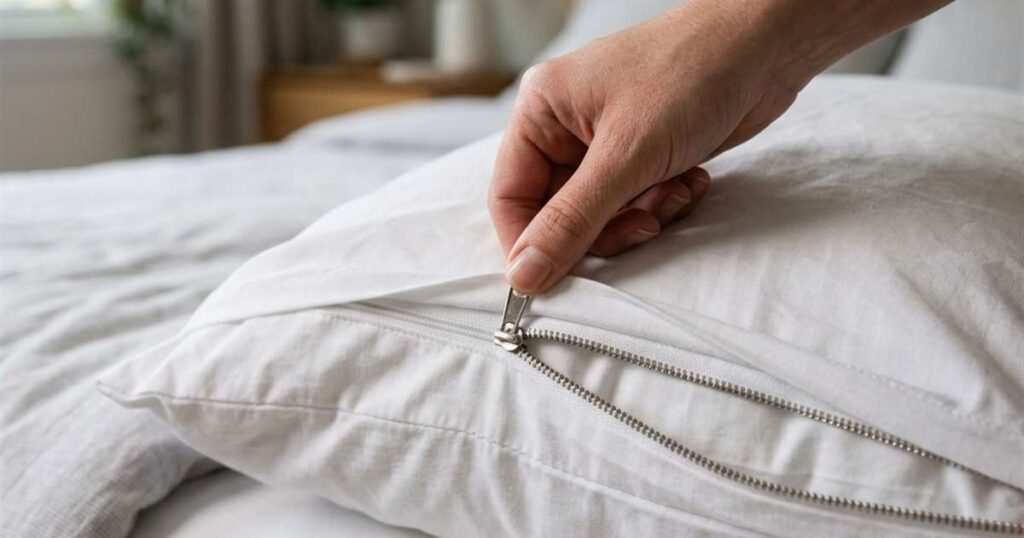
An envelope-style protector, one that folds over one end without a sealed closure. Leaves a gap where moisture can migrate around the open edge into the fill. Over weeks, the exposed end will yellow regardless of how good the membrane is on the body of the protector. A zippered encasement that closes fully around all six sides of the pillow eliminates that pathway.
The zipper should reach to a seam, not stop short. Some budget protectors use short zippers that leave a stretch of unsealed opening. That gap is enough for moisture to enter.
Does a Pillowcase Alone Prevent Yellowing?
No. This is the most common misunderstanding in pillow care. A pillowcase is designed for skin contact comfort and aesthetic presentation. Even a high-thread-count, dense-weave pillowcase reduces moisture transfer somewhat. But it does not stop it. Sweat migrates through cotton fiber over the course of a full night, particularly where face and scalp pressure is highest.
The layering system that prevents yellowing is: waterproof zippered protector underneath, pillowcase on top. The pillowcase takes the direct skin contact and gets washed weekly. The protector sits beneath, blocking what the pillowcase does not catch, and gets washed every two to four weeks. The pillow itself stays clean.
How Long Does a Pillow Protector Last Before It Needs Replacing?
The waterproof membrane in a pillow protector degrades with washing and use. Quality waterproof protectors are generally engineered for 200 to 300 wash cycles before membrane performance begins to decline, according to hotel bedding industry guidance from Hotel Bedding Factory. For a household protector washed every two to four weeks, that range translates to roughly three to five years of effective service before the membrane starts to fail.
The failure mode is specific: the membrane blisters, cracks, or delaminates from the fabric shell. High heat is the primary cause, tumble drying on high heat accelerates membrane degradation significantly faster than air drying or low-heat drying. Wash a waterproof protector on a gentle cycle in cold water and dry on low heat or line dry. Following that care protocol is what allows a quality protector to reach its full service life.
Signs a protector needs replacing:
- Moisture passes through to the pillow surface after normal sweat exposure. The membrane has failed
- Persistent odor after washing at the correct temperature. Biofilm has accumulated beyond what washing can clear
- Fabric is visibly pilling, stiffening, or thinning around high-contact areas
- The zipper no longer closes smoothly or leaves a gap at the seam
When any of these appear, replace the protector regardless of its age. A failed membrane provides no protection.
The Contrarian Point: A Protector Extends Pillow Life. But Does Not Make a Pillow Immortal
The marketing around pillow protectors sometimes implies a protector makes a pillow last indefinitely. It does not. A protector prevents the hygiene pathway to yellowing, sweat, oil, and saliva oxidation, but it does not prevent mechanical compression of the fill over time. Polyester fill pillows typically last one to two years of structural support regardless of how well they are protected. Down pillows with a protector and proper washing can reach five to seven years, according to fill-type lifespan data from Downlite Bedding. Memory foam and latex sit in between.
The honest scope of a pillow protector: it keeps the fill clean and extends the hygiene life of the pillow, often by six to twelve additional months beyond what an unprotected pillow achieves. It does not prevent the structural degradation of fill materials under nightly compression. When a pillow fails the fold test. Fold it in half, release it, and it stays folded rather than springing back. Replace the pillow. The protector has done its job keeping the fill clean; the fill has simply reached the end of its structural life.
What to Look For When Buying a Pillow Protector
| Spec | What to Look For |
|---|---|
| Membrane type | Waterproof TPU or polyurethane laminate, not “water-resistant” |
| Closure | Full-perimeter zipper reaching to the seam |
| Shell fabric | Cotton or bamboo outer for breathability and skin feel |
| Certification | OEKO-TEX Standard 100, confirms no harmful substances in membrane or dye |
| Noise | Look for “noiseless” or “silent” membrane in product specs, cheap membranes crinkle |
| Washability | Machine washable cold, low-heat or air dry |
Avoid protectors that do not disclose the membrane material or waterproofing method. Vinyl (PVC) protectors are waterproof but not breathable and typically noisy. They are appropriate for healthcare or accident-prevention use but not for nightly comfort in a standard sleep setup. Laminated TPU membranes are the right balance of protection and wearability for everyday use.
Frequently Asked Questions
Do pillow protectors actually prevent yellowing from sweat and body oils?
Yes, a quality pillow protector blocks sweat and skin oils from soaking into the pillow core. Tightly woven cotton protectors trap oils, while waterproof covers completely stop moisture. Just keep in mind you must wash the protector quarterly to prevent accumulated oils from eventually seeping through to the pillow.
Are waterproof pillow protectors too hot and crunchy to sleep on?
Many waterproof protectors use polyurethane membranes that trap body heat and create a crinkling sound. If you sleep hot, choose a tightly woven 100% cotton protector instead. Cotton breathes naturally and catches most skin cells. It just will not stop heavy sweat or liquid spills completely.
How do you wash a pillow protector to get rid of yellow sweat stains?
Wash the protector in cold or cool water using an enzymatic laundry detergent. Biological enzymes specifically break down the proteins in body oils and sweat. You can also add powdered oxygen bleach to lift stubborn yellow spots. Avoid chlorine bleach because it degrades waterproof membranes and shortens the fabric lifespan.
Does a pillow protector make pillows hot?
Modern TPU membranes are vapor-permeable. They block liquid water but allow water vapor (sweat evaporation) to pass through. That makes them breathable in practice, though not as breathable as a bare cotton shell. Hot sleepers who find warmth an issue should look for a protector with a TENCEL or bamboo outer shell combined with a moisture-vapor-permeable membrane rather than a solid vinyl layer.
How often should I wash a pillow protector?
Every two to four weeks for normal use. If you sweat heavily or have recently been ill, wash it weekly. Always follow the care label. Most waterproof protectors specify cold water, gentle cycle, and low heat or air dry to preserve the membrane.
Will a protector help if my pillow is already yellow?
No. A protector prevents future staining. It does not reverse existing oxidation in the fill. A yellowed pillow can sometimes be improved by washing with an oxygen bleach solution (check the care label first), but if the staining is deep and the fill has lost structural support, replacement is the correct next step.
Yellowing is a materials problem as much as a washing one. Our Pillow Materials guides explain which fills resist oxidation.