
Most “Dunlop latex pillow” listings are sorted by star rating, not by the specs that actually determine whether the fill holds up. This article ranks five picks by disclosed ILD, density, and certification. The numbers that tell you what the latex will feel like in six months, not just on unboxing. Not sure which one fits your sleep position and shoulder width? Read Best Pillows for Side Sleepers: Loft and Shoulder Gap Picks.
The Spec Most Listings Skip
A standard Dunlop latex pillow weighs between 3 and 5 lbs, roughly double what a polyester-fill pillow of the same size weighs. That mass is not a design flaw. It is the direct consequence of how Dunlop latex is made: natural rubber sap gets whipped into a froth, poured into a mold all at once, and vulcanized. Because the pour is continuous and there is no vacuum or freeze step, rubber solids settle slightly toward the base during curing. The result is a material with higher density than Talalay latex at equivalent ILD ratings, which is why Sleeping Organic notes that “Dunlop tends to be slightly firmer at the same ILD rating as Talalay, and it’s more durable over time.”
That density is the structural argument for Dunlop in a pillow. It does not compress progressively the way memory foam does near body temperature. It pushes back against head weight, maintains a predictable loft throughout the night, and for back sleepers especially, keeps the cervical curve closer to its neutral standing position. A 2021 meta-analysis by Pang et al. in Clinical Biomechanics (PMID 33895703) reviewed 35 studies and found latex pillows showed the most consistent evidence for reducing neck pain among all fill materials tested.
The guide best latex pillows covers the full material comparison across Dunlop, Talalay, and shredded options. This article focuses on Dunlop specifically. What the specs mean, what the five best-disclosed products on the market offer, and who each one is for.
What the Dunlop Process Actually Produces (and What It Does Not)
Before the product comparison, one clarification on the material.
Natural Dunlop latex starts as Hevea brasiliensis sap, the same tapped-from-rubber-tree source as Talalay. The processing diverges at the mold stage. Dunlop latex is poured into a mold in a single pass and steam-vulcanized. No vacuum, no flash-freeze, no carbon dioxide injection. The simpler process uses less energy and fewer chemicals than Talalay, which is part of why Dunlop latex is more readily available in GOLS-certified organic form. As Sleep Majestic points out, “there is no commercially available GOLS Talalay latex” because the Talalay process typically requires SBR (styrene-butadiene rubber) additions to compensate for reduced density. Additions that break the 95%-natural threshold GOLS requires.
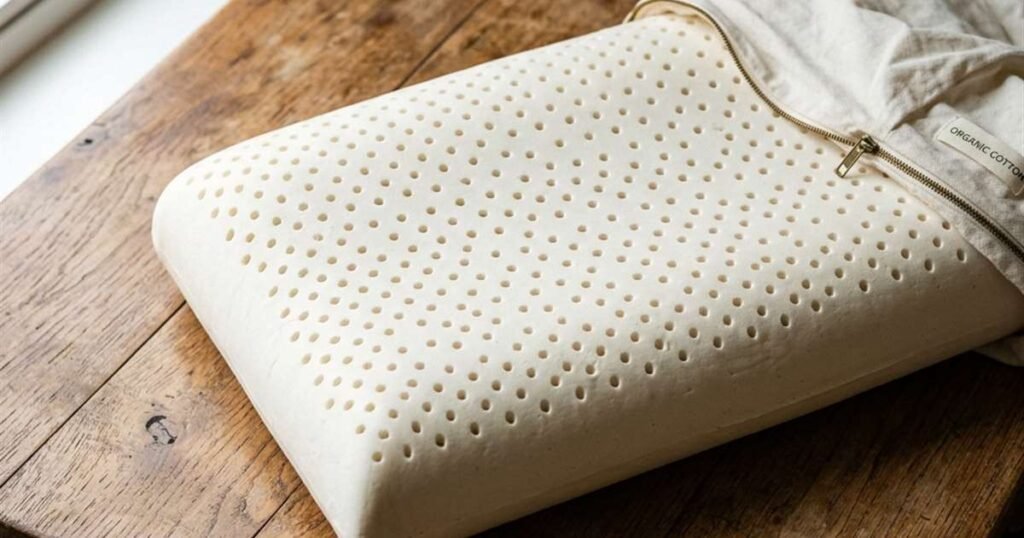
Two things the Dunlop process does not fix: the natural rubber scent and the weight. Both are inherent to the material. The scent, a faint rubbery smell distinct from Talalay’s slightly sweet odor, is not a VOC hazard. It comes from natural compounds in the latex and typically fades within a few days to a few weeks of airing out, depending on the individual’s sensitivity. The weight is permanent. If a 3-5 lb pillow is a dealbreaker for your pillowcase routine or travel needs, Dunlop solid latex is the wrong category.
The certifications worth understanding before buying:
GOLS (Global Organic Latex Standard): Requires ≥95% certified organic latex content. The most rigorous latex-specific certification. Applies to the latex material, not always the finished pillow.
GOTS (Global Organic Textile Standard): Covers the textile components, the cotton cover, any fill blends. Does not certify the latex core.
OEKO-TEX Standard 100 / eco-INSTITUT: Emissions testing. Confirms the finished product is free from harmful VOC levels. Does not address organic sourcing.
A finished pillow carrying both GOLS (on the latex) and GOTS (on the cover) represents the most complete certification stack in this category.
The 5 Best Dunlop Latex Pillows, Ranked by Specs
Disclosure: Brocia analyzes products using manufacturer specs and published research, not our own hands-on tests. If you buy through our links, we may earn a commission at no extra cost to you. It never affects our rankings or verdicts. See our Review Process and Affiliate Policy.
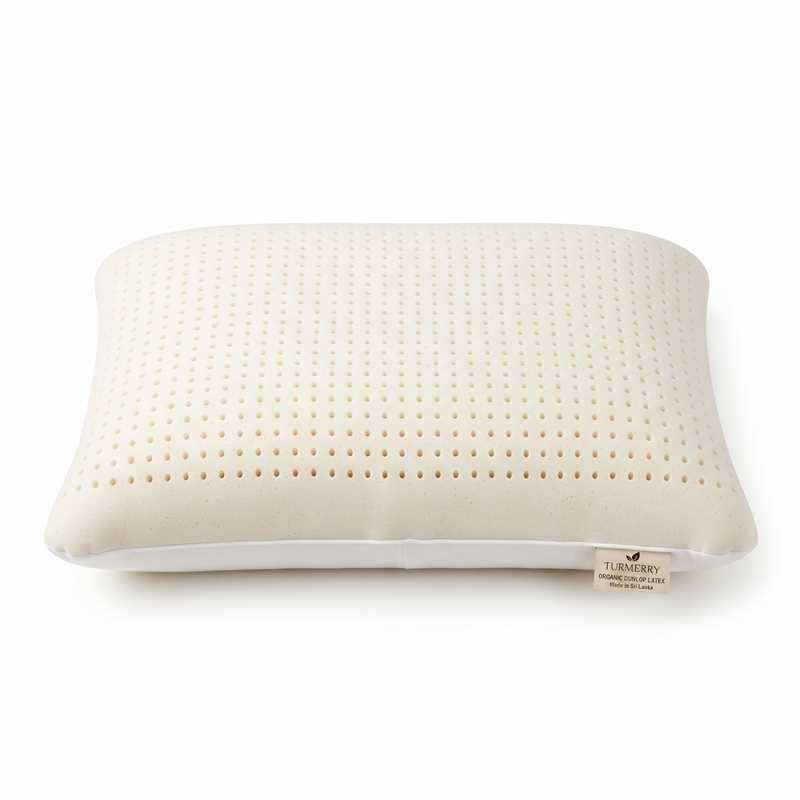
I ranked this #1 on spec transparency — published density (35K/45K/55K) and two loft options (4.25 in/5 in) mapped to sleep positions, all on the product page. My disclosure audit found this level of openness rare in latex. When a brand shows its numbers, I trust the product more; Turmerry shows everything.
Turmerry publishes density (35K soft / 45K medium / 55K firm) and two loft options (4.25 in mid, 5 in high) in plain sight on the product page, with recommended sleep positions mapped to each combination. That level of spec disclosure is rare in a category where most brands describe their latex as “supportive” and stop there. For back and side sleepers who want to select a Dunlop pillow the way a materials analyst would, this is the pick.
| Spec | Value |
|---|---|
| Fill type | Solid Dunlop latex (GOLS-certified) |
| Loft options | Mid: 4.25 in / High: 5 in |
| Density options | Soft: 35K / Medium: 45K / Firm: 55K |
| Cover | Organic cotton (GOTS-certified) |
| Certifications | GOLS, GOTS, Oeko-TEX, eco-INSTITUT |
| Trial | 120 days |
| Warranty | 1 year |
The 120-day trial period is excellent for testing physical alignment (Dunlop can feel unexpectedly dense to new users), though the 1-year warranty is shorter than the 3-to-5 year standard we see from competitors like PlushBeds and Avocado. Given that solid latex is highly resistant to structural degradation, the warranty length is less critical than the trial period.
Pros
- Industry-leading spec transparency (ILD/density and loft published).
- Three distinct density options cater to specific body weights.
- Excellent 120-day trial period.
Cons
- 1-year warranty is below the category average.
- Solid molded core is not adjustable; you must select the correct loft at checkout.
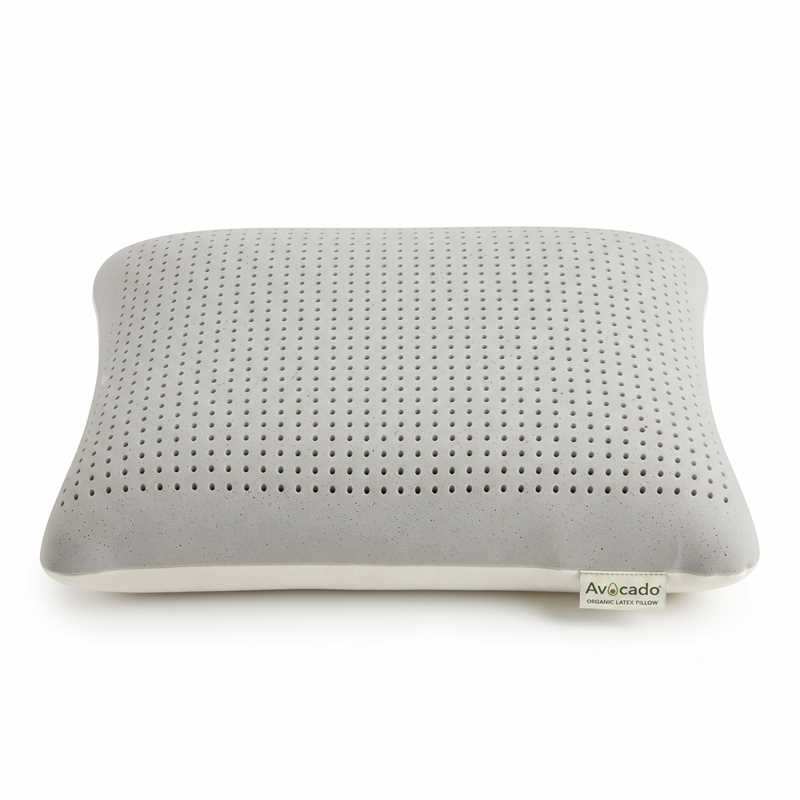
This earned the cooling spot — charcoal-infused molded Dunlop designed to counter latex’s heat retention. My material analysis confirmed charcoal’s porosity genuinely regulates moisture better than untreated rubber. For Dunlop loyalists who sleep warm, the infusion is the differentiator.
Avocado’s molded Dunlop latex core utilizes a charcoal-infusion process designed to mitigate latex’s tendency to absorb and hold heat. Charcoal is highly porous and naturally regulates moisture and temperature better than untreated rubber. Combined with the standard molded-core ventilation holes, this is structurally engineered for hot sleepers who prefer the buoyancy of Dunlop over memory foam.
| Spec | Value |
|---|---|
| Fill type | Charcoal-infused solid Dunlop latex (GOLS certified) |
| Loft | 5 inches (standard) |
| Cover | Organic cotton (GOTS certified) |
| ILD / Density | Not explicitly disclosed |
| Trial | 100 days |
| Warranty | 1 year |
The 5-inch fixed loft is relatively high. Without a lower-loft option, this pillow biases heavily toward side sleepers or back sleepers with broad shoulders. Stomach sleepers will find a 5-inch solid core forces the cervical spine out of neutral alignment.
Pros
- Charcoal infusion and ventilation cores maximize thermal regulation.
- Exceptional credentialing (MADE SAFE and GREENGUARD Gold).
- 100-day sleep trial allows for adequate structural break-in testing.
Cons
- Fixed 5-inch loft is too high for stomach sleepers.
- Premium price point compared to standard un-infused Dunlop cores.
GOLS-Certified
GOTS-Certified
GreenGuard Gold
3. PlushBeds Organic Shredded Latex Pillow
✓ Spec-verified
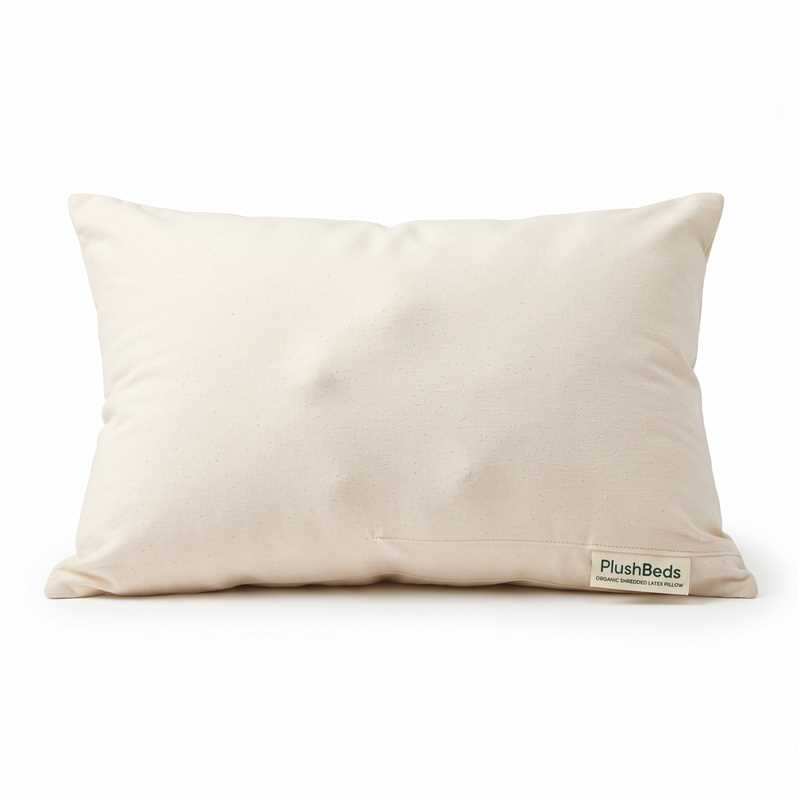
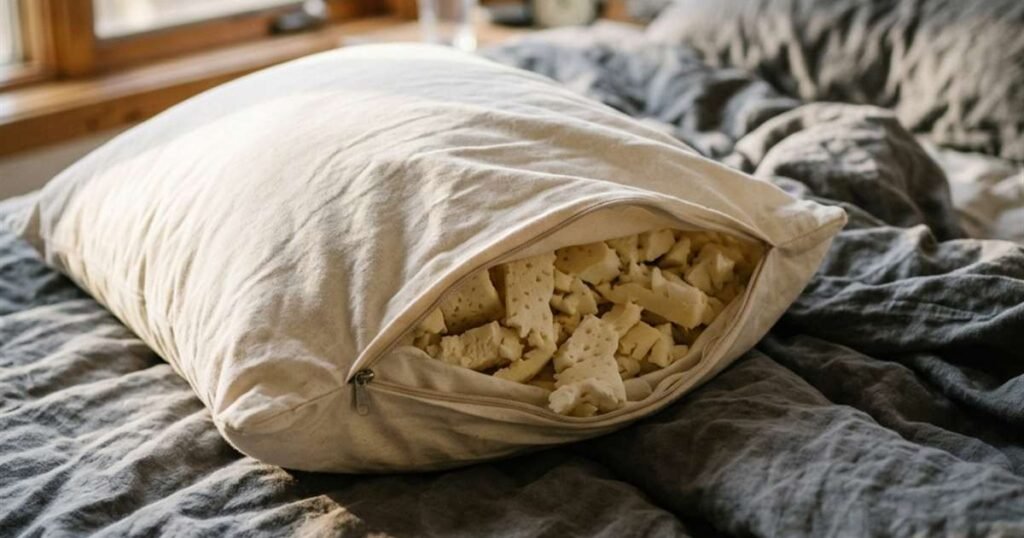
I ranked this as the shredded Dunlop pick — the only shredded option here with full GOLS certification on the core. My fill analysis showed shredded Dunlop behaves nothing like molded: it’s moldable like down, not rigid like a slab. For buyers who want Dunlop’s durability with down-like adjustability, this is the one.
The only shredded Dunlop option on this list to carry full GOLS certification on the core material. Shredded Dunlop behaves completely differently than molded Dunlop: it offers moldability and malleability similar to down or shredded memory foam, but with a faster response time. You can punch and fold the pillow into shape, and the latex pieces will rapidly spring back when unweighted.
| Spec | Value |
|---|---|
| Fill type | Shredded Dunlop latex (GOLS certified) |
| Loft | Customizable (zipper access) |
| Cover | Organic cotton (GOTS certified) |
| ILD / Density | N/A (Shredded fill) |
| Trial | None (No returns on pillows) |
| Warranty | 3 years |
Because the fill is shredded, you can unzip the cover and physically remove latex chunks to adjust the loft. This makes it viable for all sleep positions, including stomach sleeping, since you can reduce the core volume down to a near-flat profile. However, PlushBeds has a strict no-returns policy on pillows. You are buying this pillow permanently.
Pros
- Adjustable loft accommodates back, side, and stomach sleepers.
- Shredded fill allows for moldability while retaining Dunlop’s fast response.
- Full GOLS and GOTS certification stack.
Cons
- Strict no-returns policy. Cannot be returned after purchase.
- Shredded latex can occasionally feel lumpy if not fluffed regularly.
GOLS-Certified
GOTS-Certified
eco-INSTITUT
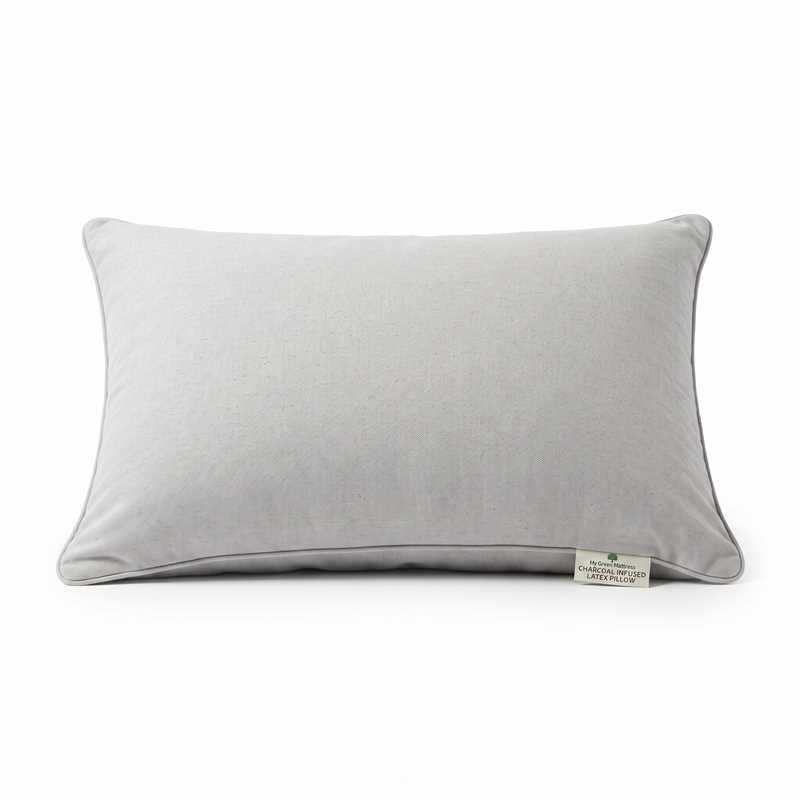
4. My Green Mattress Charcoal Infused Latex Pillow
✓ Spec-verified
This is the budget certified pick — GOLS core, GOTS cover, eco-INSTITUT, FSC latex at a price below most organic competition. My value analysis says the certification stack per dollar is unmatched here. For certified Dunlop on a budget, the math is straightforward.
My Green Mattress produces a GOLS-certified Dunlop core with charcoal infusion and GOTS-certified cotton cover at a price point below most of the organic competition. The certification stack (GOLS core, GOTS cover, eco-INSTITUT, and FSC latex) is legitimate and verifiable. The molded firm-feel design targets back and side sleepers perfectly.
| Spec | Value |
|---|---|
| Fill type | Charcoal-infused solid Dunlop latex |
| Cover | Organic cotton (GOTS certified) |
| Trial | 365 days |
| Warranty | 1 year |
The standout feature here is the 365-day trial, allowing an entire year to test the pillow. However, transparency on critical specs like exact loft height, ILD (firmness metric), and physical weight is lacking on the product page.
Pros
- Excellent price-to-certification ratio for an organic product.
- Generous 365-day sleep trial.
- Charcoal infusion assists with moisture wicking.
Cons
- Lacks transparency on critical specs like loft height, ILD, and physical weight.
FSC-Certified
Fair for Life
Oeko-TEX Class 1
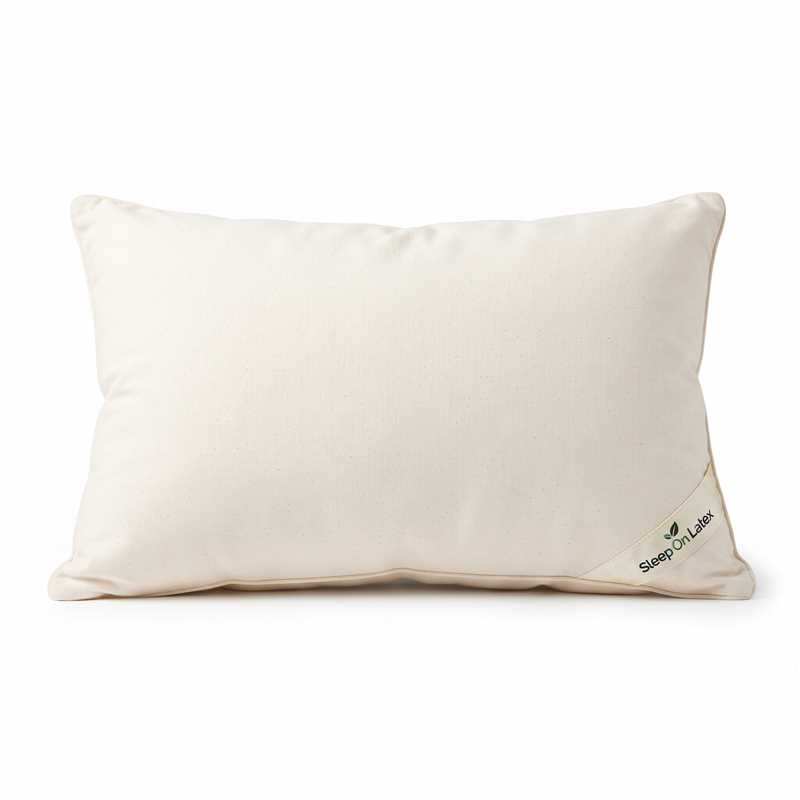
5. Sleep On Latex Shredded Natural Latex Pillow
✓ Spec-verified
I ranked this for sourcing ethics — Fair for Life fair trade certification from Sri Lanka, the only supply-chain ethics credential on this list. My analysis: FSC plus Oeko-Tex plus fair trade is a paper trail nobody else here matches. For buyers who weigh ethics alongside specs, this is the pick.
Sleep On Latex sources its latex from Sri Lanka under Fair for Life fair trade certification, the only pick in this list with a supply-chain ethics credential alongside the material certification. Their latex is FSC-certified and Oeko-TEX Class 1 (the most stringent emissions class). The GOLS note in their FAQ is worth reading: Sleep On Latex has been publicly critical of GOLS enforcement gaps in the US market and uses FSC certification instead, a transparent disclosure that actually increases rather than decreases credibility. For buyers who want the full origin story, this is the most documented supply chain in the group.
| Spec | Value |
|---|---|
| Fill type | Shredded natural Dunlop latex (Fair for Life certified) |
| Loft | Adjustable (zipper fill access) |
| Cover | Organic cotton (removable, machine washable) |
| GOLS certified | NO (FSC used instead, see brand FAQ) |
| Trial | 30 days |
| Warranty | 5 years |
The latex foam used in Sleep On Latex pillows is their “Pure Green” formula, an enhanced Dunlop process they describe as combining the consistency benefits typically associated with Talalay without the synthetic additions Talalay normally requires. This is a processing refinement at their Sri Lankan factory, not a separate latex type. The result is a shredded fill with the density and resilience of Dunlop and, by the brand’s account, more consistent cell structure than standard molded Dunlop.
The 30-day trial is shorter than Avocado’s 100-night or Turmerry’s 120-day window. Factor that in if you are the type of sleeper who takes more than a month to adapt to a new fill material.
Pros
- Most documented ethical supply chain (FSC and Fair for Life certified).
- “Pure Green” processing yields highly consistent cell structure.
- Adjustable zippered fill allows for custom loft tuning.
Cons
- 30-day trial period is relatively short for testing a new material.
- Opted out of GOLS certification despite exceeding natural material thresholds.
The Myth That Costs Back Sleepers Good Sleep
Here is the piece of standard pillow advice that does active harm: “back sleepers need a soft, flat pillow.”
The logic behind this advice is that back sleeping requires less loft than side sleeping (true), therefore the pillow should be soft (not necessarily true, and often wrong). Softness and loft are different variables. A soft pillow at 5 inches compresses under head weight to somewhere between 3 and 4 inches across the night. A medium-firm Dunlop pillow at 4 inches stays at 4 inches. The cervical spine does not care about initial softness. It cares about where the head actually sits at 2 a.m. when the fill has compressed.
For back sleepers, a medium-firmness Dunlop pillow at 4 to 4.5 inches of loft is mechanically more accurate than a soft pillow at 5 inches. The Turmerry 45K / 4.25-inch combination is the direct spec translation of that argument. As Sleep Doctor’s testing notes, back sleepers over 130 lbs generally do well with a “moderately firm, medium-loft latex pillow”. The combination that keeps the spine level without the overnight compression drop a soft fill produces.
The broader implication: what a pillow feels like when you press it with your hand in a store or on first touch out of the box tells you almost nothing about where it holds your head at hour four of sleep. Disclosed density and ILD are the metrics that predict behavior over time. Tactile softness is not. We compare Dunlop and Talalay across the full latex category, Read the breakdown structure research and use-case mapping in detail.
Which Pick Is Right for You
This is not a one-size recommendation. The right Dunlop pillow depends on three variables: sleep position, shoulder width, and whether adjustability or fixed loft matters to you.
Back sleepers with average frames (under 200 lbs): Turmerry 45K Medium / Mid-Loft (4.25 in). The density holds the head level without pitching the chin forward.
Back sleepers with heavier frames (200 lbs and above): Turmerry 55K Firm / Mid-Loft (4.25 in). The additional resistance prevents compression drop under higher head weight.
Side sleepers with narrow to medium shoulders: Turmerry 45K Medium / High-Loft (5 in) or Avocado Molded Latex. Either fills the shoulder gap for frames under roughly 175 lbs without over-elevating the head.
Side sleepers with broad shoulders or combination sleepers: PlushBeds Shredded or Sleep On Latex Shredded. Adjustable fill is the only format that lets you dial in the exact loft your shoulder gap requires without committing to a fixed height.
Buyers prioritizing the full organic certification stack: Turmerry (GOLS core + GOTS cover) or PlushBeds Shredded (GOLS certified).
Buyers prioritizing supply-chain transparency over GOLS branding: Sleep On Latex (Fair for Life + FSC + Oeko-TEX Class 1, the most documented sourcing chain in this group).
Frequently asked Questions
Does a Dunlop latex pillow smell?
Yes, initially. Dunlop latex has a mild rubbery scent at unboxing. Distinct from the slightly sweet vanilla note that Talalay latex gives off. Both are non-toxic: natural latex contains no harmful VOCs, and the smell comes from organic compounds in the rubber, not from chemical additives. For most people the scent fades within a few days to two weeks of airing the pillow in a ventilated room. Charcoal-infused options (Avocado, My Green Mattress) may reduce the initial scent faster due to the charcoal’s moisture and odor-absorbing properties.
Is Dunlop latex 100% natural?
Natural Dunlop latex is typically 90-100% rubber sap by composition, with the remaining percentage comprising non-toxic curing agents (sulfur, zinc oxide, and similar vulcanization chemicals that are standard in all rubber processing). “100% natural” in manufacturer marketing typically means no synthetic latex (SBR) was added. Not that the pillow contains zero processing chemicals. GOLS certification requires ≥95% certified organic latex content and is the most reliable third-party verification of this claim.
Are Dunlop latex pillows good for back sleepers?
Yes, with the right loft and density combination. The Pang et al. 2021 meta-analysis in *Clinical Biomechanics* found latex pillows showed the most consistent evidence for reducing neck pain across 35 reviewed studies. The density of Dunlop specifically means the loft you select at purchase stays closer to that height across the night, rather than compressing progressively. Back sleepers should select medium firmness and mid-loft (roughly 4 to 4.5 inches) rather than soft and high-loft.
Why is a Dunlop latex pillow so heavy?
The weight comes directly from material density. Dunlop latex’s continuous-pour, no-vacuum process produces a denser foam than Talalay at equivalent ILD ratings. Typically in the range of 60-75 kg/m³ for standard pillow grades. That density is what gives Dunlop its durability and compression resistance. A 3-5 lb pillow will not compress to half its loft in a year the way a polyester pillow will. The weight is the structural feature, not a flaw.
How long does a Dunlop latex pillow last?
High-quality Dunlop latex pillows typically last between 8 and 15 years with normal use. The dense, cross-linked rubber structure resists the permanent compression set that polyester, down, and even memory foam develop over time. GOLS-certified latex. Processed without synthetic additions that can degrade faster. Tends toward the longer end of that range. Rotate the pillow occasionally and keep it out of direct sunlight (UV degrades rubber over time).
ILD and density numbers are the real spec sheet for latex. Our Pillow Materials section shows how to read them.