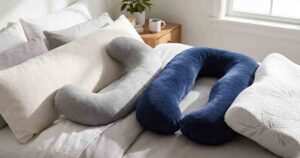
A body pillow does not stop snoring. What it does is hold you on your side, and side sleeping is where the snoring research actually points. In sleep-lab recordings of apnoeic and non-apnoeic snorers, snoring was louder and more frequent on the back than on the side, in every sleep stage (Koutsourelakis et al., Journal of Sleep Research).
So I ranked these four pillows by one question: how well does the design keep a back sleeper off their back all night? Shape first, fill firmness second, price third. Every pick gets a plain flaw and a clear who-it-is-not-for, because the pillow that fixes your neighbour’s snoring can do nothing for yours.
Why position changes snoring
On your back, gravity pulls the tongue and soft tissue toward the throat, and the airway narrows. On your side, that tissue falls sideways instead of backward. The studies put numbers on it.
About half of mild sleep apnea is positional. In one sleep-center study, 49.5% of mild cases met the strict definition of positional apnea, meaning the problem nearly disappeared off the back, against only 6.5% of severe cases (Mador et al., Chest). In a randomized trial, a positional device cut the time patients spent on their backs from 40% of the night to 0%, and their apnea index fell from 11 to 2 events per hour (Permut et al., Journal of Clinical Sleep Medicine). A head-positioning pillow cut the snoring index from a median of 218 to 115 events per hour (Chen et al., Scientific Reports). And in people who snored without apnea, six weeks of position training improved bed-partner ratings of the snoring (Benoist et al., European Archives of Oto-Rhino-Laryngology).
One honest limit before the picks. No study tested a shop-bought body pillow. The evidence covers position trainers and positioning pillows. A body pillow is the low-tech version of the same idea: a physical barrier that makes rolling onto your back harder. That is a reasonable bet for positional snoring. It is not a treatment for sleep apnea, and the last section of this post covers where the pillow’s job ends.
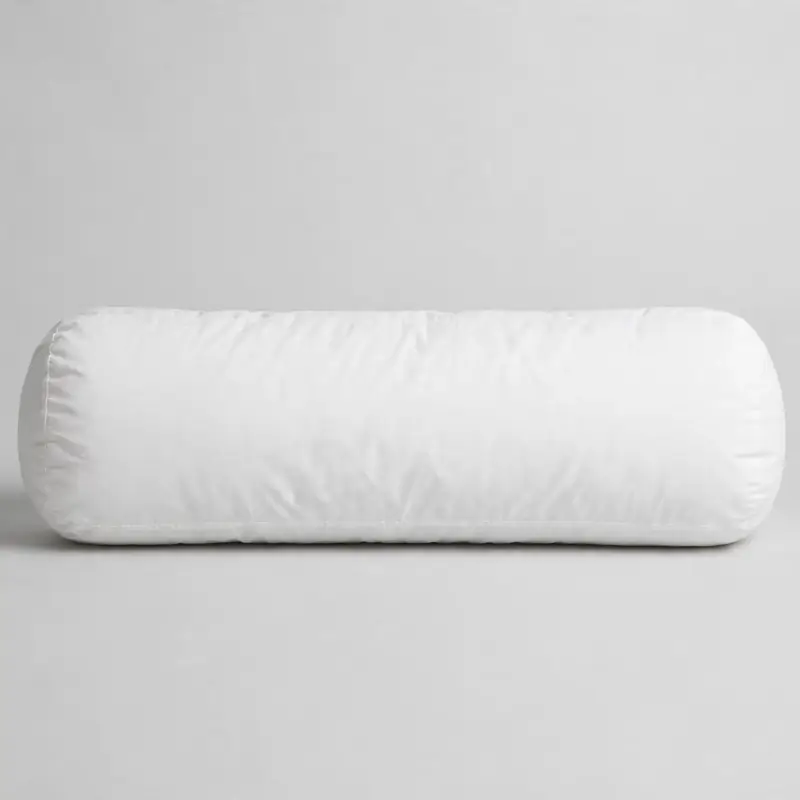
Most straight body pillows come in one firmness, and you either live with it or you don’t. The Coop is stuffed with shredded memory foam mixed with microfiber, and you can pull handfuls out or push more in. For snoring, that matters more than it sounds. A pillow that is too soft is just something to hug while you roll straight over it. Set this one firm, park it against your front, and it does a decent job of keeping you tipped on your side.
It is not perfect. It only covers one side of you, so if you tend to roll the other way, you will end up on your back anyway. And foam holds heat. If you already sleep hot, you will feel it by 2 a.m., which is why I compared the cooling models in cooling body pillows comparison separately.
Not for: skip it if you roll in both directions, or if you sleep hot and hate foam.
| Specification | Coop Original Body Pillow |
|---|---|
| Size | 20 x 54 inches |
| What’s inside | Shredded memory foam and microfiber |
| Height | Adjustable, add or remove fill |
| Cover | Removable and washable, polyester and bamboo-viscose blend (Lulltra) |
| Safety checks | CertiPUR-US and GREENGUARD Gold certified |
Pros
- You control the firmness, which most body pillows do not allow.
- Standard size, so spare cases are cheap and easy to find.
- The foam is certified, so you know what is inside.
Cons
- Only blocks one side of the bed.
- Can sleep warm.
- Costs more than the basic polyester pillows below.
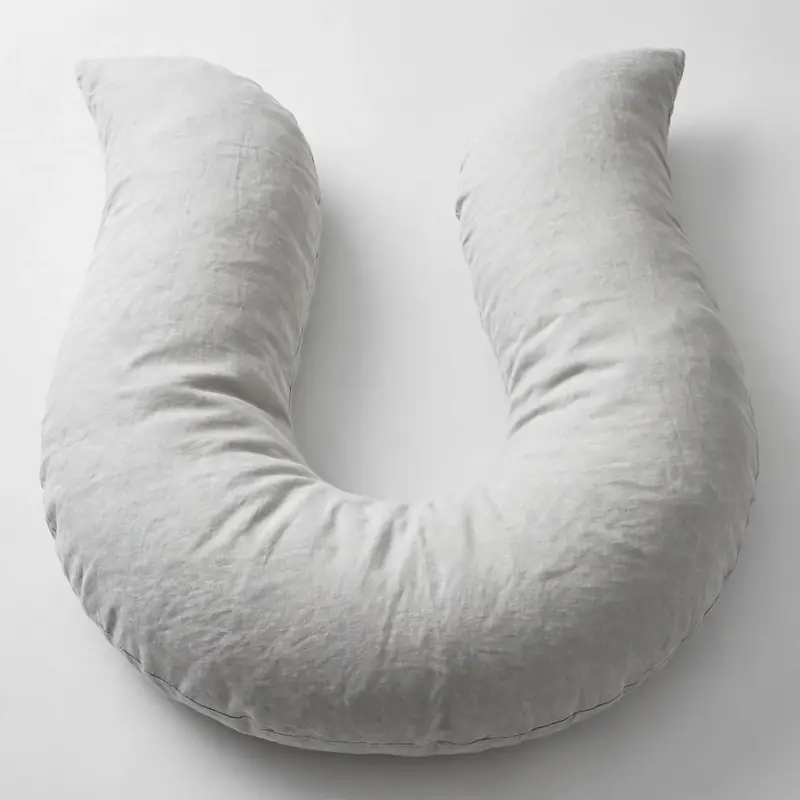
A U-shaped pillow is basically two barriers and a headrest joined together. Roll left, there is a pillow. Roll right, there is a pillow. That is the whole trick, and for back snorers it is a good one. PharMeDoc’s version is the one you see everywhere, and at around thirty dollars it is the cheapest way to test whether side sleeping quiets your snoring at all. The U layout is borrowed from pregnancy pillows, and the positions that make it comfortable are the same ones covered in guide to sleeping with a U-shaped pregnancy pillow.
The catch is the filling. It is plain polyester, and polyester slowly goes flat. Month one, it is a wall. Month eight, it is more of a suggestion. It also takes up real space, roughly a third of a queen bed, so your partner needs to be on board.
Not for: skip it if you sleep hot, share a small bed, or want something that stays firm for years.
| Specification | PharMeDoc U-Shaped Body Pillow |
|---|---|
| Size | 53 x 31 x 7 inches (brand listing) |
| What’s inside | Polyester fill |
| Height | About 7 inches |
| Cover | Removable, washable cotton blend |
| Price check | $29.99 at Walmart, 2026-10-20 |
Pros
- Blocks rolling in both directions.
- Cheapest pick here by a long way.
- Cover comes off and goes in the wash.
Cons
- Filling flattens over time.
- Wide. It will take over a queen bed.
- The wrap-around shape traps heat.
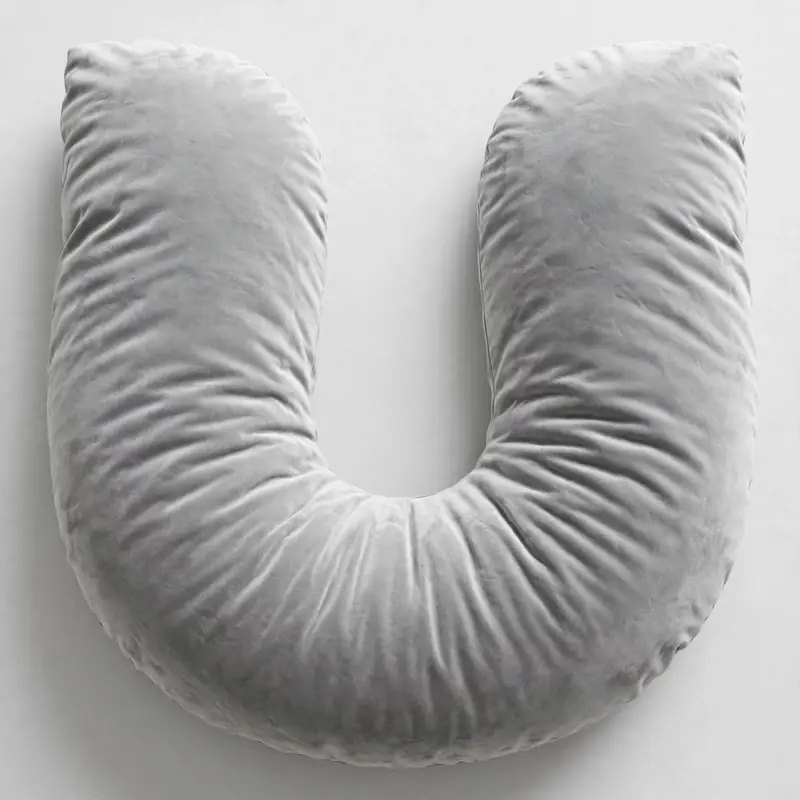
Queen Rose stretches the U shape to 55 inches. If you are tall, that extra length is the difference between a pillow that reaches your knees and one that gives up at your thighs. One thing to know before you order: the sellers cannot agree on how wide it is. Walmart’s spec sheet says 33 inches across, the Amazon listing says 31. Order expecting the wider size and make sure your bed can spare it.
Inside, it is the same polyester fill as the PharMeDoc, so the same warning applies: it will soften over time. The velvet cover feels nicer than the basic cotton ones, but velvet is warm. You are paying the extra money for length and cover feel, not for a better snoring fix.
Not for: skip it if you are under about 5 ft 6 in, or if you sleep hot.
| Specification | Queen Rose U-Shaped Body Pillow, 55 Inch |
|---|---|
| Size | 55 inches long, 31 to 33 inches wide (sellers disagree), 7 inches thick |
| What’s inside | Polyester fill |
| Cover | Removable velvet |
| Price check | $46.99 at Walmart, 2026-10-20 |
Pros
- Longer than most U pillows, better for tall bodies.
- Velvet cover feels softer against the skin.
- Still well under fifty dollars.
Cons
- Sellers list two different widths, so check your bed space first.
- Polyester fill goes flat over time.
- Velvet cover sleeps warm.
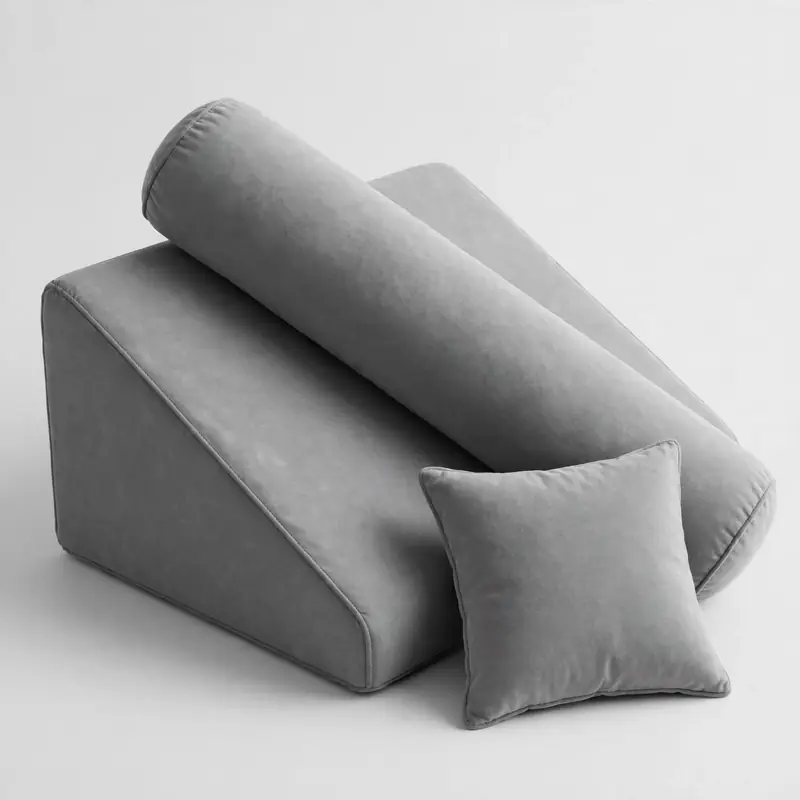
MedCline is not really a pillow. It is a foam wedge with a body pillow attached, and a pocket your lower arm slides into so your shoulder is not crushed under you. For snoring, the useful part is the slope. Sleeping on an incline on your side keeps your airway more open than lying flat, and the wedge makes it very hard to end up flat on your back. It is the most determined design here. The same slope is why wedge pillows get recommended for nighttime reflux, which wedge-angle analysis for nighttime acid reflux covers in detail.
It is also two hundred and fifty dollars, which is a lot to spend on a snoring experiment. MedCline does not even publish the full measurements, just height ranges to pick a size. And if your lower back or hips are the problem, the company itself says look elsewhere.
Not for: skip it if you sleep on your stomach, if the budget matters, or if you have lower back or hip trouble.
| Specification | MedCline Shoulder Relief System |
|---|---|
| What you get | Wedge, body pillow and small insert pillow |
| Wedge | Gel memory foam, 10 degree slope |
| Body pillow | Adjustable fill |
| Sizing | By your height, two sizes |
| Full measurements | Not published by MedCline |
Pros
- The wedge locks you in place better than any loose pillow.
- The slope helps your airway and reflux at the same time.
- Your shoulder gets a pocket instead of your full body weight.
Cons
- By far the most expensive option here.
- No full measurements published, only height-based sizing.
- Not made for people with lower back or hip problems.
How to choose between them
Match the barrier to how you roll. One direction only: the Coop, set firm. Both directions: a U shape, PharMeDoc for price, Queen Rose for length. Climbing over everything you have tried: the MedCline system, because its position is fixed by the wedge, not by your discipline.
Firmness is the spec that decides it. In the six-month position-trainer study, time spent on the back fell from 21% to 3% of the night, and the change landed within the first 3 to 9 days (van Maanen and de Vries, Sleep). A barrier that actually holds position works fast. Judge any of these pillows after two weeks of real use, not after one night, and if it has flattened or migrated off the bed by then, it was never holding you.
When a pillow is not enough
A body pillow is a snoring aid for positional snorers. It is not an apnea treatment, and the biggest evidence check says so directly: a meta-analysis of 19 randomized trials with 1,231 people found positional therapy beat placebo only for events in the supine position, showed no overall advantage, and was less effective than CPAP (Gao et al., Frontiers in Medicine). Remember Mador’s numbers too: only 6.5% of severe apnea is positional.
Get a sleep study, not a pillow, if any of these are true: a partner has seen you stop breathing, you wake gasping or with morning headaches, or you are sleepy all day despite a full night in bed. And if you already use CPAP and sleep on your side, CPAP pillow guide for side sleepers covers masks and pillow shapes that work together.
For mild, positional snoring, though, the cheapest barrier that matches how you roll is a fair first step, and it is a step the evidence supports. If your problem turns out to be general side-sleeping comfort rather than snoring, body pillows for side sleepers guide covers the wider field.
Does a body pillow help with snoring?
It helps positional snoring, the kind that is worse on your back. Sleep studies show snoring is louder and more frequent in the supine position, and a body pillow works by holding you on your side. It does not treat sleep apnea.
Which body pillow shape is best for snoring?
A U shape if you roll in both directions, because it blocks both sides. A firm straight body pillow if you roll one way only. A wedge-and-pillow system like MedCline if ordinary pillows fail to hold you.
Can a body pillow replace a CPAP machine?
No. A meta-analysis of 19 trials found positional therapy less effective than CPAP and no better than placebo on overall apnea scores. If you have sleep apnea, use the treatment your doctor prescribed.
How long does a body pillow take to reduce snoring?
Position studies show time spent on the back drops within the first 3 to 9 days when the aid holds position properly. Give a pillow two weeks before judging it, and check whether it is still in place in the morning.
Is a wedge pillow or a body pillow better for snoring?
They do different jobs. A wedge inclines your head and torso, which helps the airway directly. A body pillow holds you on your side. Systems like MedCline combine both, at a much higher price.