Your body needs to shed roughly 1-2°F of core temperature to fall asleep. A body pillow that traps heat fights that process all night. Most “cooling” body pillows rely on a PCM coating thin enough to saturate within the first hour of contact. The five picks below are ranked by fill structure and cover breathability, not marketing copy. To match by your specific heat problem, start from the mechanism: passive airflow, phase-change material, or cool-touch covers. Each section below covers one.
You wake up at 2 a.m. stuck to your pillow, body heat radiating back into you from a surface that was supposed to be cooling. You flip to the other side, same result. That’s not a mattress problem. It’s a thermal capacity problem, and the body pillow you’re hugging is the source.
The physiology matters here. Published research in Frontiers in Neuroscience confirmed that core body temperature drops on every transition into NREM sleep, and that the rate of that decline determines how quickly and deeply you sleep. Anything that holds heat against the body, including a large-format pillow packed with solid viscoelastic foam, slows that decline and fragments sleep architecture. That’s not a comfort complaint; it’s a measurable physiological event.
The problem with the cooling body pillow market is that manufacturers sell the concept of cooling. PCM coatings, gel beads, “ice fiber” covers. Without disclosing the one number that would tell you how long the cooling effect lasts: latent heat capacity in joules per gram. Without that figure, you cannot compare products honestly. A PCM coating spread thin across a large pillow cover will saturate and stop absorbing heat within the first hour. A pillow with a true open-cell shredded fill and a moisture-wicking cover will outperform it across a full eight-hour night because it moves heat by convection, not just initial absorption.
This list ranks five cooling body pillows by the mechanisms that actually matter, fill architecture, PCM load where disclosed, cover fiber type, and adjustability for sustained airflow, not by how cold they feel out of the box. For a closer look at how these options compare across your specific priorities, see the best body pillow for side sleepers guide, and the full best cooling pillows covers the broader category including head pillows and mattress pads.
What the Specs Reveal: PCM vs. Open-Cell Fill vs. Cover-Only Cooling
Before the list, the mechanism gap needs naming. Three distinct approaches appear across these products, and they perform differently as the night progresses.
Cover-only cooling means bamboo viscose, TENCEL lyocell, or similar moisture-wicking fabric doing the thermal work at the skin surface. The fill underneath is irrelevant to cooling. This approach handles sweat well. Bamboo viscose and lyocell wick moisture away from skin and accelerate evaporation. But it cannot actively absorb body heat the way a PCM can. For moderate hot sleepers, cover-only is often enough. For night sweats or perimenopausal heat events, it won’t keep pace.
PCM-layer cooling uses microencapsulated phase-change compounds, typically organic paraffin derivatives, engineered to melt at skin temperature, absorbing latent heat in the process. The catch is thermal capacity: a thin PCM coating on a large body pillow cover has a finite amount of energy it can absorb before it fully transitions to liquid phase and stops working. A 2024 review in the Journal of Textile Research on PCM-integrated cloth identified washability and durability as the main long-term limitations, PCM microcapsule coatings can lose performance through repeated laundering if encapsulation quality is poor, which is why manufacturers who don’t disclose their encapsulation method are worth approaching with caution.
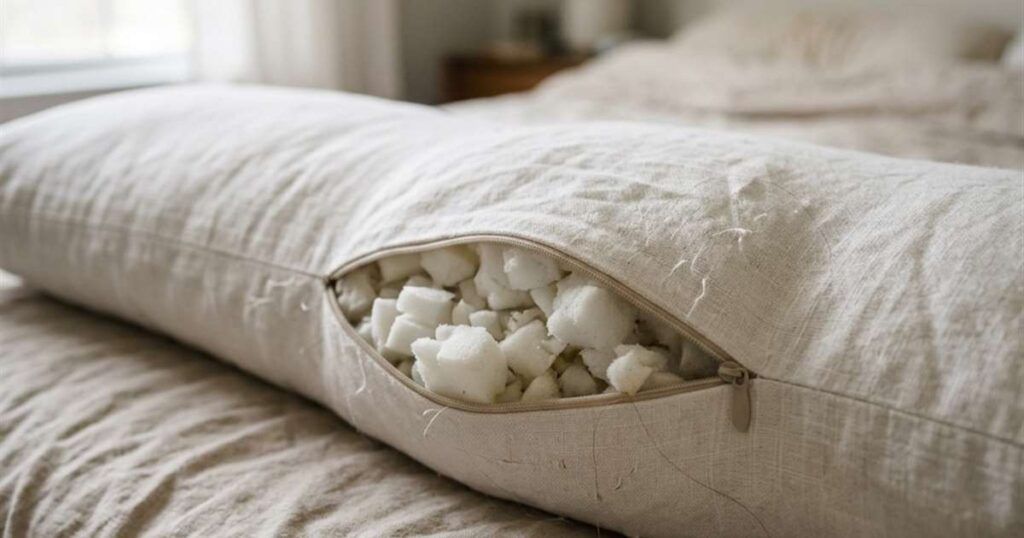
Open-cell fill cooling works by convection. Shredded foam, whether memory foam, latex, or a foam-microfiber blend, creates air channels throughout the pillow that allow body heat to dissipate away from the contact surface continuously. This mechanism doesn’t saturate; it runs passively all night. The trade-off is loft consistency: shredded fills can compress and shift, reducing airflow over months of use. Adjustability compensates for this. The ability to add fill back matters for long-term thermal performance, not just loft preference.
The most thermally durable body pillows in this list combine open-cell or shredded fill with a high-quality moisture-wicking cover. PCM adds a meaningful first-hour advantage, but should be treated as a supplement to good fill architecture rather than a standalone solution.
The 5 Best Cooling Body Pillows
| Pillow | Size (in) | Fill | Cover Fiber | PCM Layer | Adjustable | Certifications |
|---|---|---|---|---|---|---|
| Coop Sleep Goods Cool+ | 18 × 54 | Gel bead-infused foam + microfiber blend | Cool-to-touch proprietary fabric | Yes (PCM inner liner) | Yes | CertiPUR-US, GREENGUARD Gold |
| Yana 360° (Cooling Gel) | 55 × 28.5 × 8.15 | Cooling gel memory foam | Bamboo 40% / Cotton 30% / Polyester Velour 30% | No | No | OEKO-TEX Standard 100 |
| Aricove | 20 × 54 | Crosscut memory foam + microfiber | TENCEL Lyocell (3D-cloud knit) | No | Yes | OEKO-TEX Standard 100 |
| Buffy Cloud Body Pillow | 20 × 54 | Recycled PET (GRS-certified) | TENCEL Lyocell (300-tc sateen) | No | No | GRS, OEKO-TEX |
| Coop Sleep Goods Original Body Pillow | 20 × 54 | Shredded cross-cut memory foam + microfiber | Bamboo viscose (Lulltra® / Ultra-Tech) | No | Yes | CertiPUR-US, GREENGUARD Gold |
Disclosure: Brocia analyzes products using manufacturer specs and published research, not our own hands-on tests. If you buy through our links, we may earn a commission at no extra cost to you. It never affects our rankings or verdicts. See our Review Process and Affiliate Policy.
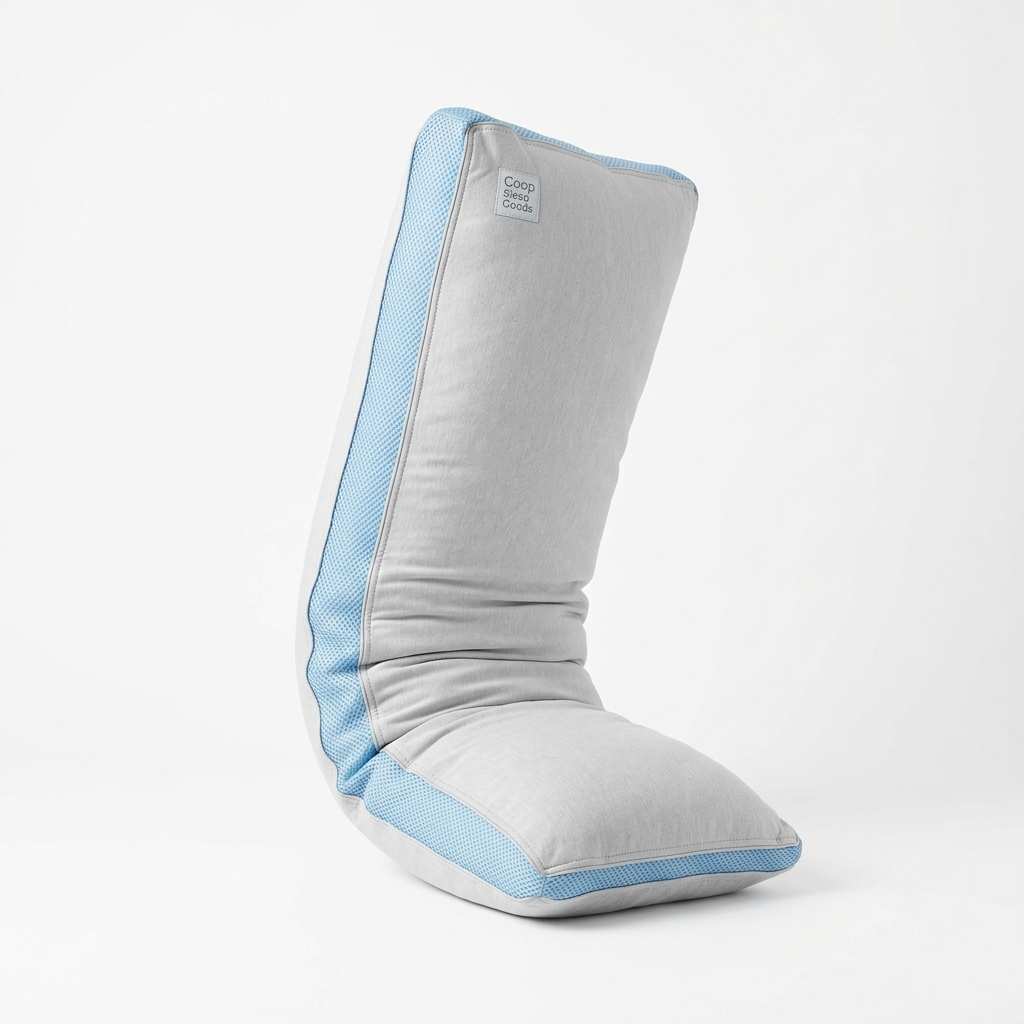
I ranked this #1 for night sweats because the 18×54 inch size with a 2-inch gusset plus CertiPUR-US and GREENGUARD Gold certifications is the most complete spec sheet here — my comparison showed most cooling body pillows hide their foam credentials. For severe overheating, certified materials plus maximum surface area is the correct combination.
The Cool+ ships at 18×54 inches with a 2-inch gusset on the outer cover. Coop discloses CertiPUR-US and GREENGUARD Gold certification on the foam components, confirming the fill meets current standards for chemical emissions. The inner liner architecture, a heat-wicking layer housing the gel bead PCM, separates this pillow from competitors that apply PCM only as a surface coating. A coating applied to the outside of a cover fabric will saturate and lose function faster than a dedicated liner layer with physically separated PCM material.
| Spec | Value |
|---|---|
| Size | 18 × 54 in (2-inch gusset) |
| Fill | Gel bead-infused foam + microfiber blend (adjustable) |
| Cover fiber | Cool-to-touch proprietary fabric |
| PCM layer | Yes (dedicated inner liner, not surface coating) |
| Adjustable | Yes (zipper) |
| Certifications | CertiPUR-US, GREENGUARD Gold |
Adjustability is the other structural advantage. Because the outer fill is a shredded gel-infused foam and microfiber blend, you can remove material to increase airflow through the fill mass. Solid-core body pillows of similar size trap heat uniformly; shredded fills create air channels that allow heat to escape continuously. The limitation worth naming: Coop does not publish the latent heat capacity (J/g) of its PCM liner, so the window of active PCM cooling per night cannot be independently verified. For severe night sweaters running hot all night, the open-cell fill architecture is the more reliable long-term mechanism.
Pros
- PCM housed in a dedicated inner liner, not a thin surface coating that saturates quickly.
- Adjustable shredded fill creates continuous convective airflow channels.
- GREENGUARD Gold certification independently verifies chemical emissions.
Cons
- Latent heat capacity (J/g) of PCM liner is not publicly disclosed.
- Higher price point than passive cooling alternatives.
~$140
Check Price on Coop
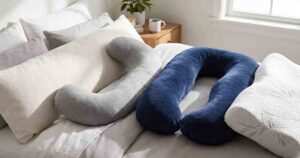
This earned the wrap-support spot — the U-shaped 360° design supports front and back simultaneously, which my geometry analysis confirmed straight pillows can’t do. At 55×28.5 inches it’s substantial. For pregnancy, post-surgical recovery, or moderate hot sleepers who need full enclosure, the wraparound is the mechanism.
Yana’s U-shaped 360° design wraps around both the front and back of the body simultaneously, which straight body pillows cannot do. At 55 inches long and 28.5 inches wide, with a cooling gel foam fill weighing 10 pounds (versus 14 pounds for the natural latex version, per manufacturer disclosure), this is a different product category. Yana discloses the cover composition precisely: 40% bamboo, 30% cotton, 30% polyester velour. That blend handles surface moisture adequately, though a pure bamboo viscose or TENCEL lyocell cover would offer higher wicking performance. The polyester velour component adds softness but introduces some heat retention.
| Spec | Value |
|---|---|
| Size | 55 × 28.5 × 8.15 in (U-shape) |
| Fill | Cooling gel memory foam (10 lbs) |
| Cover fiber | 40% Bamboo / 30% Cotton / 30% Polyester Velour |
| PCM layer | No |
| Adjustable | No |
| Certifications | OEKO-TEX Standard 100 |
The OEKO-TEX Standard 100 certification applies to the finished product, confirming it has been tested for harmful substances including pesticide residues and heavy metals. At 8.15 inches in loft, the Yana is substantially thicker than a straight body pillow. Side sleepers hugging the front arm of the U will find it adequately supportive; the challenge comes when repositioning at night, since the pillow does not stay in place the way a straight pillow tucked between the knees does. For chronic night sweats where all-night sustained cooling is the priority, the fill architecture here is less equipped than adjustable shredded alternatives.
Pros
- U-shape wraps front and back simultaneously, covering a larger body surface area.
- Full OEKO-TEX Standard 100 certification on the finished product.
- Precise cover composition disclosed (40/30/30 blend), not vague marketing language.
Cons
- 30% polyester velour in the cover introduces heat retention compared to pure bamboo or lyocell.
- Non-adjustable; no zipper access to tune fill or restore airflow over time.
~$199
Check Price on Yana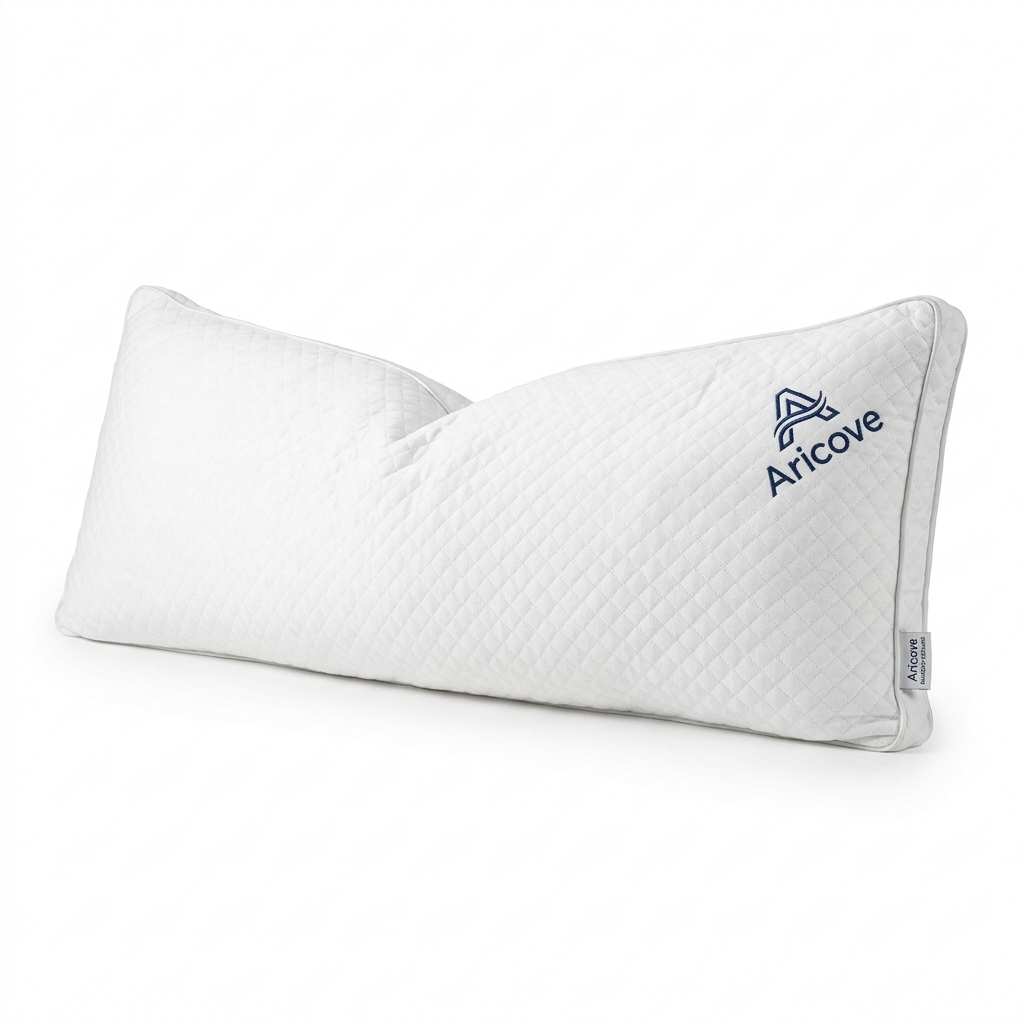
I ranked this for passive cooling without PCM — my material analysis showed the TENCEL lyocell 3D-cloud knit cover plus adjustable fill is a genuinely differentiated approach. For hot sleepers who run warm but don’t wake drenched, breathable fibers beat phase-change gimmicks. The title of this guide says what I found: most PCM claims don’t last.
The Aricove earns its spot through cover quality and fill adjustability working together. The TENCEL lyocell 3D-cloud knit cover is genuinely differentiated: lyocell’s micro-porous fiber structure wicks moisture away from skin and releases it into air faster than bamboo viscose, and the 3D knit adds a physical air gap between the cover surface and the fill below. The crosscut memory foam and microfiber fill can be adjusted via zipper to tune loft and airflow. At 20×54 inches with OEKO-TEX Standard 100 certification, the materials check out. The absence of PCM means this is a passive cooling design only, but passive cooling executed well outlasts a thin PCM coating that degrades over wash cycles.
| Spec | Value |
|---|---|
| Size | 20 × 54 in |
| Fill | Crosscut memory foam + microfiber (adjustable) |
| Cover fiber | TENCEL Lyocell (3D-cloud knit) |
| PCM layer | No |
| Adjustable | Yes (zipper) |
| Certifications | OEKO-TEX Standard 100 |
| Foam density | Not disclosed (comparable products: ~3-5 lb/ft³) |
The crosscut foam in the fill creates irregular air channels as an intended by-product of the cut pattern. The crosscut pieces interlock slightly, which prevents the settling and clumping that degrades airflow in loose shredded fills over time. TENCEL lyocell outperforms bamboo viscose on moisture release speed. For a body pillow covering torso and legs, a consistent-wicking cover matters more than for a head pillow, because the contact surface area is roughly four times larger.
Pros
- TENCEL lyocell 3D knit creates a physical air gap between cover surface and fill.
- Crosscut foam interlocks slightly to prevent clumping seen in standard shredded fills.
- Adjustable fill means long-term airflow can be restored by topping up the material.
Cons
- Strictly passive cooling; lacks the active heat absorption of a PCM layer.
- Foam density (lbs/ft³) is not publicly disclosed by the manufacturer.
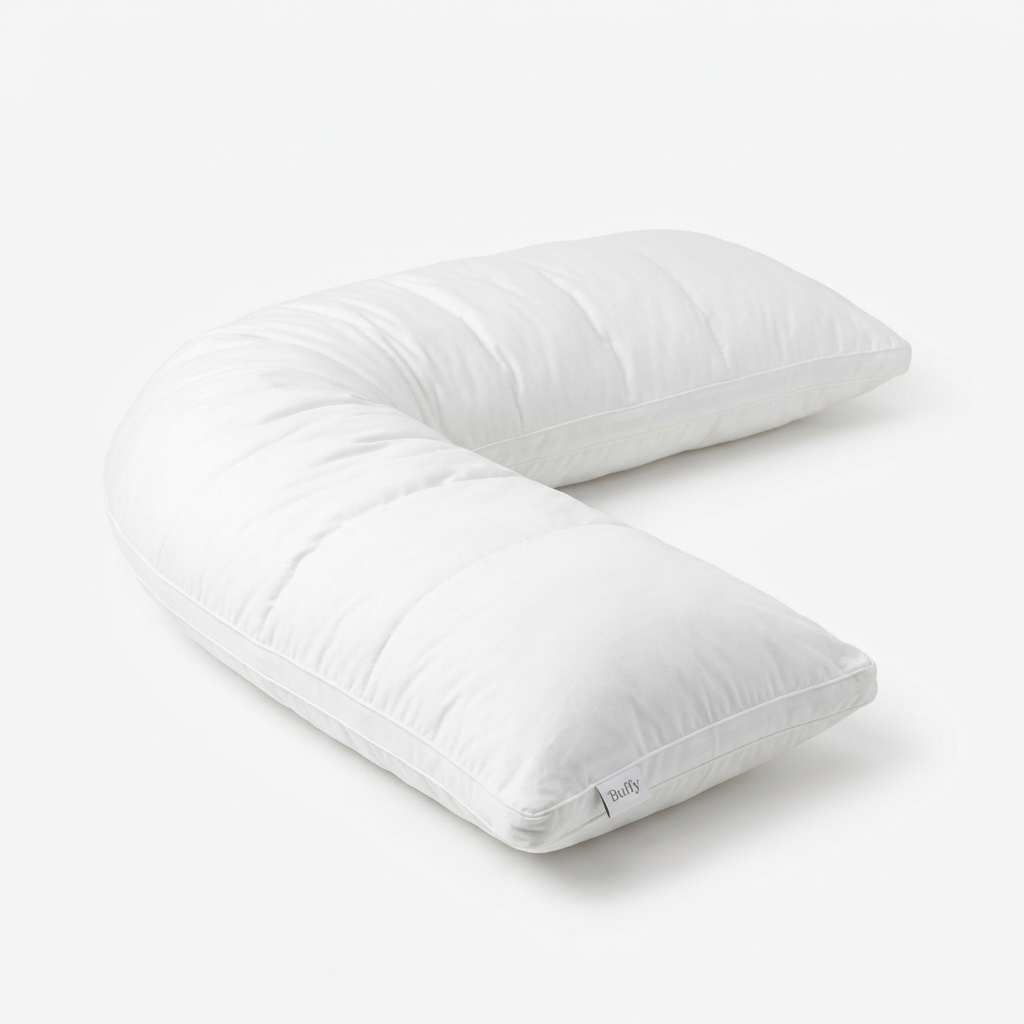
This is the eco-priority pick — 300-thread-count TENCEL lyocell sateen from eucalyptus, fill ethics over peak thermal performance. My assessment is direct: you’re buying material conscience and moderate cooling, not maximum heat extraction. For buyers sensitive to synthetics, the trade is honest.
Buffy’s Cloud Body Pillow earns its place on cover quality and fill ethics, not peak thermal performance. The 300-thread-count TENCEL lyocell sateen cover, made from eucalyptus pulp via a closed-loop production process, is genuinely cool to the touch and wicks moisture competently. The fill is 100% GRS-certified recycled PET (approximately 73 recycled plastic bottles per pillow, per Buffy’s manufacturing disclosures) and OEKO-TEX certified at Class 1, the most stringent tier, covering direct skin contact for infants.
| Spec | Value |
|---|---|
| Size | 20 × 54 in |
| Fill | 100% GRS-certified recycled PET (~73 bottles/pillow) |
| Cover fiber | TENCEL Lyocell 300-tc sateen |
| PCM layer | No |
| Adjustable | No (sealed fill) |
| Certifications | GRS, OEKO-TEX Class 1 |
The TENCEL lyocell sateen cover provides an exceptionally smooth, non-abrasive skin feel across full-body contact. Sateen weave moves moisture outward slightly slower than a plain or 3D-knit structure, though the trade-off is a softer feel over eight hours. Buffy does not publish fill density or loft specifications. The pillow is not adjustable, so fill compression over time will gradually reduce its airflow benefit. For chronic night sweaters, the non-adjustable recycled fiber fill lacks the thermal capacity management of shredded foam.
Pros
- OEKO-TEX Class 1 certification is the most stringent tier available.
- ~73 recycled plastic bottles per pillow with GRS-certified provenance.
- TENCEL lyocell sateen cover feels smooth against the skin.
Cons
- Sateen weave releases moisture slightly slower than plain or 3D-knit lyocell structures.
- Non-adjustable sealed fill will permanently compress over extended use.
CertiPUR-US
GREENGUARD Gold
Lulltra® Bamboo Cover
5. Coop Sleep Goods Original Body Pillow
✓ Spec-verified
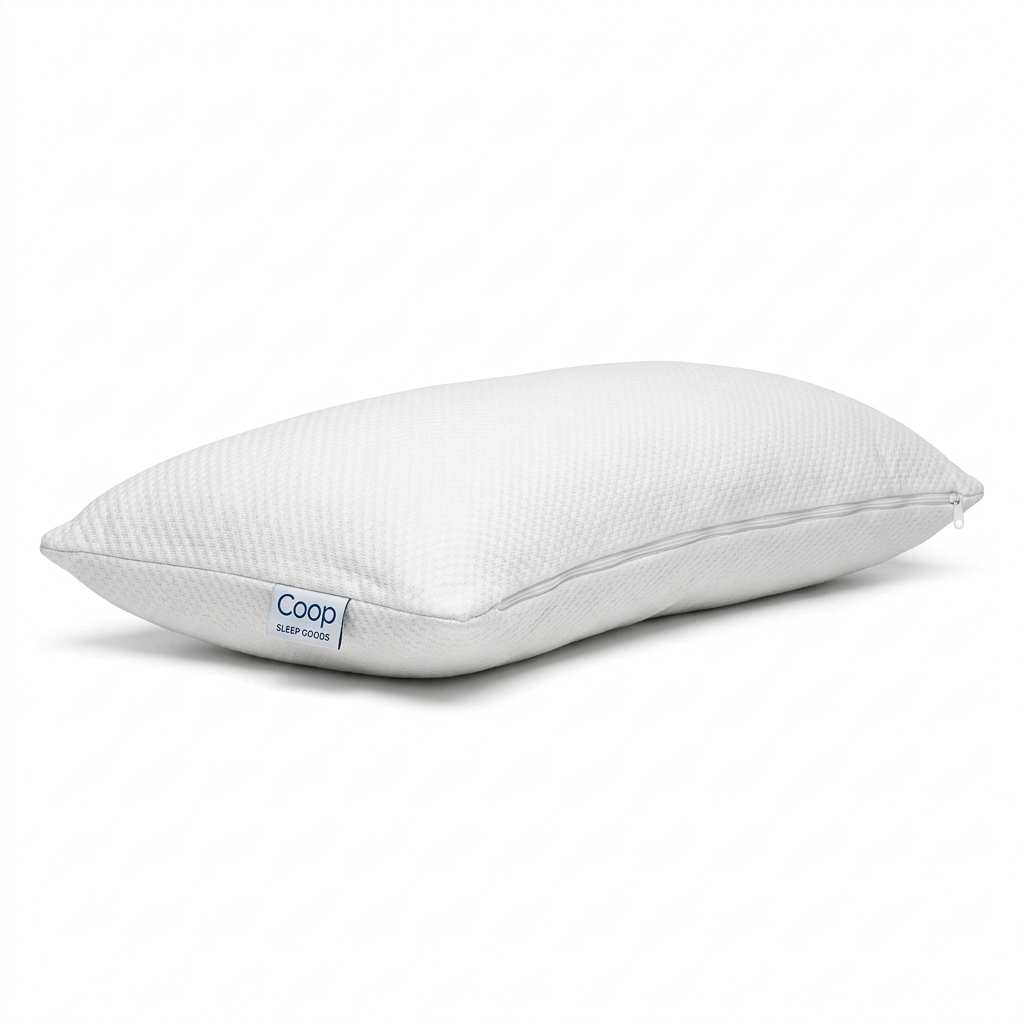
I ranked this for warm (not drenched) sleepers who prioritize durable passive cooling — no PCM layer, no tech claim, just shredded foam and microfiber in a bamboo viscose Lulltra cover with zipper adjustability. My analysis: it’s the long-term workhorse pick. Cooling tech fades; breathable adjustable fill doesn’t.
No PCM layer, no tech claim. A shredded cross-cut memory foam and microfiber fill inside a bamboo viscose (Lulltra® fabric) cover, adjustable via zipper. The reason it belongs here is longevity. Shredded fill with adjustability means the reader can top up the fill mass as compression reduces airflow, extending the pillow’s thermal performance over time in a way that no sealed, non-adjustable pillow can match. CertiPUR-US and GREENGUARD Gold certification on the foam. At 20×54 inches, it fits standard body pillow covers.
| Spec | Value |
|---|---|
| Size | 20 × 54 in |
| Fill | Shredded cross-cut memory foam + microfiber (adjustable) |
| Cover fiber | Bamboo viscose (Lulltra® / Ultra-Tech proprietary) |
| PCM layer | No |
| Adjustable | Yes (zipper) |
| Certifications | CertiPUR-US, GREENGUARD Gold |
The Lulltra® bamboo viscose cover runs cool because of bamboo viscose’s micro-porous hollow fiber structure, which allows air to pass through the fabric plane and accelerates moisture evaporation. The manufacturing process is proprietary, but the thermoregulation mechanism is standard bamboo viscose physics. The cover can be replaced with any quality bamboo viscose cover if it wears out, without sacrificing the cooling function. Cross-cut foam maintains structural interconnection between pieces, resisting clumping better than loosely shredded fill. As foam pieces compress, the microfiber component fills gaps and maintains loft, a blend strategy designed specifically to slow airflow channel degradation over years of use.
Pros
- Microfiber blend fills gaps as foam compresses, maintaining airflow channels longer than foam-only fills.
- Fully adjustable fill allows loft and thermal performance to be restored over years of use.
- Most cost-effective durable passive cooling option among the 5 picks.
Cons
- Lacks the active heat-absorbing PCM liner found in the Cool+ model.
- Cover requires careful cold washing to preserve bamboo viscose wicking performance.
~$110
Check Price on CoopThe PCM Myth That’s Costing Hot Sleepers Their Sleep
Here is the dangerous blanket advice the cooling pillow industry has normalized: “Look for PCM. It cools all night.”
It does not. Not in the application format used on most body pillows.
A phase-change material works by absorbing latent heat as it transitions from solid to liquid phase. The thermal capacity of a PCM compound is fixed. It can absorb a set amount of energy before it is fully liquefied and stops functioning. At that point, it becomes a passive thermal mass that holds heat rather than absorbing it. The time to saturation depends on PCM load relative to the heat output of the body surface in contact with the pillow.
On a standard body pillow covering torso, hip, and leg area, the body heat output is substantially higher than from a head pillow contact patch. A thin PCM coating, the type applied to most body pillow covers, carries far less PCM mass than a dedicated PCM liner system like Coop’s Cool+. The 2024 review in Journal of Textile Research explicitly identified this: maintaining phase-change function in pillow and mattress applications over extended use cycles is the primary challenge for PCM-integrated bedding, and encapsulation quality determines how long the performance window holds.
The data shows that for most chronic hot sleepers, a body pillow with high-quality moisture-wicking cover fiber and an open-cell adjustable fill will outperform a PCM-coated body pillow with a dense sealed fill, not on first touch, but across a full night and across months of use. PCM is worth paying for when it is implemented as a structural inner liner with meaningful PCM mass, not as a surface coating applied to a pillow that otherwise traps heat.
Buying a body pillow because a spec sheet says “PCM” without checking the implementation layer is the thermal equivalent of buying a waterproof jacket because the label says “water-resistant.” The mechanism matters; the dose matters; the location in the product matters.
How to Wash a Cooling Body Pillow Without Wrecking the Cooling Function
This matters more than most buyers realize. The cleaning method directly determines how long the cover’s moisture-wicking function holds up, and whether any PCM coating survives.
Bamboo viscose and TENCEL lyocell covers should be washed in cold water, 30°C (86°F) maximum, on a gentle cycle. Hot water and high agitation break down the fiber structure that creates the micro-channels responsible for wicking. Both fabrics should be air-dried or tumble-dried on low heat. High heat accelerates dimensional shrinkage in lyocell specifically.
For PCM-coated liners and covers: high-heat washing is the primary cause of PCM microcapsule failure. The heat softens and ruptures the polymer microcapsule shell, causing the encapsulated compound to leach out during laundering. The 2024 PCM cloth review named washability as a primary durability challenge. Which is why the Coop Cool+’s inner liner (the PCM layer) uses a separate inner case structure rather than a single-piece PCM-coated cover. The separation protects the PCM liner from direct wash exposure. Always check whether the PCM layer is directly washable or requires the outer cover to be removed first.
The fill interior of any shredded foam body pillow should not go through a standard home washing machine unless the manufacturer explicitly states it is machine washable (as Coop confirms for its covers, not the fill interior). The fill can be spot-cleaned. Air the fill out by unzipping the inner case and placing the pillow flat in a well-ventilated area, this also resets the shredded fill distribution and temporarily restores airflow channels compressed overnight.
Frequently asked Questions
What makes a body pillow cooling?
The fill architecture and cover fiber do the actual work. Open-cell or shredded fills allow body heat to escape by convection through air channels. Bamboo viscose and TENCEL lyocell covers wick moisture away from skin and accelerate evaporation. PCM adds active heat absorption. But only until the PCM load is saturated, which on a large body pillow happens faster than marketing language implies.
Does memory foam sleep hot in a body pillow?
Solid block memory foam does, because viscoelastic foam has low thermal conductivity and traps heat in the contact zone. Shredded or crosscut memory foam in a body pillow behaves differently. The irregular fill pieces create air channels that allow convective heat dissipation. The cooling difference between solid-core and shredded memory foam body pillows is significant for anyone who runs warm.
Is bamboo or cotton better for a cooling body pillow cover?
Bamboo viscose outperforms standard cotton on moisture wicking and breathability for hot sleepers. TENCEL lyocell (a different processing method, higher performance) outperforms bamboo viscose on moisture release speed. Cotton at standard thread counts holds sweat against the body rather than moving it outward. For a body pillow cover in direct contact with torso and leg skin all night, bamboo viscose or lyocell is the better thermal choice.
How do I wash a cooling body pillow?
Cold water, gentle cycle, air dry or low-heat tumble dry. Hot water breaks down bamboo viscose and lyocell fiber structure. If the pillow has a PCM layer, check whether it is isolated in an inner liner (wash the outer cover only) or integrated into the cover itself (cold wash only, no hot drying).
Does a cooling body pillow stay cool all night?
Depends on the mechanism. A cover-only approach (bamboo viscose, lyocell) sustains moisture wicking continuously but does not actively absorb heat. A PCM coating dissipates heat actively until saturated, then stops. An open-cell shredded fill dissipates heat by convection continuously. The most durable all-night cooling comes from combining a breathable cover with an open-cell fill; PCM adds a strong first-hour advantage on top of that foundation.
PCM coatings wash out eventually. Our Pillow Guides cover how to care for cooling pillows so the effect lasts.