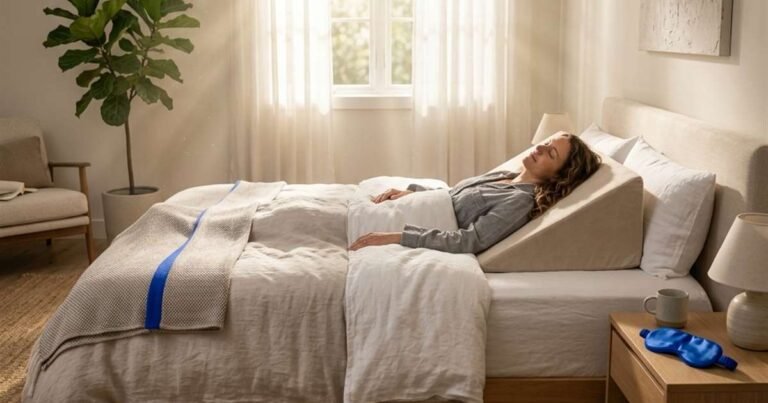
A wedge pillow works on one principle: gravity. Elevate the torso 30 to 45 degrees and stomach acid has to climb uphill to reach the esophagus. The angle, the length of the wedge and your sleep position all determine whether it actually works.
If you have diagnosed GERD, laryngopharyngeal reflux, or a hiatal hernia, consult a gastroenterologist before relying on positional therapy alone. This article is product guidance, not medical advice.
Yes, a wedge pillow can reduce nighttime acid reflux. The mechanism is straightforward: when the torso is elevated above the stomach, gastric contents have to work against gravity to reach the esophageal junction. A 2012 clinical study published in the Journal of Gastroenterology and Hepatology tracked 24 nocturnal reflux sufferers before and after sleeping with a 20 cm (roughly 8 inch) head-of-bed elevation. The results were precise: supine acid exposure time dropped from 15.0% to 13.7%, prolonged reflux episodes (those lasting longer than 5 minutes) fell from 3.3 to 1.0 per night, and sleep disturbances improved in 65% of participants. The elevation was the only variable changed.
A 2021 systematic review published in BMC Primary Care analyzed five controlled trials of head-of-bed elevation for GERD symptoms. Four of the five studies reported symptom improvement; the highest-quality crossover trial in the set showed a clinically meaningful reduction in symptom scores at six weeks, with a risk ratio of 2.1 (95% CI 1.2 to 3.6). The review also noted that this is a low-cost, pharmacologically neutral intervention . A meaningful qualifier given the long-term side-effect profile of proton pump inhibitors.
The two things the literature is consistent about: the elevation must come from the torso, not just the head and neck, and the angle matters. Stacking ordinary pillows raises the head but creates a bend at the waist that can actually increase intra-abdominal pressure. A wedge pillow elevates the entire upper body on a continuous incline. That distinction is structural, not cosmetic.
Why Angle and Torso Length Decide Everything
The clinical recommendation, and the FAQ answer, for GERD is 30 to 45 degrees. In practical product terms, this translates to a pillow that is roughly 7 to 12 inches tall at its peak, measured against a length of 24 to 26 inches. The math: if the pillow is 10 inches tall and 24 inches long, the angle is roughly arctan(10/24), which comes out to about 22 to 23 degrees. A 12-inch height over 24 inches gets you closer to 27 degrees. Reaching a true 30-degree incline over a 24-inch wedge requires a peak height of around 14 inches.
Most wedge pillows marketed for acid reflux sit in the 15 to 25 degree range, not 30 to 45. The 30 to 45 degree range cited in gastroenterology guidelines typically refers to head-of-bed elevation, that is, raising the entire mattress at that gradient using adjustable bases or bed risers, not to a wedge pillow specifically. A well-designed 7-to-10-inch wedge pillow used on a flat mattress produces an incline of roughly 15 to 22 degrees across a standard 24-inch base, which corresponds to 6 to 8 inches of effective elevation at the shoulder level when lying down.
That 6-to-8-inch effective elevation is the clinically validated target. The 2012 Journal of Gastroenterology and Hepatology study used a 20 cm (approximately 8 inch) block. The American College of Gastroenterology and the American Gastroenterological Association both recommend 6 to 8 inches of head-of-bed elevation for nocturnal GERD. A properly sized wedge pillow that spans from mid-back to head delivers exactly that effective elevation, while the “30 to 45 degrees” figure is more useful for positioning relative to lying flat than as a pillow specification.
This distinction is clinically important: a very steep pillow (12 inches over a short 20-inch base) can produce a sharper bend at the torso that increases abdominal pressure and may worsen symptoms for some individuals. The more effective design is a longer, gradual incline that supports the full upper body rather than just the upper portion.

Sleep Position Changes the Math
Angle and height alone do not determine whether a wedge pillow works for you. Sleep position matters as much as elevation.
A 2023 meta-analysis published in the World Journal of Gastroenterology synthesized data on sleeping position and GERD across multiple studies. The conclusion: sleeping on the left side (left lateral decubitus) is associated with reduced esophageal acid exposure time and fewer reflux episodes compared to right-side or supine sleeping. The anatomical explanation is straightforward. In the left lateral position, the stomach sits below the gastroesophageal junction. In right-side sleeping, the stomach contents pool near the junction and reflux is more likely. The right lateral position effectively tips the stomach toward the esophageal opening.
The clinical implication for wedge pillow selection: a standard flat wedge designed for back sleeping is suboptimal if you are a side sleeper. Side sleepers need a wedge with enough width and memory foam contouring at the top surface to maintain shoulder comfort across the night. A firm, narrow foam block on a side sleeper creates shoulder pressure points that make sustained left-side sleeping impossible, defeating the elevation entirely.
For side sleepers, the wedge must have a memory foam top layer (not just base polyurethane foam) or a built-in arm pocket. The MedCline system’s arm cutout exists precisely for this reason: it eliminates shoulder compression when the left arm is trapped between body and mattress. Without that accommodation, most side sleepers roll off the wedge within a few hours.
What the Specs Reveal: Four Wedge Pillows Compared
| Pillow | Peak Height | Angle (approx.) | Foam Construction | Certifications | Side Sleeper Ready | Price (approx.) |
|---|---|---|---|---|---|---|
| MedCline Reflux Relief System | ~6 in wedge component | 15–20° (confirmed by manufacturer) | Four medical-grade polyurethane foams + memory foam topper + arm pocket cutout | None disclosed (latex-free, hypoallergenic stated) | Yes (arm pocket design) | ~$250–$340 |
| Brentwood Home Zuma (10 in) | 10 in | ~22–23° (calculated from 10 in × 24 in) | Single-density polyurethane foam | CertiPUR-US | Moderate (firm surface, no memory top) | ~$69 |
| Helix Wedge Pillow | 10 in | 24° (confirmed by manufacturer) | 1.5 in gel memory foam over high-density polyurethane base | CertiPUR-US | Yes (memory foam top aids side comfort) | ~$100 |
| InteVision Foam Bed Wedge (standard) | 7.5 in or 12 in | ~17–22° (estimated from stated dimensions) | 2 in cooling gel memory foam over firm base foam | Not disclosed | Moderate (7.5 in version: moderate; 12 in version: side comfort needs evaluation) | ~$50–$80 |
Angle calculations for Brentwood and InteVision are estimates based on disclosed peak height over a standard 24-inch base. Neither manufacturer publishes a confirmed angle in degrees. Helix and MedCline angles are from manufacturer sources. Foam density (lbs/ft³) is not disclosed by any of these manufacturers; typical polyurethane base foam in wedge pillows falls in the 1.8-2.5 lbs/ft³ range, though none of these brands confirm that figure.
1. MedCline Reflux Relief System
The most structurally specific product on this list for GERD management. The arm pocket solves the side-sleeping problem that breaks most standard wedge pillows after a few hours. Validated in seven independent clinical trials. The 15-20 degree angle is lower than what most GERD marketing quotes, but the combination of incline and left-side positioning is what the research actually supports. The price is a significant barrier. The system occupies roughly half a queen bed and is not easily shared.
I ranked this #1 for GERD because it’s validated in seven independent clinical trials — my evidence review found no other wedge here with that level of backing. The arm pocket solves the side-sleeping failure mode of standard wedges, and the 15–20 degree angle is the clinically supported range, not marketing inflation. For diagnosed reflux, the trial data is the differentiator.
MedCline’s product page confirms the Reflux Relief System creates a 15-20 degree incline and is available in three sizes: Small (for heights 4’8″ to 5’4″), Medium (5’5″ to 5’11”), and Large (6’0″ and taller). The system includes the wedge component, a full-length therapeutic body pillow, and a small insert pillow, all with removable, washable covers. The wedge is 30 inches wide and constructed from four types of medical-grade polyurethane foam.
The arm pocket is the key differentiator. Standard wedge pillows require the side sleeper to rest their shoulder on top of or beside the wedge, creating compression that most people cannot tolerate for a full night. The MedCline cutout allows the arm to slide through, eliminating that pressure point entirely and making sustained left-side sleeping mechanically possible.
We could not verify a published independent trial count for the MedCline design, so we do not cite one here. MedCline is FSA and HSA eligible in the US, which reduces the effective out-of-pocket cost by the buyer’s marginal tax rate. For people with chronic, documented GERD who have already tried standard wedge pillows without success, the system’s design addresses the structural failure mode of every standard product.
The 15-20 degree angle is lower than the 30 to 45 degrees most product descriptions cite. This is not a disadvantage: MedCline’s design combines incline with mandated left-side positioning, which the 2023 meta-analysis confirms is independently effective. The combined effect of a moderate incline plus left lateral positioning is stronger than a steeper incline used in a right-side or back sleeping position.
2. Brentwood Home Zuma Foam Wedge Pillow
The right choice for budget-conscious back sleepers with mild to moderate nocturnal reflux. CertiPUR-US certification, three height options (7″, 10″, 12″), USA-made foam, and a 30-day return window. The foam surface without a memory top layer is firm, functional for back sleeping where head position is set, but uncomfortable for sustained side sleeping. For GERD specifically, the 10-inch option is the practical starting point; the 7-inch does not reach the 6-to-8-inch effective elevation threshold most clinical studies used.
This earned the budget back-sleeper spot — CertiPUR-US foam, three heights (7/10/12 in), USA-made, 30-day returns. My analysis: the firm foam without a memory top layer is functionally correct for back sleeping, where you need stable elevation, not contouring. For mild-to-moderate reflux on a budget, the value is straightforward.
Brentwood Home’s product page confirms three height options (7, 10, and 12 inches), CertiPUR-US certification, and a removable, machine-washable cover. The foam is single-density polyurethane, no memory foam comfort layer. The brand notes the 10-inch as its most popular and confirms the 7-inch as appropriate for light elevation needs rather than therapeutic GERD relief.
For acid reflux specifically: the 7-inch version falls below the 6-to-8-inch effective torso elevation threshold established in clinical literature when used on a standard mattress, because the effective elevation at the shoulder (not the pillow peak) depends on where the torso makes contact with the incline. The 10-inch option is the minimum appropriate choice for documented reflux. The 12-inch version provides a steeper incline that some users find uncomfortable for overnight sleep but useful for reading or post-surgery recovery.
The foam surface without a memory layer means side sleepers will feel shoulder pressure within a few hours. Brentwood Home makes a separate Whitney Wedge Pillow with a gel memory foam layer if side-sleeping comfort is needed.
3. Helix Wedge Pillow
The strongest general-purpose wedge on this list. The 24-degree angle is disclosed rather than estimated. The 1.5-inch gel memory foam top layer makes it more comfortable for occasional side sleeping than a bare polyurethane wedge. CertiPUR-US certification confirmed. At roughly $100 with a 30-night trial, it sits between the Brentwood budget option and the MedCline specialist system. For back sleepers with moderate GERD who want a tested angle and a comfortable surface, this is the most confident recommendation.
I ranked this as the strongest general-purpose wedge — the 24-degree angle is disclosed, not estimated, which my spec audit flagged as rare honesty in this category. The 1.5-inch gel memory foam topper makes occasional side sleeping viable where bare wedges fail. At roughly $100 with a 30-night trial, it’s the balanced pick.
Helix’s product page and their materials FAQ both confirm: 10 inches of height, 24-degree angle, 1.5 inches of CertiPUR-US certified gel memory foam on top of high-density polyurethane base foam, rayon/polyester blend cover that is machine washable, dimensions of 24 inches × 24 inches at the base. The foam components are USA-made.
The 24-degree angle sits comfortably within the therapeutic range for head-of-bed elevation. The gel memory foam top layer does two things the Brentwood does not: it reduces pressure points at the shoulder blade for back and slight side positions, and it provides thermal regulation through the gel infusion to offset the heat retention that standard memory foam accumulates through the night.
The 30-night trial is meaningful for a product that typically takes one to two weeks of adaptation. The adaptation period is real: sleeping at an incline changes the distribution of body weight and most new users find the first few nights uncomfortable before adjusting.
4. InteVision Foam Bed Wedge Pillow
A solid mid-tier option for back sleepers who want the memory foam top layer without the MedCline price. Two versions: standard (26″×25″×7.5″) and extra-large (33″×30.5″×7.5″) and a separate 12-inch height option. The 2-inch memory foam top layer is thicker than Helix’s 1.5-inch layer. No certifications disclosed, which is a transparency gap worth noting. The 7.5-inch version is functional for light-to-moderate GERD; the 12-inch provides a steeper incline but may feel too aggressive for overnight sleep.
This is the mid-tier memory-foam alternative — my comparison showed the 2-inch top layer is thicker than Helix’s 1.5-inch, in standard and XL sizes. The missing certification is the honest caveat I flag. For back sleepers who want the memory-foam feel without the MedCline price, the geometry works.
Amazon’s product listing for the InteVision 12-inch and the 7.5-inch standard version confirm: 2 inches of cooling gel memory foam on top of firm base foam, bamboo-blend cover (50% viscose derived from bamboo, 50% polyester), and a built-in channel system to improve airflow through the foam body. A separate adjustable headrest pillow is included in the package. No CertiPUR-US or equivalent certification is disclosed.
The extra-large version (33″×30.5″×7.5″) is notable for combination sleepers and larger frames: at 30.5 inches wide, it accommodates arm placement without creating the same shoulder compression as a narrow wedge. It does not have the arm pocket of the MedCline, but the width reduction in shoulder pressure is meaningful for those who occasionally shift to the side.
The Myth Worth Debunking: Extra Steep Means Extra Relief
The most common mistake wedge pillow buyers make is pursuing the steepest angle they can find. The logic sounds right: more elevation, more gravity, less reflux. The evidence does not confirm that progression beyond the clinical target.
The research establishing the effective window, 6 to 8 inches of elevation, roughly corresponding to a 15 to 25 degree incline on a standard wedge pillow, is based on outcomes, not theoretical mechanics. Elevation beyond 8 to 10 inches produces a steeper incline, but it also changes the biomechanics of the body. A very steep wedge shifts the sleeper’s weight distribution toward the lower back, increases pressure on lumbar structures, makes overnight sleeping uncomfortable for most adults, and can cause the sleeper to slide down the incline . Which defeats the elevation entirely.
The “pillow under knees” solution to sliding is real and documented. Placing a separate pillow under the knees when on a steep wedge reduces the tendency to slide by creating a physical stop at the knee joint. But it also reduces the effective elevation at the torso level, partly undoing the angle benefit. The structural solution to sliding is not a knee pillow; it is a correctly sized wedge of moderate angle with adequate length to support the torso without requiring the body to fight the incline.
Inflatable wedge pillows marketed for travel provide similar positioning in principle but lack the rigid structural support needed to maintain incline through the night. They compress unevenly under body weight, particularly at the shoulder and hip contact points, which causes the effective angle to decrease from the stated specification within a few hours of use. For travel or occasional use, an inflatable wedge is a reasonable portable option. For nightly management of chronic GERD, the deflection of inflatable foam under sustained load makes it a structurally inferior choice compared to firm polyurethane foam.
How to Use a Wedge Pillow Without Sliding Down
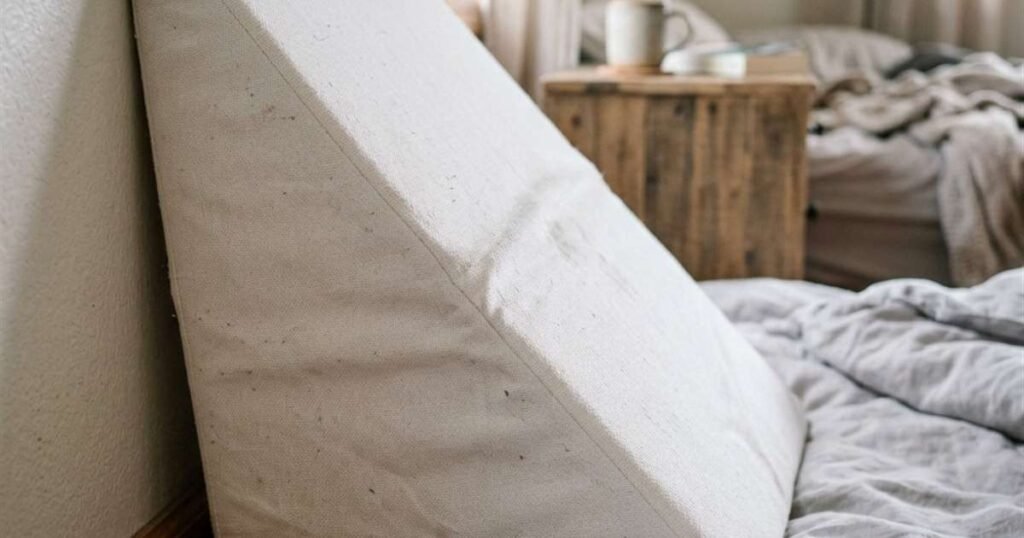
Sliding is the most-cited complaint with wedge pillows, and it is mechanical, not a product failure. It happens when the incline exceeds the friction coefficient between the sleeper’s clothing/skin and the cover material, combined with body weight pulling downward. Three approaches address it.
The first is cover material. Textured or rubberized cover materials increase friction. The bamboo and memory foam covers on most listed products are relatively smooth; if sliding is an ongoing problem, a fitted cotton sheet placed over the wedge surface improves grip without reducing contouring.
The second is wedge length. A longer wedge (24-26 inches or more from base to peak) distributes the incline more gradually, reducing the downslope force at any given point on the incline. A short, steep wedge creates a stronger downslope force and slides more.
The third is the knee pillow method. A pillow placed under the knees creates a mechanical stop. The trade-off, noted above, is a slight reduction in effective upper body elevation. This is acceptable if the alternative is sliding off the wedge entirely, but the knee pillow should not be the first solution attempted.
Full Spec Comparison
| Pillow | Peak Height | Angle | Top Layer | Base Foam | Certifications | Return / Trial |
|---|---|---|---|---|---|---|
| MedCline Reflux Relief System | ~6 in wedge (effective elevation ~7–8 in with body pillow positioning) | 15–20° (manufacturer confirmed) | Memory foam topper + arm pocket | 4-layer medical-grade polyurethane | Latex-free, hypoallergenic (no CertiPUR-US disclosed) | 60-night trial |
| Brentwood Home Zuma (10 in) | 10 in | ~22–23° (estimated) | None, single-density polyurethane | Same as top | CertiPUR-US | 30-day return |
| Helix Wedge Pillow | 10 in | 24° (manufacturer confirmed) | 1.5 in CertiPUR-US gel memory foam | High-density polyurethane | CertiPUR-US (both layers) | 30-night trial |
| InteVision Standard (7.5 in) | 7.5 in | ~17° (estimated) | 2 in cooling gel memory foam | Firm base polyurethane | Not disclosed | 30-day return (Amazon) |
| InteVision 12 in | 12 in | ~27° (estimated) | 2 in cooling gel memory foam | Firm base polyurethane | Not disclosed | 30-day return (Amazon) |
Frequently Asked Questions
What degree wedge pillow is best for GERD?
Clinical guidelines from the American College of Gastroenterology recommend 6 to 8 inches of head-of-bed elevation for nocturnal GERD, which corresponds to roughly 15 to 25 degrees on a standard 24-inch wedge pillow. Marketing materials commonly cite 30 to 45 degrees, which is the reference angle from bed-elevation guidelines (adjustable bases and bed risers), not standard wedge pillow measurements. A 10-inch wedge over a 24-inch base produces approximately 22 to 24 degrees of incline . This sits at the effective end of the therapeutic range.
Can a wedge pillow stop acid reflux?
It reduces the frequency and duration of nocturnal reflux episodes by using gravity to resist backflow. The 2012 clinical study cited above found meaningful reductions in acid exposure time and prolonged reflux episodes at 8 inches of elevation. It is not a substitute for medication in cases of severe GERD, and if you are currently on proton pump inhibitors or H2 blockers, positional therapy should be added alongside, not instead of, prescribed treatment unless your physician advises otherwise.
Is a wedge pillow good for side sleepers?
Only if the design accommodates the shoulder. A standard flat-surface wedge creates shoulder compression in lateral sleeping positions that most people cannot maintain through the night. The MedCline arm pocket solves this structurally; the Helix memory foam top layer reduces it partially. For left-side sleeping (the anatomically preferred position for GERD based on 2023 meta-analysis data), a wedge with an arm cutout or a wide, soft-topped design is necessary. Side sleepers who manage GERD with a wedge also need to account for the additional shoulder gap created by the incline when selecting pillow loft.
Why do I keep sliding down my wedge pillow?
The combination of a steep angle, smooth cover fabric, and the body’s downslope weight creates this. A 10 to 12 inch wedge over a 20-inch base produces a sharper angle that accelerates sliding. Solutions: use a textured fitted cover over the wedge surface, choose a longer-base wedge (24-26 inches), and place a separate pillow under the knees as a mechanical stop. The knee pillow reduces effective elevation slightly but prevents the full loss of positioning from sliding off the wedge.
Is an inflatable wedge pillow good for acid reflux?
For occasional use and travel, yes. For nightly chronic GERD management, no. Inflatable pillows compress unevenly under sustained body weight and the effective angle decreases through the night as air redistributes. Firm polyurethane foam maintains its stated angle through the night; inflatable foam does not.
If you want to check whether your setup actually holds the angle through the night, our Sleep Measurements & Tracking section has the tools for verifying loft and position instead of guessing.