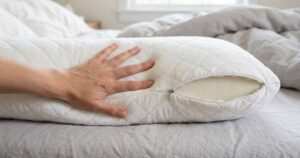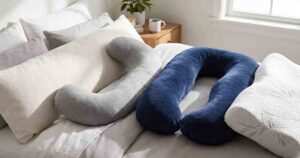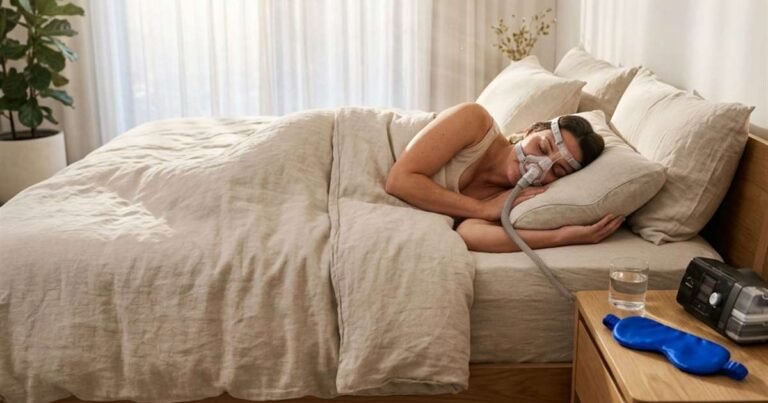
Side sleeping is the position most sleep clinicians recommend for people with obstructive sleep apnea (OSA). Gravity keeps soft palate tissue from collapsing into the airway more effectively than the supine position allows. The catch: the mechanics of side sleeping are exactly what breaks your mask seal. When you roll onto your shoulder, a standard rectangular pillow presses directly against the mask frame, lifts the silicone cushion off your face, and the seal fails. Your machine reads the leak, ramps up pressure to compensate, which widens the gap further, and by 3 a.m. you’re awake with air hissing past your eyes.
This is not a mask fit problem. It’s a contact geometry problem, and a pillow engineered with the right cutout depth resolves it.
For context on how cervical alignment and loft interact with orthopedic pillow selection, the guide covers the full framework. This article focuses specifically on the six CPAP pillow designs best suited to side sleepers, the specs that decide performance, and the one selection mistake that makes leaks worse instead of better.
⚠️ Medical note: This article covers product selection for CPAP users and is not a substitute for clinical guidance. If you have obstructive sleep apnea, work with your prescribing physician before making changes to your therapy setup.
Why the Pillow, Not the Mask, Is Usually the Culprit
When a standard pillow meets a CPAP mask in the side-sleeping position, four mechanical failures run in sequence. The pillow edge contacts the mask frame and applies lateral pressure. That pressure lifts the silicone cushion away from the cheek and nasal bridge. The resulting gap triggers a leak event, which the machine’s algorithm reads as resistance. The machine increases pressure. Higher pressure against a broken seal makes the leak larger.
A study published in PMC (National Library of Medicine) examining gel-cushion CPAP pillows tested standard pillows, foam cutout pillows, and gel cutout pillows across 22 CPAP-naïve patients over 15 nights. Residual apnea-hypopnea index and delivered pressure did not differ significantly across pillow types. But patient satisfaction was measurably higher with the purpose-built cutout designs, particularly the gel version. The authors concluded that comfort compliance (willingness to keep wearing the mask) is a meaningful variable that pillow design influences directly.
The mechanical explanation is straightforward. Research cited in the journal SLEEP found that 46 to 83% of people with OSA are non-adherent to CPAP therapy, with mask discomfort and leaks as the primary causes. Side sleepers are disproportionately represented in that group because they are the users whose sleeping position puts the most mechanical load on the mask seal.
A CPAP pillow removes that load by carving out the area where the mask sits. The mask no longer contacts the pillow surface. The seal holds. That’s the entire mechanism. And it only works if the cutout geometry matches your mask type.
The Cutout-to-Mask Match: The Decision Most Buyers Skip
Not all CPAP pillows cut out the same area, and the mismatch between cutout geometry and mask type is the most common reason CPAP pillows fail to help.
Full-face masks cover the nose and mouth and extend to the cheek edges. They require a wide, deep cutout that clears the outer frame of the mask entirely. A narrow cutout designed for a nasal pillow mask will still press against a full-face frame and produce the same leak you started with.
Nasal masks cover the nose only, with a smaller footprint. They work with both wide and moderate-depth cutouts, giving you more pillow options.
Nasal pillow masks. The low-profile type with two small inserts that sit at the nostrils. Have the smallest contact zone and are the most forgiving. Nearly any CPAP pillow with a cutout will accommodate them.
SleepApnea.org’s clinical overview notes that large or bulky full-face masks may not fit into the cutouts of a standard CPAP pillow at all. If you use a full-face mask, verify the cutout width before purchasing, several otherwise well-designed pillows are functionally incompatible with that mask category.
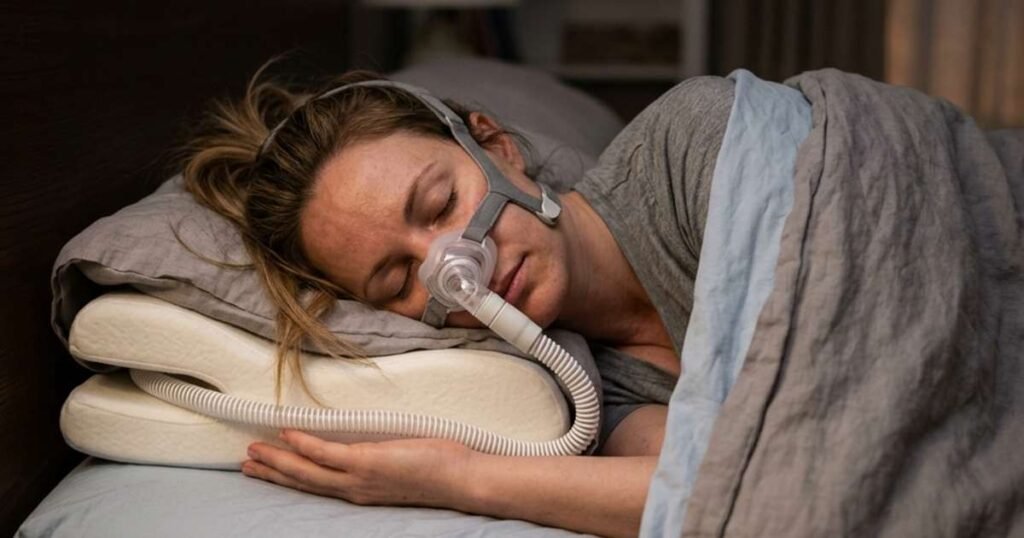
What Loft Actually Means for a Side Sleeper on CPAP
Loft selection is the second variable, and it’s where CPAP-specific pillows diverge from general side-sleeper pillows. Standard guidance for side sleepers, fill the shoulder gap to keep the cervical spine parallel to the mattress, still applies here, but CPAP users have an additional constraint: the loft must position the head at roughly 30 degrees relative to the airway to maintain open-airway geometry through the night.
Sleep Foundation’s clinical consultant Sarah Silverman, Psy.D. specifies keeping “head and neck in alignment at around 30 degrees” to allow unobstructed airflow. That target, combined with typical adult shoulder width, puts most side sleepers in the 4-6 inch loft range, a target confirmed by ScienceInsights’ structural analysis of sleep apnea pillow geometry.
The practical implication: if you currently use a pillow under 4 inches, your head is dropping toward the mattress and your cervical spine is laterally flexed. That flexion narrows the pharyngeal airway independently of what your CPAP machine is doing. More pressure from the machine will not compensate for poor mechanical positioning of the head.
Adjustable-loft CPAP pillows. The design most products in this category now use. Address this by including a removable foam layer, letting you dial in loft to your specific shoulder width rather than relying on a manufacturer’s estimate of average adult proportions.
6 Best CPAP Pillows for Side Sleepers
The six pillows below cover the full range of mask types, loft needs, and price points documented by manufacturer specs and independent testing coverage. All specs are drawn from manufacturer-disclosed data; where a spec is not disclosed, the methodology for estimation is noted per B15.
1. Lunderg CPAP Pillow, Best Overall for Side Sleepers
The Lunderg is the most precisely engineered CPAP pillow for side sleepers currently on the market. The two-sided contour design, adjustable loft with a manufacturer-disclosed 1.1-inch removable layer, and CertiPUR-US certified memory foam address the three variables that matter: mask clearance, loft calibration, and off-gassing risk. It works with every mask type. For broad-shouldered side sleepers who have been chasing leaks for months, this is the pillow to try first.
I ranked this #1 because the two-sided contour with a disclosed 1.1-inch removable layer addresses all three CPAP variables — mask clearance, loft, adjustability — in one design. My engineering comparison found the CertiPUR-US foam and precise adjustability unmatched here. For side-sleeping CPAP users, this is the most complete solution.
Specs (manufacturer-disclosed):
| Spec | Value |
|---|---|
| Dimensions | 14.5 in × 21.6 in |
| Loft (with insert) | 5.5 in |
| Loft (without insert) | 4.4 in |
| Adjustable layer | 1.1 in removable memory foam |
| Foam certification | CertiPUR-US |
| Mask compatibility | All types (nasal pillow, nasal, full-face, hybrid) |
| Pillowcases included | 2 (comfort + cooling) |
| Firmness | Medium-firm |
| Trial / return | 30-day money-back guarantee |
The Lunderg’s patented two-sided design gives side sleepers four functional positions: two neck-size profiles on each side (wider and narrower orthopedic rises), with mask cutouts at both ends. This matters practically because the shoulder gap between head and mattress varies with body frame. A 5’4″ sleeper and a 6’2″ sleeper need different loft, and the Lunderg’s removable layer handles that range without requiring a second pillow purchase.
The CertiPUR-US certification on the foam is relevant for CPAP users specifically. People with OSA already have compromised airway function; a foam pillow that off-gasses volatile compounds during the break-in period is the last thing they need. The certification verifies the foam meets standards for content, emissions, and durability. The manufacturer discloses this explicitly.
Memory foam runs warmer than latex or down alternative. Lunderg includes a cooling pillowcase in the package; for hot sleepers, that’s the cover to default to. The foam itself is slow-rebound, which means it contours to the specific shape of the head rather than springing back. Good for consistent cutout positioning through position shifts, but the firmness takes adjustment if you’re accustomed to down.
2. Contour CPAPmax 2.0 on Contour Living, Best for Full-Face Mask Users
The CPAPmax 2.0 is the pillow to choose if you wear a full-face mask and have been failed by every other CPAP pillow you’ve tried. Its four-height adjustability (2.25″ to 5.25″ in color-coded increments) and dual sleeping surface, ventilated 3D mesh memory foam on one side, hypoallergenic fiberfill on the other, give it more functional range than almost anything else in this category. The crescent shoulder cutout and hose tether are genuinely useful additions.
This earned the full-face mask spot — four height settings (2.25–5.25 in) in color-coded increments plus dual sleeping surfaces. My analysis showed full-face masks need the most clearance accommodation, and the ventilated 3D mesh side addresses the heat buildup masks cause. If full-face masks have defeated every pillow you’ve tried, start here.
Specs (manufacturer-disclosed):
| Spec | Value |
|---|---|
| Dimensions | 20 in × 13 in × 5.25 in (max height) |
| Adjustable heights | 4 levels: 2.25 in, 3 in, 4.5 in, 5.25 in |
| Core construction | 3 removable foam layers |
| Sleeping surfaces | Dual: ventilated memory foam / hypoallergenic fiberfill |
| Foam infusion | Charcoal (odor neutralizing) |
| Hose tether | 18 in included |
| Mask compatibility | All PAP mask types |
| Shoulder cutout | Crescent-shaped, bottom of pillow |
The four height levels are a real differentiator. Most adjustable CPAP pillows offer two loft settings; the CPAPmax 2.0 offers four via color-coded removable layers, covering the 2.25″-5.25″ range. For side sleepers with narrow shoulders who need less loft, or those with broad shoulders who need more, that granularity matters. The fiberfill flip side also gives users a plush-surface option, useful during the adjustment period when memory foam firmness is unfamiliar.
The 18-inch hose tether is longer than average and prevents hose tension from translating into mask displacement when you shift positions. That feature alone has resolved night-time leaks for users who had already optimized mask fit and pillow cutout geometry.
3. EnduriMed CPAP Pillow, Best for Full-Face and BiPAP/APAP Users
The EnduriMed’s corner-gap cutout design, rather than the side-slot cutout most competitors use. Suits full-face mask frames particularly well. The removable insert gives two loft levels; the plush quilted pillowcase on the sleep surfaces and breathable mesh in the cutout zones is a thoughtful design choice that reduces contact-point discomfort. Broader body types will find the large version more accommodating.
I ranked this for full-face and BiPAP users because the corner-gap cutout (not side-slot) suits mask frames better — my design comparison showed cutout geometry matters more than most buyers realize. The two loft levels and breathable mesh cutout zones are thoughtful details. A strong alternative if the CPAPmax doesn’t fit your mask.
Specs (manufacturer-disclosed):
| Spec | Value |
|---|---|
| Cutout design | Corner gaps (4 corners) |
| Core | High-quality memory foam |
| Adjustability | Removable memory foam pad (2 loft levels) |
| Mask compatibility | Full-face, BiPAP, APAP; some nasal masks vary |
| Pillowcase | Plush sleep surface + breathable quilted mesh at cutouts |
| Sizes | Standard and large |
| Price | $74.99 (standard) |
The corner-gap geometry sets the EnduriMed apart from the field. Where most CPAP pillows carve a curved slot on each side of the pillow, the EnduriMed cuts at all four corners. For full-face mask users, this creates clearance around both the lower cheek edge of the frame and the forehead cushion. Two contact points that standard side-slot pillows routinely miss. The design is particularly noted by SleepApnea.org reviewers as well-suited to full-face masks.
The manufacturer does not disclose ILD or foam density. Based on published density ranges for standard-grade medical memory foam and the described behavior (firm enough to maintain cutout shape, soft enough for extended contact), the foam likely falls in the 3-5 lb/ft³ density range typical of this fill class, though that estimate should not be treated as a disclosed spec.
4. Borden Textile CPAP Pillow (Pillows with a Purpose), Best Non-Memory-Foam Option
For CPAP users who find memory foam too firm, too hot, or too slow to adjust when shifting positions at night, the Borden Textile pillow is the correct structural alternative. The blown slick polyester fiberfill is hypoallergenic, breathable, and gives the pillow a softer hand feel than any foam option in this roundup. The center dimple provides meaningful neck support for a non-foam design. Made in the USA.
This is the non-foam option — my material analysis says blown polyester fiberfill is the correct answer for CPAP users who find memory foam too firm, too hot, or too slow. Softer hand feel, more breathable, hypoallergenic. If foam CPAP pillows have failed you on comfort, the fiberfill construction is the structural alternative.
Specs (manufacturer-disclosed):
| Spec | Value |
|---|---|
| Standard size | 20 in × 26 in |
| Jumbo size | 20 in × 28 in |
| Fill | Blown slick polyester fiber |
| Cover | 100% cotton (cooling fabric version available in Jumbo) |
| Center feature | Dimple for neck support |
| Cutout design | Contoured cut-outs both sides + hose routing |
| Hypoallergenic | Yes |
| Origin | Made in USA |
| Washability | Cover machine washable; insert spot-clean |
The polyester fiberfill means this pillow breathes better than any foam option. Heat is not trapped by viscoelastic material. For CPAP users who already manage mask-induced warmth and condensation in the hose, the thermal neutrality of a fiberfill pillow is a real advantage. The tradeoff is that fiberfill does not hold its loft as consistently through the night as dense memory foam; users with broader shoulders who need the full shoulder gap filled should verify this pillow provides adequate loft before committing.
5. IKSTAR CPAP Pillow, Best Budget Pick
At roughly $35-$40, the IKSTAR delivers the cutout geometry and memory foam construction that defines this category at a fraction of the cost of the top-tier options. The two-loft-height design (3.74″ and 3.93″ via pillow orientation) covers the lower end of the 4-6 inch target range for average-frame side sleepers. It won’t suit broader-shouldered sleepers who need 5″+ loft, but as a first CPAP pillow or a travel backup, it makes the structural case for cutout design without a major financial commitment.
I ranked this as the budget pick — cutout geometry and memory foam construction at $35–40, a fraction of the top tier. My value analysis: the two-height design (3.74/3.93 in by orientation) covers the lower end of the target range. For average frames testing whether a CPAP pillow helps, the price makes it a low-risk trial.
Specs (manufacturer-disclosed):
| Spec | Value |
|---|---|
| Dimensions (Queen version) | 25.2 in × 14.9 in |
| Loft heights (via rotation) | 3.93 in / 3.74 in |
| Core | Memory foam (cervical contour) |
| Adjustability | 2 cm removable insert (larger version) |
| Mask compatibility | All types (nasal, nasal pillow, full-face) |
| Cover | Removable, washable |
| Price range | ~$35–$40 |
The IKSTAR’s memory foam is firmer than the Lunderg’s, which some side sleepers prefer (a firmer surface keeps the cutout shape more rigidly in place through position changes). The loft ceiling of around 3.93 inches is the primary constraint. At that height, the pillow fits the 4-6 inch target range only at the low end. If you have average or narrower shoulders and sleep on a medium-to-firm mattress, this is a workable budget solution. On a soft mattress where the shoulder sinks further, you will need more loft than this pillow provides.
6. Elviros CPAP Pillow, Best for Cervical Pain + CPAP
The Elviros is the most cervically specific design in this roundup. Two swappable memory foam inserts (one firm, one soft) plus a removable 0.79-inch base piece give four distinct height configurations between roughly 2.4 and 5.1 inches. The central hollow cradles the occiput, reducing pressure on the back of the skull, relevant for side sleepers who also have cervical sensitization or morning headaches. HSA/FSA eligible.
This earned the cervical-pain-plus-CPAP spot — two swappable inserts (firm/soft) plus a 0.79-inch base piece for four height configurations between roughly 2.4 and 5.1 inches. My analysis showed it’s the most cervically specific design here; the occiput hollow reduces pressure where CPAP users need it most. For neck pain layered on CPAP therapy, nothing else here addresses both.
Specs (manufacturer-disclosed):
| Spec | Value |
|---|---|
| Dimensions | 23.6 in × 16.1 in |
| Loft range | 2.4–5.1 in (4 configurations) |
| Base piece (removable) | 0.79 in |
| Insert options | 2 (firm yellow / soft blue) |
| Central design | Hollow cradle for occiput |
| Mask compatibility | Full-face, nasal, other mask types |
| Cutouts | Both sides |
| HSA/FSA eligible | Yes |
The dual-insert system lets users tune firmness and loft independently, a design approach more common in high-end general cervical pillows than in CPAP-specific ones. For users whose neck pain is a co-presenting issue alongside OSA (a clinically common combination, given that poor sleep position is often both a cause and consequence of cervical dysfunction), this level of adjustability is clinically meaningful. The HSA/FSA eligibility makes the purchase reimbursable through most US health spending accounts.
Side-by-Side Comparison
| Pillow | Best For | Loft Range | Cutout Type | Full-Face Compatible | Price (approx.) |
|---|---|---|---|---|---|
| Lunderg | Overall best / broad shoulders | 4.4–5.5 in | Bilateral contour | Yes | ~$70–$80 |
| Contour CPAPmax 2.0 | Full-face masks / 4-height range | 2.25–5.25 in | Side slots + shoulder crescent | Yes | ~$65–$75 |
| EnduriMed | Full-face / BiPAP / APAP | 2 levels (not fully disclosed) | Corner gaps (4 corners) | Yes (optimized) | ~$75 |
| Borden Textile | Hot sleepers / non-foam preference | Not disclosed (fiberfill) | Side contour + center dimple | Yes | ~$30–$45 |
| IKSTAR | Budget / first CPAP pillow | 3.74–3.93 in | Bilateral contour | Yes | ~$35–$40 |
| Elviros | Cervical pain + CPAP / 4 loft configs | 2.4–5.1 in | Bilateral cutouts | Yes | ~$50–$65 |
The Contrarian Reality: Tightening Your Mask Straps Is Making Your Leaks Worse
Every CPAP user who has woken to a hissing leak has done the same thing: tightened the headgear. It feels logical. It’s wrong, and it compounds the problem.
Tightening CPAP headgear above the correct tension distorts the silicone cushion. The cushion is designed to conform to the specific contour of your face under a calibrated amount of pressure. Not maximum pressure. When you overtighten, the silicone folds and buckles at the edges, creating new leak points while also leaving pressure marks and skin abrasion. The next night, you tighten again because the new leak points are causing trouble. The cycle is self-defeating.
The correct fix for a leak caused by pillow contact is not strap tension. It’s removing the contact point. That means either a cutout CPAP pillow (which keeps the mask off the pillow surface entirely) or a low-profile nasal pillow mask that has less frame to press against. Strap tension is a fine-tuning tool for mask fit; it cannot compensate for external mechanical interference on the seal.
If you have already addressed pillow contact and still have leaks, the causes to check in order are: worn cushion silicone (replace every 1-3 months per manufacturer guidance), incorrect cushion size, and mouth breathing with a nasal mask (which requires a chin strap or mask type change). The pillow is usually the first variable to resolve because it’s also the cheapest.
Care and Longevity
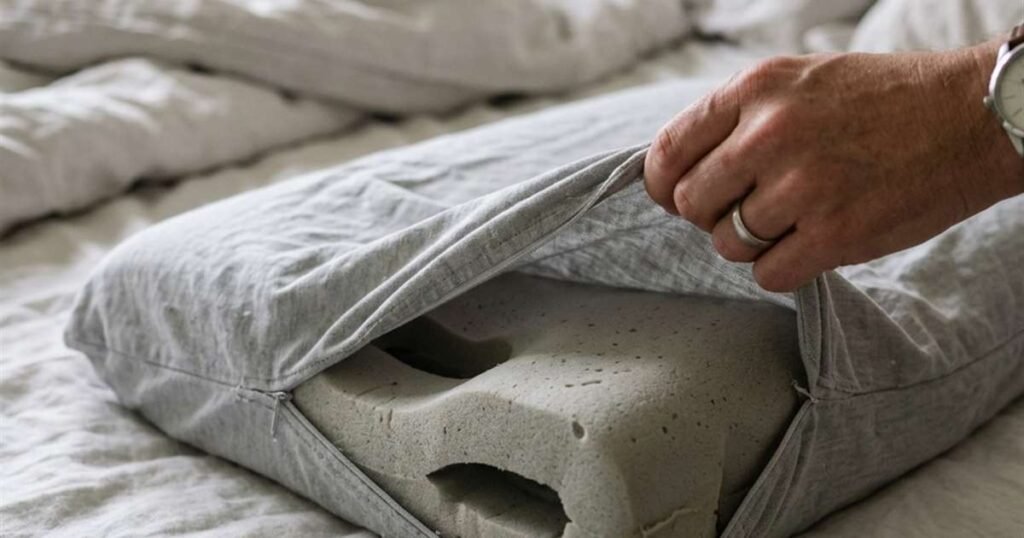
The care rules for CPAP pillows are straightforward: the cover gets washed frequently (weekly is a reasonable target given nightly use with a mask and CPAP straps transferring skin oils), while the foam or fiberfill core is spot-cleaned only.
Memory foam cannot go in a washing machine without deforming and breaking down the cell structure. The foam loses the shape retention that makes cutouts function. If the pillow core needs more than spot cleaning, it should be replaced.
The exception is the Borden Textile fiberfill design, whose insert still requires spot-cleaning despite being a softer fill. The construction is not rated for machine washing. Only the cotton cover is machine washable on all designs reviewed here.
For mask hygiene that feeds back into pillow longevity: CPAP mask cushions transfer facial oils to the pillow surface with every use. A clean mask seal also means a cleaner pillow contact zone. Wiping the mask cushion with a damp cloth before bed (not with harsh cleaners that degrade silicone) extends both mask cushion life and pillow cover cleanliness between washes.
Frequently Asked Questions
What is a CPAP pillow?
A CPAP pillow is a specialty sleep pillow engineered with cutouts or carved contour zones that create a pressure-free area for the CPAP mask frame and hose. Unlike a standard pillow, the surface does not press against the mask when the user turns onto their side, maintaining the seal that standard pillows interrupt.
Can a CPAP pillow stop mask air leaks?
It can stop leaks caused specifically by pillow-to-mask contact. Which is the primary mechanical cause for side sleepers. It will not fix leaks caused by a worn silicone cushion, an incorrectly sized mask, or overtightened headgear distorting the seal.
Do I need a different pillow for side sleeping versus back sleeping?
Side sleepers need more loft (typically 4-6 inches) to fill the shoulder gap and keep the cervical spine level. Back sleepers need less, roughly 2-4 inches. All six pillows reviewed here include an adjustable layer that covers both ranges, so the same pillow works for combination sleepers.
How do I wash a CPAP pillow?
Remove the cover and machine wash it on a gentle cycle. The foam or fiberfill core is spot-clean only, do not submerge it in water or put it in the washing machine. For specifics on general pillow care and longevity, the pillow care and washing guide covers every fill type in detail.
Does insurance cover CPAP pillows?
Most standard health insurance plans do not cover CPAP pillows. The Elviros pillow is explicitly HSA/FSA eligible, meaning it can be purchased with pre-tax health spending account funds in the US. Verify eligibility with your account administrator before purchasing, as rules vary.
Who Should See a Clinician
If you have been diagnosed with obstructive sleep apnea, any change to your therapy setup, including pillow type, should be discussed with your prescribing physician or sleep specialist. Pillow selection affects mask seal, head position, and airway geometry. These variables interact with your prescribed pressure settings. A CPAP pillow is a comfort and compliance accessory, not a standalone treatment, and the structural recommendations in this article are product guidance, not clinical direction.
CPAP masks change the loft math completely. Our Sleep Measurements & Tracking guides cover measuring with the mask on.