
Inflatable vs foam camping pillow: the answer depends on one number before anything else. How far are you carrying it? Everything else in this comparison is downstream of weight, because every other variable, sleep position, temperature, noise sensitivity, determines only which of the two categories fits the trip. The weight budget determines whether the category is viable at all.
This article puts both fill types through the same five decision criteria so the comparison lands on your actual trip, not on a spec sheet. For specific product recommendations in each category, the compressible backpacking pillow guide covers the top five picks with full spec tables. The full camping pillow hub covers car camping foam options.
The Core Trade-Off in One Table
| Criterion | Foam | Inflatable | Hybrid (foam/down over air bladder) |
|---|---|---|---|
| Weight | 8-12 oz | 2-4 oz | 3-5 oz |
| Packed size | Fist to grapefruit | Lime to tennis ball | Lime to soda can |
| Comfort (sleep surface) | Closest to home pillow | Varies: cold and noisy if bare TPU | Best of both, insulation layer eliminates bare-bladder problems |
| Loft adjustability | Cinch cord only (coarse) | Micro-adjustable valve | Micro-adjustable valve |
| Cold-surface issue | None | Yes, bare TPU cold at altitude | Minimal, insulation layer buffers the bladder |
| Crinkle noise | None | Yes, moves with repositioning | Reduced, cover layer dampens noise |
| Durability | High, no failure mode short of seam split | Moderate, puncture and valve failure | Moderate, same bladder failure risk |
| Machine washable | Yes (foam fill) | Cover only | Cover only |
| Price range | $25-$50 | $25-$80 | $45-$80 |
Fill Material: What Is Actually Inside Each Type
Foam fill: Loose chunks of open-cell polyurethane foam, often upcycled scrap from sleeping pad production, as in the Therm-a-Rest Compressible Cinch, inside a stretchy cover. The fill can be compressed, stuffed, and cinched down to a fraction of its lofted size. When unpacked, the foam expands to near its original loft without needing inflation.
Inflatable bladder: A thermoplastic polyurethane (TPU) sheet heat-welded into a pillow shape, inflated by mouth through a valve. TPU is airtight, flexible, and puncture-resistant at meaningful thicknesses (20-30 denier nylon-laminated versions are more durable than bare TPU). The failure modes are valve leak and seam failure . Both are repairable with a standard bladder patch kit. The sleep surface of a bare TPU bladder is cold to the touch until it warms from body heat, and the material crinkles audibly when the head repositions.
Hybrid: An inflatable TPU bladder with a layer of synthetic insulation (PrimaLoft, Zerofiber) or down sewn over the exterior face. The insulation layer does three things: it buffers the cold surface of the bladder, it dampens the crinkle noise, and it adds a few degrees of warmth at the contact point. The weight penalty over a bare inflatable is 1-2 oz. The packed size penalty is minimal.
The Five Decision Criteria
1. Trip Weight Budget
This is the primary sort. A foam pillow in the 8-12 oz range is weight-neutral on a car camping trip and increasingly costly on a multi-night backpacking trip where every added ounce reduces the energy available for distance.
Foam pillows like the Therm-a-Rest Compressible Cinch are the most comfortable but the heaviest; for ultralight thru-hikers and bikepackers, the weight cost is prohibitive over long miles where the pack is carried the entire time.
The practical threshold: if the total base weight of the pack is under 20 lbs and the trip is over 3 nights, an inflatable or hybrid pillow is the weight-responsible choice. If the total base weight is already over 25 lbs and the trip is a weekend car camp, a foam pillow costs nothing meaningful.
2. Sleep Position
Sleep position determines the minimum loft the pillow needs to provide. Loft is the vertical distance between the sleeping pad surface and the head in its resting position . It has to match the shoulder-to-ear gap for spinal neutrality.
Side sleepers need higher loft (4-6 inches depending on shoulder width) and need the loft to be consistent across the full width of the pillow, the head should not roll off the edge into the shoulder gap.
Stomach sleepers need minimal loft (1-2 inches). An inflatable partially deflated to 40-50% capacity is the cleanest solution . Precise valve control gets to a loft level that no cinch cord can reliably achieve.
3. Temperature
Bare inflatable pillows provide little insulation from the ground and can feel cold against the face at low temperatures . A real issue at altitude where tent temperatures drop well below the ambient air temperature at camp.
Foam fill is thermally neutral. The open-cell structure and textile shell warm to body temperature within minutes and stay there. There is no cold surface to flinch from on a 40-degree night.
For 3-season camping at elevations above 7,000 feet, or any winter camping, the cold-surface issue tips the comparison toward foam or hybrid. For warm-weather camping below 5,000 feet, it is a non-issue and weight wins.
4. Noise
The crinkle noise of a bare inflatable bladder, audible each time the head repositions on the TPU surface, is the single most reported complaint in user reviews of inflatable camping pillows. It is not a minor issue for light sleepers or anyone sharing a tent.
Foam produces no noise. Hybrid pillows with a textile cover over the bladder reduce crinkle noise significantly but do not eliminate it entirely. Some inflatable bladders use nylon-laminated TPU rather than bare TPU, which reduces the crinkle; the Sea to Summit Aeros Premium’s brushed 50-denier stretch-knit cover is one example. But the noise reduction is partial , foam is categorically quieter.
If noise sensitivity is a known issue for the sleeper, foam or hybrid is the correct category.
5. Durability and Field Repairability
Foam pillows have no catastrophic failure mode. The foam loses loft gradually over years of compression cycles; the textile shell can split at the seam, but a seam split does not render the pillow non-functional overnight. A foam pillow that starts losing loft gives weeks of warning.
Inflatable pillows can fail overnight. A puncture from a pine needle, a valve failure in cold conditions, or a seam leak from a manufacturing defect can deflate the pillow by morning. Valves are a known weak point on inflatable pillows, and debris like pine needles can find their way into the tent and eventually puncture the bladder. Most inflatable camping pillows come with or can be paired with a standard TPU patch kit , a small puncture is repairable in the field in under 5 minutes. Valve failures are harder to address without a replacement valve.
The practical consequence: on a solo multi-night trip in a remote location without resupply, a foam pillow is the lower-risk choice. An inflatable with a patch kit carried separately is acceptable risk management on most trips.
The Hybrid Category: When It Wins Both Arguments
The hybrid pillow, an inflatable bladder with a PrimaLoft, Zerofiber, or down layer over the sleep surface, exists because neither pure category wins every criterion. It keeps the inflatable’s weight and packed size within a few ounces while fixing the two complaints that make bare inflatables divisive: cold surface and crinkle noise.
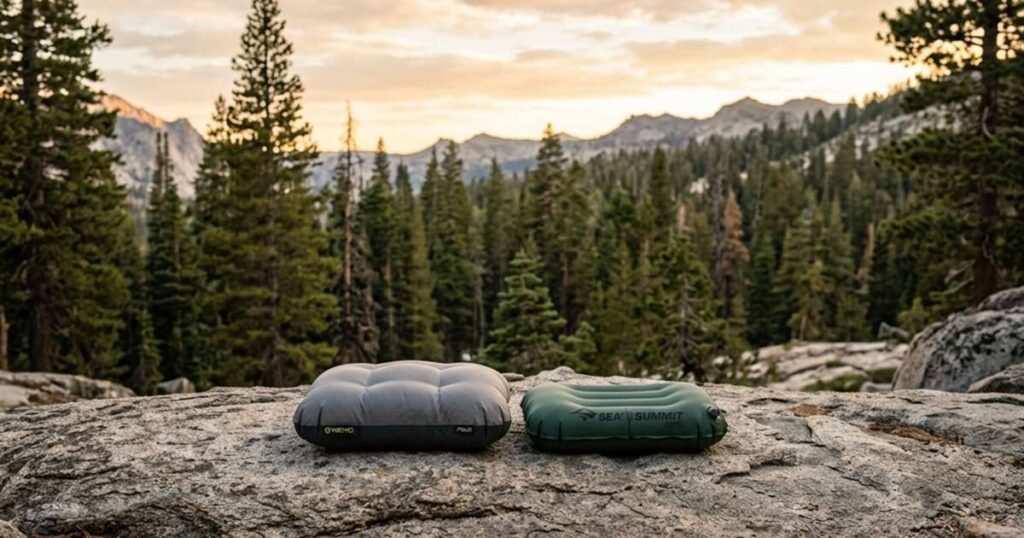
Testing across multiple outlets has found that the combination of air and foam or insulation in hybrid designs offers great cushioning and support with minimal bulk . Moving the Nemo Fillo to the top of overall rankings ahead of foam-only options for backpackers who need to balance comfort and pack weight.
The hybrid’s limitation is that it still carries the inflatable’s durability risk. The bladder can puncture; the valve can fail. The insulation layer complicates a field repair because the patch has to go through or around the cover rather than directly onto a bare bladder.
For most backpackers choosing between foam and inflatable for the first time, the hybrid is the correct starting point , it removes the strongest objections to inflatables without the weight penalty of foam.
The Contrarian Take: “Just Use Your Jacket” Fails the Fill Science Test
Stuffed-jacket pillows appear in every ultralight guide as the weight-free alternative to a dedicated camping pillow. The argument is correct in one specific scenario: a warm one-night bivy where the jacket is not needed for insulation during sleep.
It fails the fill science test for two reasons. First, insulation fill, down clusters or synthetic batting, is designed to loft in three dimensions, not to support a concentrated load like a human head. Second, a jacket’s insulation compresses under the head’s weight and stays compressed, losing the loft that makes it warm when worn during sleep. Leaving the jacket uncompressed means sleeping cold.
The “use your stuff sack as a pillow” approach runs out when you run out of clean clothes, on a week-long trip that is night three. A dedicated pillow does not compete with clothing for space because it is designed to compress and recover.
The NEMO Fillo Elite at 2.8 oz is the point at which the weight argument for the jacket workaround disappears. Under 3 oz and lime-sized packed is not a meaningful weight savings against something that does not work reliably across multiple nights.
Decision Tree
Use this in order:
Step 1, Trip type: Car camping or base camp → foam. Backpacking over 10 miles → inflatable or hybrid. Mixed or casual backpacking → hybrid.
Step 2, Sleep position: Side sleeper → needs wide surface; rules out narrow bare inflatables. Back or stomach sleeper → any type.
Step 3, Temperature: Below 45°F at camp → foam or hybrid to avoid cold surface. Above 55°F → any type.
Step 4, Noise tolerance: Light sleeper or shared tent → foam or hybrid. Deep sleeper in solo tent → any type.
Step 5, Trip duration and risk tolerance: 3+ nights in remote location → foam for reliability. Weekend trips with trailhead access → inflatable or hybrid.
Frequently Asked Questions
Which is better for camping: inflatable or foam pillow?
Neither is universally better. Foam wins on comfort, noise, cold-weather performance, and durability. Inflatable wins on weight and packed size. The decision tree in this article converts those abstract trade-offs into a concrete recommendation based on trip type, sleep position, temperature, and noise tolerance.
How much does a foam camping pillow weigh?
Foam camping pillows in the compressible category typically weigh 8-12 oz. The Therm-a-Rest Compressible Cinch weighs 8.6 oz in the Regular size. Car camping foam pillows with larger surface areas can run 12 oz and above.
Do inflatable camping pillows make noise?
Bare TPU inflatable bladders produce an audible crinkle each time the head repositions on the surface. The noise level varies by bladder construction. Thicker, nylon-laminated TPU is quieter than bare TPU. Hybrid pillows with textile covers over the bladder significantly reduce the crinkle. Foam pillows produce no noise.
Can inflatable camping pillows be repaired in the field?
Yes. A small puncture in a TPU bladder can be patched with a standard repair kit (the same type used for inflatable sleeping pads) in under 5 minutes. Valve failures are harder to address in the field. Always carry a patch kit when backpacking with an inflatable pillow.
What is a hybrid camping pillow?
A hybrid camping pillow combines an inflatable TPU air bladder with a layer of synthetic insulation (PrimaLoft, Zerofiber) or down on the exterior sleep surface. The insulation layer adds warmth, softness, and noise reduction at a 1-3 oz weight penalty over a bare inflatable. Hybrid pillows are the best compromise for backpackers who find bare inflatables uncomfortable but cannot justify the full weight of a foam pillow.