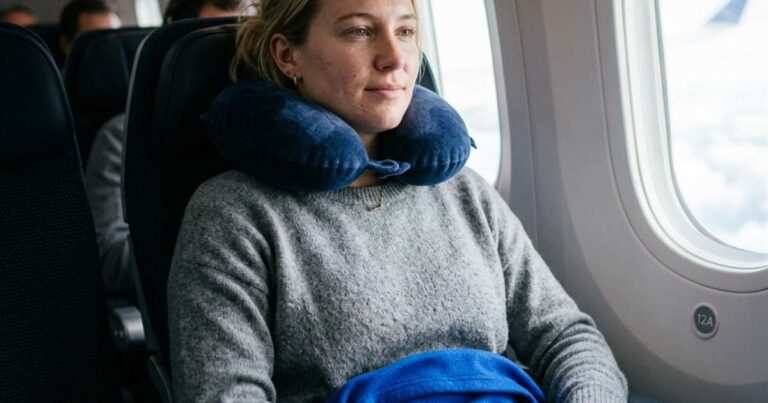
At 15 Degrees of Forward Head Tilt, Your Neck Is Carrying 27 Pounds. A Neck Pillow Won’t Help If You’re Wearing It Wrong. A human head weighs 10-12 lbs at rest. Tilt it forward by just 15 degrees, the angle of a nod, and the effective load on the cervical spine rises to around 27 lbs, according to biomechanical load models cited by OSHA’s ergonomics guidelines. Hold that for an 8-hour flight and your neck muscles fight that load the entire time. That is the mechanism behind the stiff neck you land with.
The neck pillow you bought to fix this problem probably made it worse. Worn the standard way, opening at the front, bulk behind your skull, it props your head backward and does nothing to stop your chin dropping forward. The fix takes three seconds: flip it backward so the bulk sits under your chin. This guide covers the backward method, positioning for scarf-style, collar, and inflatable pillows, and the one case where a neck pillow should stay in the bag.
Why the Standard Position Fails
The original design intent of a U-shaped travel pillow was to support the neck while the user reclines slightly and leans the head back. In that scenario. Seated recline, head resting against a headrest. The bulk behind the skull makes sense. It cushions the contact point.
The problem: most economy airline seats recline only 4-6 inches, not enough for genuine head-back resting. The effective seated angle is roughly 100-110° from vertical. At that angle, the head’s center of mass is forward of the spine, gravity pulls it further forward, and the neck muscles must fire continuously to hold it neutral. When you fall asleep and those muscles stop firing, the head drops. The bulk of a standard-position U-pillow, behind the skull, does not intercept that motion. The chin goes to the chest, the cervical spine enters flexion, and the muscles spend the sleep phase under load rather than recovering.
The backward position, opening at the back, bulk under the chin, creates an anterior stop. The chin rests against the thicker front section, which physically prevents the forward drop. The cervical spine stays closer to neutral. The muscles can relax. This is not a travel hack; it is basic contact-point mechanics applied to the correct failure mode.
How to Wear Each Pillow Type
Standard U-Shaped Pillow: The Backward Method
This is the method that works for the majority of travelers on the majority of routes.
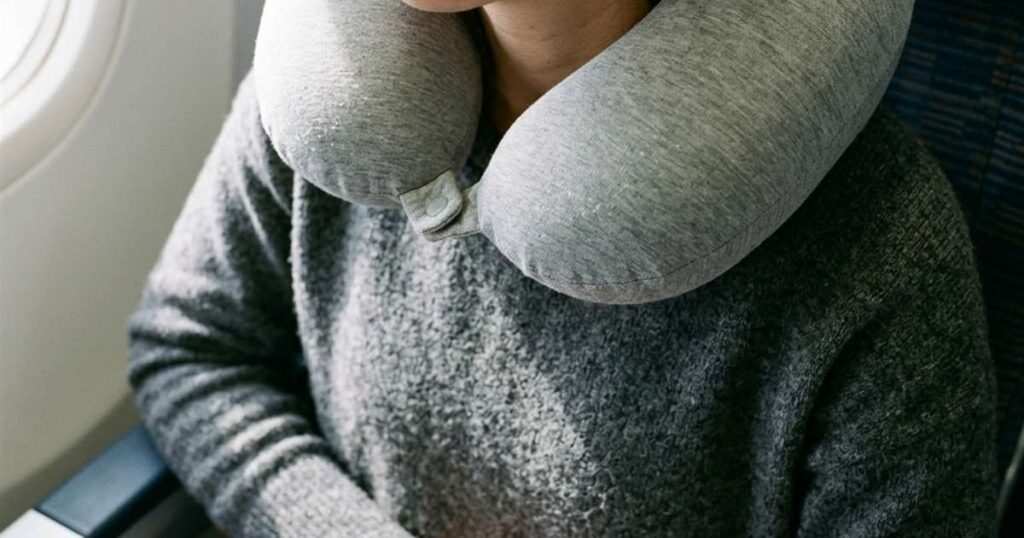
Step 1. Rotate the pillow 180 degrees so the opening faces the back of your neck, not your throat.
Step 2. Place it around your neck with the thicker, more padded section resting under your chin and along your jaw.
Step 3. If the pillow has a snap, clip, or velcro fastener at the front opening, secure it at the back of your neck. Snug enough that the pillow does not rotate during sleep, loose enough that you can still turn your head left and right without resistance.
Step 4. Check the jaw-to-floor angle. Your jaw should be roughly parallel to the floor, or within 10-15 degrees of it. If your chin is pointing downward, the pillow is too thick for your neck and the fill needs compressing or a thinner model is needed. If your jaw tilts up, the pillow is not providing chin contact and the forward drop will still happen.
Step 5. Lean your seat back if available. Even a small recline shifts weight distribution and reduces how hard the pillow has to work. The seat recline does some of the cervical work; the pillow handles the residual forward drop.
Scarf-Style Pillows (Trtl, Trtl Plus)
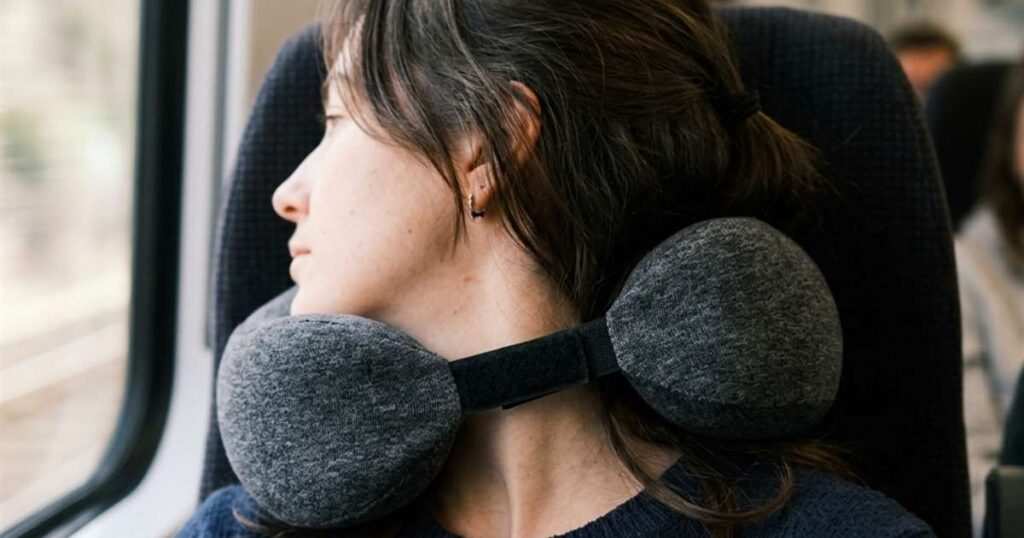
Scarf-style pillows use a rigid internal frame rather than foam fill. The positioning logic is different because there is no “forward or backward”. The frame goes to one side.
Step 1. Unwrap the fleece scarf fully before putting it on.
Step 2. Position the internal plastic C-frame on the side of your neck you will lean toward. Window seat traveler leaning left: frame on the left. The curved top of the frame should align between your shoulder and your jawline. It acts as the shelf your head rests on.
Step 3. Wrap the fleece around your neck and secure the velcro. The wrap should be firm enough to hold the frame against the side of your neck without it rotating away when your head relaxes onto it.
Step 4. Lean your head toward the side where the frame is positioned. Your head should feel supported within roughly 1-2 inches of dropping. The frame intercepts the motion cleanly. If your head drops more than 2 inches before finding the frame, the frame is not positioned high enough on the neck.
Step 5. For the Trtl Plus specifically: use the internal height toggles to raise or lower the frame until it contacts your jaw at the correct level. A frame positioned too low provides shoulder contact but not jaw contact, which means it supports your shoulder, not your head.
The Trtl only supports one side. Middle-seat travelers who do not have a window to lean against, or combination sleepers who shift sides during a flight, will find the Trtl does not adapt to them. This is a position-specific tool.
360° Collar Pillows (Ostrichpillow Go, BCOZZy, similar)
Full-circumference collar pillows wrap around the entire neck. They do not have a “correct direction” the way a U-shape does, but they do have a fit issue that determines whether they work: tightness.
Step 1. Open the velcro closure fully before positioning.
Step 2. Place the collar around the neck at the base, it should sit at the point where the neck meets the shoulder, not up under the ears.
Step 3. Close the velcro at the front until the collar is snug but not compressive. The test: you should be able to fit two fingers between the collar and your neck without stretching them. If you cannot, it is too tight. If there is visible gap beyond that, it is too loose and your head will slide within it during sleep.
Step 4. For pillows with an asymmetric cut (higher at the front than the back, like the Ostrichpillow Go): orient the higher section toward the front of your neck. This provides gentle chin elevation that reduces forward drop tendency.
Step 5. Check that the collar does not push your head forward off the headrest. A collar that is too thick, or positioned too high on the neck, will hold your skull away from the headrest and create the same problem as a mispositioned car headrest , your head has no rear contact and must be held up by the pillow alone.
Inflatable Pillows
Inflation level is the primary fitting variable. Most inflatable travel pillow failures come from over-inflation.
Step 1. Inflate to roughly 70% capacity, not full. A fully inflated travel pillow is firm enough that it resists head movement rather than conforming to it. The head slides off rather than resting. At 70%, the foam has give without collapsing.
Step 2. Wear in the backward position (same as the U-shaped method) with the bulk under the chin, if the pillow is U-shaped. Inflate before positioning so you can adjust pressure with the pillow in place.
Step 3. If your head still drops forward after positioning, add small amounts of air in increments. The pillow may need slightly more structure for your neck geometry.
Step 4. If the pillow feels hard or causes jaw discomfort, release air until the contact pressure eases. The correct feel is firm support without active pressure against the chin.
What “Too Thick” Looks Like, and How to Fix It
The most common positioning failure after direction is fill thickness. A pillow that is too thick behind the skull (standard position) or under the chin (backward position) does one of two things: it pushes the head forward into flexion, or it creates contact pressure that wakes you up.
The diagnostic check is simple. With the pillow in place and your head in its resting position, ask:
Is your chin pointing downward? The pillow is too thick. The fill is elevating the chin above neutral, which paradoxically causes more neck extension strain. For adjustable pillows, remove fill until the chin is level. For fixed-fill pillows, try a thinner model.
Is your head pulling away from the headrest? The collar or bulk is too deep. Try reducing inflation (inflatable), repositioning lower on the neck, or switching to a lower-profile model.
Does your jaw feel compressed upward? The chin rest is too high. The pillow is supporting the chin bone rather than cradling under it, the support point should be the soft tissue under the jaw, not the mandible itself.
The jaw-parallel-to-floor rule is the calibration standard. If your jaw is level, the cervical spine is close to neutral regardless of which direction the pillow faces.
Using a Neck Pillow in a Car: The Safety Constraint
A neck pillow can be used safely in a car by a passenger. It should never be used by the driver, and it should not be used in a way that pushes the head forward of the car’s built-in headrest.
The car’s head restraint, that adjustable post behind the skull, is a crash safety component, not a comfort feature. It is designed to limit how far the head travels backward in a rear-end collision, reducing whiplash injury. A thick travel pillow that pushes the skull forward of the headrest defeats this function entirely: in a rear-end impact, the head will travel the full distance to the headrest plus the thickness of the pillow before the restraint engages. That additional distance of uncontrolled head travel is the difference between whiplash and a more serious cervical injury.
The safe approach for car passengers: use a low-profile collar pillow or a slim U-shape in the standard (not backward) position, ensuring the back of the skull maintains contact with or remains within 1-2 inches of the head restraint surface. The pillow cushions neck contact; it does not replace headrest function.
Drivers should not use a neck pillow. Neck pillows reduce head rotation range, the rotation needed for mirror checks and shoulder checks. Any restriction of that range in a moving vehicle is a safety issue. Adjust the car’s built-in headrest position (height and forward tilt) before reaching for a travel pillow.
The Position by Seat Type
| Seat Type | Recommended Pillow Position | Key Constraint |
|---|---|---|
| Airplane window seat | Backward (bulk under chin), lean to window | Pillow rests against window for lateral support |
| Airplane middle seat | Backward (bulk under chin), upright | No wall support; chin contact is the only anchor |
| Airplane aisle seat | Backward or 360° collar | Vulnerable to being bumped; collar stays in place better |
| Train window seat | Backward or scarf-style (Trtl) to window side | Same logic as airplane window seat |
| Car passenger | Standard or slim 360° collar | Must not displace head from car headrest |
| Car driver | No travel pillow | Head rotation restriction is a safety risk |
Frequently Asked Questions
Should a neck pillow opening face forward or backward?
Backward. Opening at the back, bulk under the chin. The standard forward-opening position places the support behind the skull, which does nothing to prevent the head from dropping forward when neck muscles relax during sleep. Rotating the pillow 180 degrees moves the bulk to the front, where it intercepts the forward drop. This applies to every standard U-shaped travel pillow regardless of fill material.
Why does my head fall forward even with a neck pillow?
The pillow is either positioned in the standard (wrong) direction with bulk behind the skull, or it is too thick and the chin is being pushed upward past the support zone rather than resting against it. Flip the pillow backward. If the chin still drops forward, the fill is too thin to reach the chin at your neck length, try adding a rolled-up jacket or scarf under the chin as a supplement, or upgrade to a pillow with a dedicated chin strap like the Cabeau TNE S3.
How tight should a neck pillow be?
Snug enough to stay in position without active effort, loose enough that you can fit two fingers between the collar and your neck without stretching them. Overtightening compresses the carotid artery region on the sides of the neck and creates active pressure that disrupts sleep. The pillow should hold position passively; it should not feel like a brace.
Can you use a travel neck pillow in a car?
Passengers can, with constraints. The pillow must not push the head forward of the car’s built-in head restraint. The restraint is a crash safety component that requires contact with the skull to function. Use a low-profile design and keep rear skull contact with the headrest. Drivers should not use neck pillows: they restrict the head rotation range needed for mirror and shoulder checks.
Is sleeping with a neck pillow safe?
Yes, for flights and trains. A properly positioned neck pillow that keeps the cervical spine near neutral is safer than sleeping unsupported, which allows the head to drop into sustained forward flexion. The one exception is the driver’s seat of a moving vehicle: no neck pillow while driving.