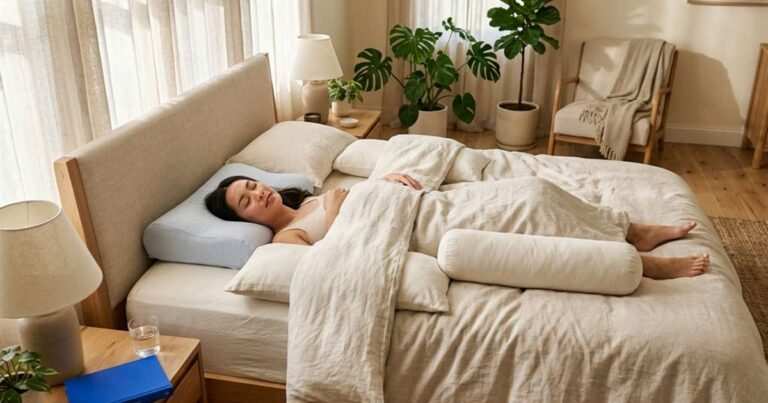
Most guides on training yourself to sleep on your back tell you to put pillows around your body and be patient, and that advice is not wrong exactly, it just skips the two things I think every guide should lead with, which are the contraindication that makes back sleeping actively harmful for a good chunk of the population and the pillow geometry that decides whether the position is comfortable enough to hold for a full night.
Start here. Warning first, how-to second, because the stakes are real. On your back, gravity pulls the tongue and soft palate backward until the upper airway narrows, and the Sleep and Breathing review puts it plainly: supine-related obstructive sleep apnea is the most common clinical phenotype of OSA, and in people whose apnea depends on position, breathing events happen twice as often on the back as anywhere else. So if you snore heavily, wake gasping, or already know or suspect sleep apnea, get a physician or sleep specialist to say it is safe before you train yourself onto your back. For that group, side sleeping is what the evidence supports. The opposite of this guide.
Back sleeping has genuine structural advantages, when it suits you. The pillow setup required to make it work is addressed below in detail, and our guide to the best pillows for back sleepers goes deeper on product specifics. Next up, the five-night transition protocol, the three-piece pillow system, and the fix for when the position still will not stick after night two.
⚠️ Got a neck, spinal, or breathing condition already? Sort that out with a physiotherapist or physician before you touch your sleep position.
My honest framing: back sleeping is worth training for, but not for everyone — I lead with the contraindication most guides bury. Sleep apnea sufferers usually do worse on their backs. No pillow setup fixes that, and I will not pretend otherwise. For everyone else the three-piece system and 5-night plan here are mechanically sound, and the position is trainable, but only if your airway tolerates it.
Why Back Sleeping Is Worth the Effort
I keep coming back to it for one reason. Lying on your back is the only common sleep position that holds the spine neutral, keeps your face off the pillow, and spreads your weight evenly across your back. All three. At once.
The spine argument rests on a 2015 study in the Journal of Biomechanical Engineering (PMC), where researchers measured cervical spine alignment at several pillow heights while people lay on their backs, and a pillow height in the 10 cm range held the C2-C7 Cobb angle at 14.9°, right inside the physiologic normal range for cervical lordosis. That is the whole case, and it fits in one number. Give the spine proper support and the supine position asks less of the neck and lower back than any other posture, no twisting load the way stomach sleeping brings, no sideways bend the way side sleeping on a wrong pillow does.
Skin next. A 2016 study in the Aesthetic Surgery Journal confirmed that side and stomach sleeping leave distinct mechanical compression wrinkles after hours of sustained facial distortion, while back sleeping takes the face off the pillow completely and removes the main mechanical cause of those wrinkles. Cosmetic? Sure, partly. But it is also why physiotherapists and dermatologists, coming at the question from entirely different angles, end up recommending the same position.
The Three-Piece Pillow System
Barrier pillows alone, the standard advice, solve only one of three mechanical problems. What actually sinks most habitual side or stomach sleepers who try to switch is that three things go wrong at once, since they roll out of position during the night, their lower back arches into discomfort without knee support, and their neck sits at the wrong angle without cervical support. Each requires a separate intervention.
Piece 1: The Cervical Contour Pillow (head and neck)
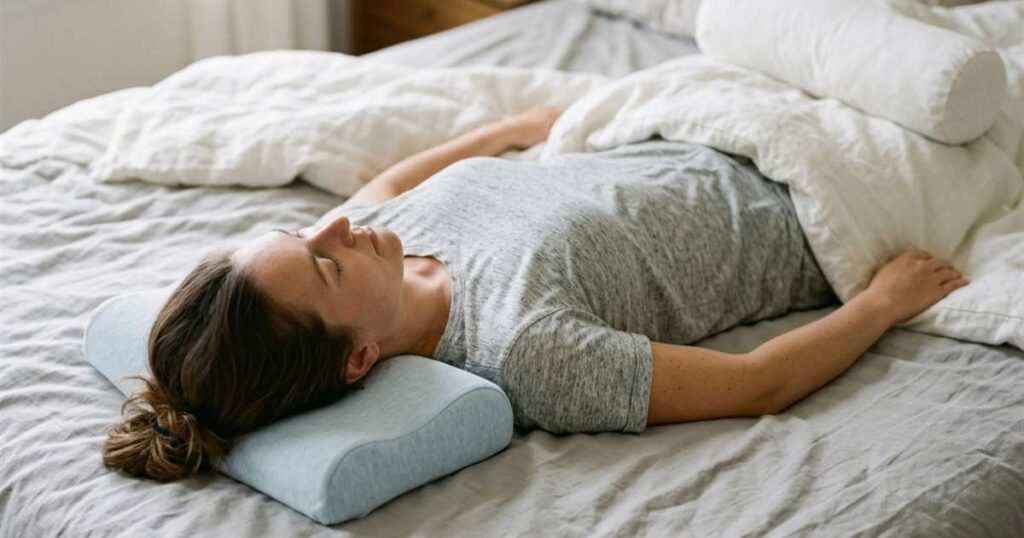
A standard rectangular pillow does one thing: it props up the back of your head. Meanwhile the cervical lordosis, the inward curve of the neck between head and shoulders, hangs over the gap between the occiput and the mattress with nothing under it, so the muscles around it stay switched on all night instead of relaxing. A cervical contour pillow, also called a cervical roll pillow or orthopedic pillow, fixes exactly that. Its raised neck roll along the bottom edge fills the gap, and the recessed middle cradles the head without shoving it forward.
Loft. A 2021 systematic review in the Healthcare journal (PMID 34683013) puts the right range at roughly 7-10 cm, about 3-4 inches, for most adults on a medium-firm mattress. Go past 10 cm and you overextend the cervical curve. Drop below 7 cm and the lordosis gets no support at all. The test is quick: lie flat, stare at the ceiling, neither chin-to-chest nor chin-to-sky, and feel whether anything is holding your neck up. Nothing there? Too flat. Chin dropping toward your chest? Too high.
Piece 2: The Knee Bolster (lumbar decompression)
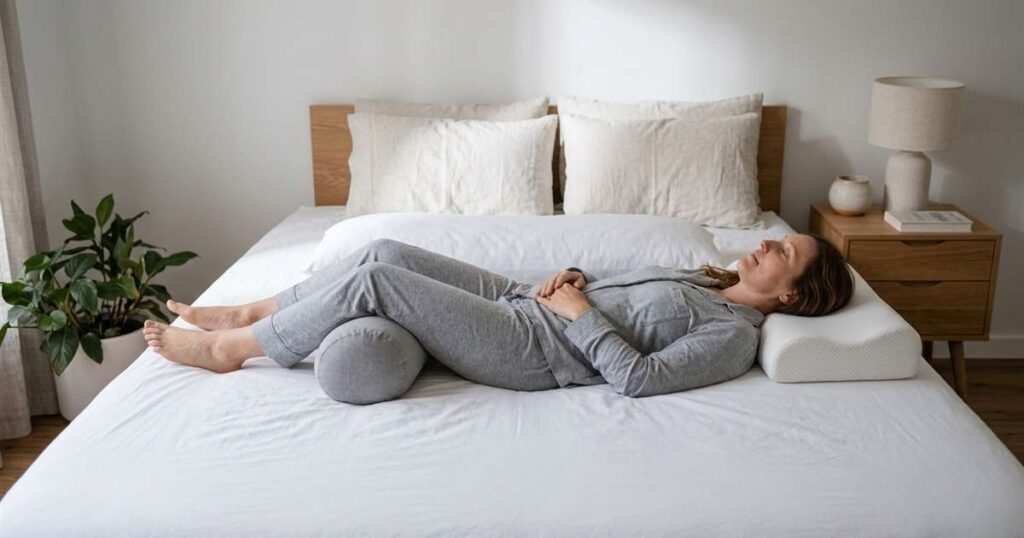
Straighten your legs out flat and the hip flexors pull the pelvis into anterior tilt. The lumbar curve deepens. Low back pressure builds. Within an hour of lying on your back, most people wake up. Put a small cylindrical bolster pillow or a folded firm pillow under the knees, lift them about 4-6 inches, and the hip flexor tension releases while the lumbar arch settles back to neutral. One addition. That alone clears up most of the lower back discomfort that stops new back sleepers before the first night is even over.
You do not need to buy anything special for a knee bolster. Fold a firm pillow in half and it works. The goal is consistent elevation of the knees, not precision, the lumbar response to even modest hip flexion is significant.
Piece 3: Body Pillows Against the Hips (barrier system)
Barriers sound like folk wisdom. The evidence says otherwise. A study in Sleep Medicine Research looked at body pillow effects and found people stayed in a lateral sleeping position longer with a body pillow, which tells me physical barriers genuinely cut down on unconscious position changes during sleep. Turn the mechanism around and it works for training back sleeping too: firm body pillows or tightly rolled blankets along both sides of the torso, from shoulder level to hip level, create proprioceptive resistance that interrupts a roll before it becomes a full position change. The barrier does not have to hurt. It just has to be firm enough that rolling into it gives you a tactile signal that wakes you briefly.
One body pillow on each side. Two standard pillows stacked vertically on each side works just as well. Whichever you use, push them flush against the hips and ribs. No gap. A gap kills the early-detection function entirely.
The 5-Night Training Plan
Night 1: Establish the Setup
Goal for the first night: get the three-piece system in place and actually fall asleep on your back. Starting there is not enough. Rolling is expected.
- Set the cervical contour pillow at the head. Neck roll at the bottom edge. Head resting in the recessed center. That is the whole move.
- Put a firm bolster or folded pillow under both knees. Lift them about 4-6 inches. Done.
- Put a body pillow, or two stacked pillows, flush against each hip. Both sides. Flush matters more than firmness here.
- Arms at your sides. Or lightly on your stomach. Not overhead. Overhead risks shoulder strain, and night one is not the time to find that out.
- First thing when you wake: which way did you roll? Which piece failed first?

Night 2: Diagnose and Adjust
Goal: fix the specific failure from Night 1. Most failures are either barrier gaps or pillow height.
- Rolled sideways? Push the hip barriers in closer. Kill any gap between the barrier and your body.
- Lower back ached? Raise the knee bolster higher. Or slide a second folded pillow underneath it.
- Neck felt strained? Check the cervical pillow height. Chin level. Not tilted up, not tilted down.
- Set it all up again with those adjustments. Fall asleep in position. Same drill, better setup.
- Note: did the adjustment change anything when you woke?

Night 3: Extend Duration
Goal for night three is simple: wake up on your back at least once during the night. Not just start there. Wake there.
- Run the Night 2 setup again exactly as adjusted. No changes. Let your body start adapting.
- If you wake mid-night on your back: count it as a win, your barriers are working.
- Keep rolling to one side? Add a rolled blanket on that side. On top of the pillow. Extra resistance, same idea.
- Optional, and it does help: before you lie down, try progressive muscle relaxation. Work through each muscle group from toes to shoulders, tightening it, then letting it go. It takes the edge off the urge to shift the moment you hit the bed.

Night 4: Reduce Dependence on Barriers
Goal: test whether one barrier side can be reduced without rolling.
- Night four is a test. Take the barrier away from the side you rolled toward less. Keep the dominant-roll side in place.
- The cervical pillow and knee bolster stay exactly where they are. Do not touch what is working.
- Note whether removing one barrier caused rolling, restore it if yes.
- Count your wake-ups and compare them with nights 1-3. Waking up less often means your sleep continuity is improving, and better continuity means you are adapting.
Night 5: Consolidate
Night five asks a harder question: can you actually live with this setup? Run the one that worked best across nights 1-4 and find out.
- Run the most effective setup from the previous four nights. Nothing new. Just the winner.
- When you wake up, check three things against how your old position felt: neck, lower back, sleep continuity. Be honest about all three.
- Neck or back worse than before the transition? Stop. The pillow setup still needs more adjustment. Do not keep going without sorting out the geometry.
- Sleep comparable or better? Good. Stick with the setup for two further weeks before you start taking barriers away.
- Snoring or gasping worse than before? Stop. See a physician before you continue.

What Happens if the Position Doesn’t Stick
Five nights is a realistic minimum for establishing a new sleep position as the default starting position. Full transition? That takes longer. Positional therapy research keeps landing on the same window, two to four weeks before a position change turns habitual, and most people drop out in the first week.
After night two, the failures split into two buckets. Mechanical or comfort-based. Each one has a specific fix.
Mechanical failure looks like this: barriers in place, and you still roll. Usually the barrier sits too low, sits too far from your body, or is too soft to push back. The fix is a tightly rolled blanket or a firm cylindrical body pillow instead of soft pillows. What you need is enough resistance to wake you briefly when you roll into it, enough to stop the roll before it finishes, and not so much that it hurts.
Comfort failure is simpler to spot: your back aches, your neck stiffens, and the pillow geometry is wrong for your body. The usual culprit is a cervical pillow that sits too tall and pushes the head forward until the neck flexes. The second most common one is knee support that gives out, because the bolster is compressible enough to flatten within an hour and the lumbar spine arches again. Trade the compressible bolster for a firmer one. Or use a hard foam block at a fixed height instead of a pillow.
Five nights of adjusting the setup and still hurting? Neck pain, shoulder pain, waking stiffness that will not quit? At that point the pillow geometry needs calibrating to you specifically. A cervical pillow sized to your neck length and mattress firmness does that far more precisely than any generic recommendation can.
Arms, Snoring, and the Two Questions You Will Get Wrong Without Help
Arms. Keep them at your sides or resting lightly on your stomach, which is biomechanically neutral on your back. Throw them overhead into the “starfish” position and the shoulder sits in abduction for long stretches, which can load the rotator cuff and cause shoulder impingement if your shoulders are already tight. So start at the sides. If your hands go numb or uncomfortable from pressure on the ulnar nerve, rest one arm lightly across your lower abdomen.
Snoring gets worse on your back. Significantly worse, for most people. Gravity pulls the tongue, uvula, and soft palate backward and the airway narrows. So if your partner says the snoring is new or much heavier since you started back sleeping, or you wake up with a dry mouth, a headache, or a gasping feeling, stop the protocol and see a physician. That combination points toward positional obstructive sleep apnea. That needs medical assessment. Not a different pillow.
The Contrarian Point: The “5 Nights” Headline Is Honest Marketing, Not a Clinical Claim
Every guide on this topic, including this one, uses a night count to make the process feel finite. The honest version is that five nights establishes the mechanical habit of starting in the correct position, using the correct setup. Whether your body stays there through REM cycles and position changes during deep sleep is a separate question that takes longer, typically two to four weeks of consistent setup before the position becomes reliably maintained without full barrier dependence.
The five-night protocol is real and useful. But if you are still rolling by night five, that is not failure. That is normal adaptation pace. Continue the setup. I keep repeating that because positional therapy research consistently shows compliance climbing over the first four weeks as proprioceptive memory for the position gets stronger.
Frequently Asked Questions
How do you train yourself to fall asleep comfortably on your back?
Put a supportive pillow directly under your knees first. That flattens your lower back against the mattress and takes the strain off your lumbar spine. A couple of extra pillows tucked under your arms help too, the secure feeling is half the point. Still waking up uncomfortable? Your mattress might be too firm.
Why do side sleepers feel exposed when trying to sleep on their backs?
Enclosure. Side and stomach sleepers live with that feeling every night. Flat on your back, the pressure is gone, and the missing weight can feel oddly exposed. A thin pillow under each arm brings some of it back, enough tactile feedback to feel like the security of side sleeping.
Should I worry if I roll over after falling asleep on my back?
Only the position you fall asleep in matters. Everything after that is noise. Your body shifts during the night to relieve pressure points, and that is entirely natural. Trying to lock yourself into one posture will only keep you awake. Give it time, and the hours you spend on your back will grow on their own.
How long does it take to train yourself to sleep on your back?
Five nights is enough to build the starting-position habit and get the mechanical setup right. That is the honest scope of it. Full habituation. Where the body maintains the position through unconscious position changes during sleep. Getting to that point typically takes two to four weeks of consistent setup, based on positional therapy adaptation data, so expect some rolling all through the transition, because it does not mean the protocol is failing.
What is the best pillow for back sleeping?
Get a cervical contour pillow. It holds up the neck lordosis while cradling the head at a loft of roughly 7-10 cm, about 3-4 inches, on a medium-firm mattress. A standard rectangular pillow at the same height cannot do that, because it has no neck roll to fill the gap between the occiput and the mattress. The full cervical pillow guide for back sleepers covers the specification details.
Is it bad to sleep on your back with your arms above your head?
For most people, no, not in the short term. But arms overhead hold the shoulder in sustained abduction, and that can strain the rotator cuff and cause impingement if your shoulders are already tight. Start with your arms at your sides, or resting lightly on your lower abdomen. Those are the neutral positions.
Should I sleep on my back if I snore?
No. Or at minimum, not without medical clearance first. Of all the sleep positions, back sleeping drives snoring and obstructive sleep apnea hardest, because airway soft tissue falls backward under gravity. Already snoring, or snoring worse since you started sleeping on your back? See a physician before continuing. Side sleeping is the clinically supported position for snorers.
Do body pillows actually stop rolling over?
Yes, when the setup is right. Research on body pillows in sleep position maintenance confirms they stretch out how long you stay in the target position, because they give you proprioceptive resistance to rolling. What matters most is placement. Flush against the hips and ribs, not at a gap. A gap wipes out the early tactile signal that interrupts a roll before it completes.
Training your position changes what loft you need. Our Pillows by Sleep Position guides cover transitioning heights.