You do not need tennis balls to dry a pillow properly. What you need is mechanical agitation during the drying cycle to prevent fill from clumping into dense, damp pockets. And tennis balls are simply one way to create that agitation. Several alternatives work equally well, and two of them work better for specific fill types. The method that is right for your pillow depends on what is inside it.
For the full maintenance context around washing and drying across all pillow types, the pillow care guide covers every fill category in one place. This article focuses specifically on the drying stage and what each alternative to tennis balls actually does mechanically to the fill.
Why Fill Clumps in the Dryer, and What Stops It
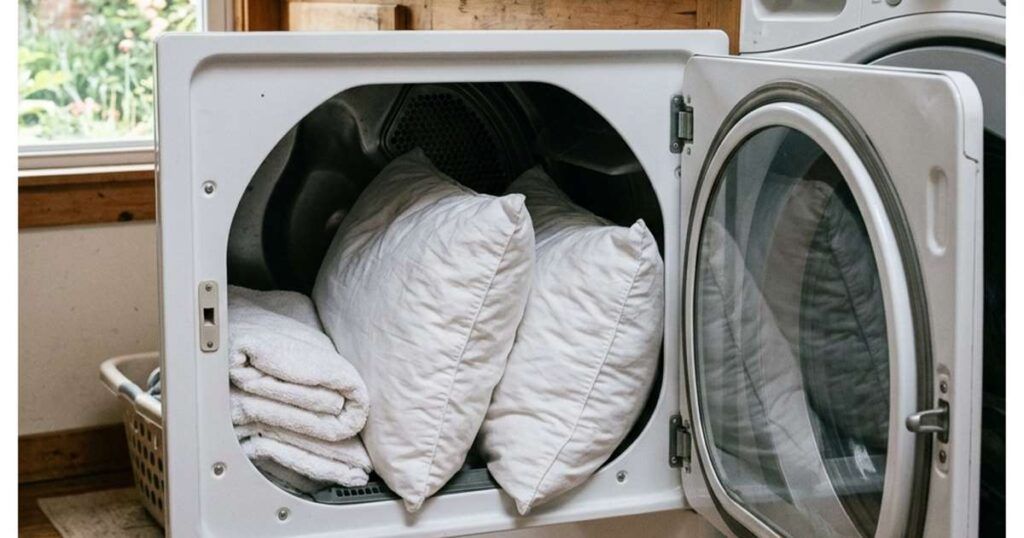
When a wet pillow goes into a dryer, the fill material compresses under its own weight and the tumbling motion pushes damp fibers or clusters together. As heat drives moisture out, those compressed areas dry in a bonded state. Which is what produces hard, lumpy patches in a pillow that seemed fine before washing.
Agitation during the drying cycle interrupts that process. Something physically striking the pillow repeatedly as it tumbles forces the fill apart before it can bond and dry compressed. Tennis balls do this through impact. So do several other objects and methods. The fill type determines how much agitation force is useful and whether heat is a constraint.
| Fill type | Clumping risk | Heat sensitivity | Best drying approach |
|---|---|---|---|
| Down and feather | High | Low-moderate | Dryer balls or wool balls, medium heat, long cycle |
| Polyester fiberfill | Moderate | Low | Dryer balls, clean towels, medium-high heat |
| Shredded memory foam | Moderate | High | Air dry flat; dryer on lowest heat only if needed |
| Solid memory foam | N/A (spot-treat only) | Very high | Air dry exclusively |
| Latex | High | High | Air dry flat exclusively |
| Buckwheat | Low (hull fill) | Low | Air dry preferred; dryer on low acceptable |
Five Methods That Replace Tennis Balls
1. Wool Dryer Balls (Best Overall Replacement)
Wool dryer balls are the most direct substitute for tennis balls and outperform them on two counts: they are odor-neutral (no rubber off-gassing, which tennis balls produce when heated) and they improve drying efficiency by separating items in the drum and increasing airflow. A set of three to six wool dryer balls creates consistent agitation across the pillow surface throughout the cycle.
I ranked this #1 because wool balls beat tennis balls on both counts that matter — no rubber off-gassing when heated, and better drum airflow from separating items. My analysis: they’re the direct substitute with zero downsides. If you’re still using tennis balls, this is the upgrade.
Use three balls minimum per pillow. Fewer and the agitation becomes uneven, which can still allow localised clumping. Wool balls work on every fill type that tolerates a dryer (down, feather, polyester fiberfill). They are not appropriate for memory foam or latex, where the dryer itself is the constraint.
Heat setting: Medium for down and feather (high heat degrades cluster structure over repeated cycles). Medium to high for polyester fiberfill.
2. Clean Sneakers (Tied Together)
A clean pair of canvas or fabric sneakers tied together by their laces creates a similar impact dynamic to tennis balls. The laces keep the pair bound so they strike the pillow as a unit rather than bouncing independently. Avoid rubber-soled sneakers with thick outsoles. The harder the sole, the more aggressive the impact, which risks compressing down clusters rather than separating them.
This is the no-purchase option — clean canvas sneakers tied by the laces strike as a unit, mimicking ball impact. My practical assessment: it works, but avoid thick rubber outsoles (hard impact damages fill). For the ‘I need it now’ scenario, the closet solution is legitimate.
This works best for polyester fiberfill, which tolerates more aggressive agitation. For down, wool dryer balls are the better choice.
3. Dry Towels (No-Impact Method)
Adding two or three large, clean, dry towels to the dryer with the pillow does two things: the towels absorb moisture from the pillow fill as they tumble together, and the physical bulk of the towels provides gentle agitation as they turn with the pillow. This is the slowest method but the gentlest. Appropriate for down pillows where cluster integrity matters and for anyone who wants to avoid impact agitation entirely.
I ranked this as the gentlest method — two or three dry towels absorb moisture while tumbling and provide soft agitation. My analysis says it’s the slowest option but the safest for delicate fills. When in doubt about a pillow’s durability, towels are the conservative choice.
The trade-off is drying time. A down pillow dried with towels alone typically needs more dryer cycles to reach fully dry than a pillow dried with wool balls. Plan for two to three full cycles and check the center of the pillow between each one.
Heat setting: Low to medium for down. Medium for polyester.
4. Mesh Laundry Bags with Tennis Ball Alternatives Inside
If you have dryer-safe silicone or rubber balls (sold specifically as dryer agitators), placing them inside a mesh laundry bag with the pillow creates contained agitation with slightly less free-flying impact than loose balls. This reduces noise and keeps the agitation more consistent. Silicone dryer balls are odor-neutral like wool balls and produce a similar result.
This earned the contained-agitation spot — dryer-safe balls in a mesh bag with the pillow means less noise and less free-flying impact. My comparison: slightly gentler than loose balls, slightly more effective than towels alone. The middle path for noise-sensitive households.
This method is worth naming because some people searching for tennis ball alternatives are specifically trying to reduce dryer noise, silicone balls and the mesh bag combination is quieter than loose wool balls, which in turn are quieter than tennis balls.
5. Air Drying Flat (No Dryer Required)
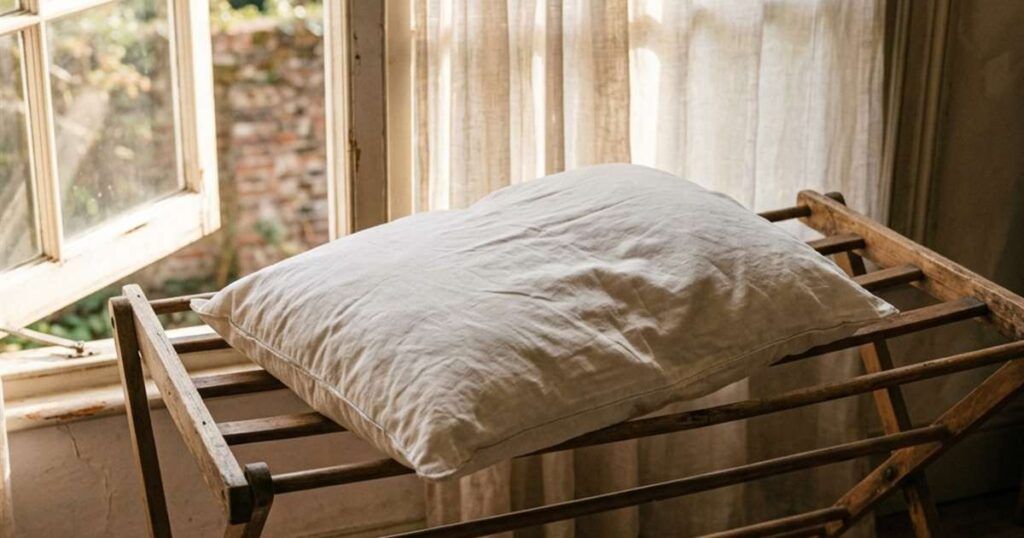
For fills that should not go in a dryer at all, solid memory foam and latex in particular, and for anyone who prefers to avoid machine drying, air drying flat on a ventilated surface is the correct approach. The agitation-to-prevent-clumping problem does not apply to solid foam (it cannot clump). For down and fiberfill, air drying requires manual intervention: flip the pillow every two to three hours and break up any developing clumps by hand as the fill dries.
This is the mandatory method for solid memory foam and latex — my material analysis is blunt: the dryer destroys these fills, so the agitation question doesn’t apply. Air dry flat on a ventilated surface. For foam and latex, this isn’t an alternative; it’s the only correct answer.
Air drying takes significantly longer than machine drying. 12 to 48 hours depending on fill density, pillow thickness, and ambient humidity. The fill must be completely dry before the pillow goes back into use. Pressing the center: if it feels cool or retains a dense, heavy quality, it is still wet inside. Mildew can establish in fill that stays damp for more than 24 to 48 hours.
The One Drying Mistake That Ruins Pillows
Taking a pillow out of the dryer while it is warm and assuming it is dry is the most common drying error. Warmth from the dryer creates the impression of dryness at the surface while the fill interior, particularly in down and dense fiberfill, is still carrying meaningful moisture. A pillow put back into use in that state stays damp inside for hours under a pillowcase, creating the exact conditions for mildew and odor that washing was meant to prevent.
The verification is simple. Press firmly on the center of the pillow immediately after removing it from the dryer. If that area feels cooler than the edges, or if the fill has a compressed, heavy quality that does not spring back the way the outer edges do, it needs another cycle. Down pillows in particular typically need two to three full dryer cycles on medium heat to reach fully dry. Not because they are poorly designed, but because down clusters hold air (and therefore moisture) in a way synthetic fills do not.
Drying by Fill Type, Quick Reference
| Fill type | Dryer allowed? | Agitation method | Heat setting | Cycles needed |
|---|---|---|---|---|
| Down | Yes | 3-6 wool dryer balls | Medium | 2-3 |
| Feather | Yes | 3-6 wool dryer balls | Medium | 2-3 |
| Polyester fiberfill | Yes | Wool balls, towels, or sneakers | Medium-high | 1-2 |
| Shredded memory foam | Caution | Air dry preferred; lowest heat only | Low | Check frequently |
| Solid memory foam | No | Air dry flat | N/A | 12-48 hrs |
| Latex | No | Air dry flat | N/A | 12-48 hrs |
| Buckwheat | Preferred air dry | No agitation needed | Low if dryer used | Air: 4-8 hrs |
Frequently Asked Questions
Can you dry pillows without tennis balls?
Yes. Wool dryer balls, silicone dryer balls, dry towels, and clean sneakers all create the agitation needed to prevent fill from clumping during drying. For fills that cannot go in the dryer at all, such as solid memory foam or latex, air drying flat on a ventilated surface is the correct method regardless.
Why do tennis balls get used to dry pillows?
They create mechanical agitation inside the dryer drum, repeatedly striking the pillow and breaking up clumps in the fill as moisture evaporates. Any object that tumbles freely and strikes the pillow repeatedly serves the same purpose. The problem with tennis balls is that they off-gas rubber odor when heated, which transfers to the pillow.
How do you know when a pillow is completely dry?
Press firmly on the centre of the pillow. If that area feels cooler than the edges or has a dense, compressed quality that does not spring back the way the outer fill does, it is still carrying moisture inside. Return it to the dryer for another cycle or continue air drying.
Can you dry a memory foam pillow in the dryer?
Solid memory foam cannot be dried in a dryer because heat degrades the viscoelastic polymer structure. Shredded memory foam can tolerate the lowest dryer heat setting for short periods, but air drying flat is the safer default. Neither type should be dried with heavy agitation balls.
How long does it take to air dry a pillow?
Air drying takes between 12 and 48 hours, depending on fill density, pillow thickness, and ambient humidity. Down pillows take longest. Polyester fiberfill dries faster. Solid memory foam and latex require the full range. Flip every 2 to 3 hours and press the centre to verify dryness before use.
How do you fix a pillow that came out lumpy after drying without tennis balls?
Massage the lumpy areas by hand from the centre outward to break up damp bonded clusters, then return the pillow to the dryer with three wool dryer balls or clean dry towels on low heat for 15 minutes. High heat bakes compressed clusters into permanent lumps, so keep the heat low while manually separating the fill.
Does running an extra spin cycle help pillows dry faster?
Yes. Running a second high-speed spin cycle in your washing machine before drying removes up to 30% of residual water trapped inside the fill. Removing that bulk water mechanically before the drying stage cuts overall dryer time significantly and reduces the risk of fill clumping regardless of which agitation method you use.
Drying is half of pillow setup. Our Pillow Setup & Adjustment section covers the full wash-to-loft routine.