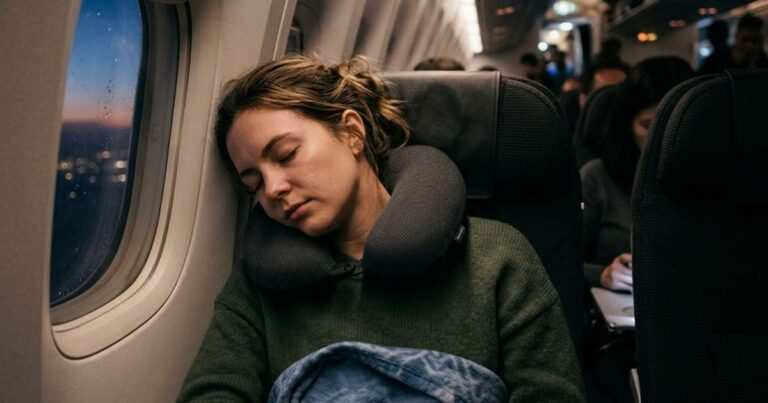
The Cabeau Evolution S3 is the top pick: its seat strap system anchors to the headrest wings, eliminating the pillow rotation that makes most foam travel pillows useless by hour three. For $39.99 and 11.6 oz, nothing else at this price is as mechanically complete, full stop, and the 5-inch height fits average to tall necks. Petite travelers, though, should size down. Economy seats only recline to roughly 100-110°, which sounds fine until your neck muscles switch off mid-flight and your 10-12 lb head flops forward like it has somewhere better to be. The classic U-shape feels nice around your neck. It does absolutely nothing about that forward drop, though. These 7 picks solve the real problem, head position, not just comfort.
The U-shaped travel pillow has been the default airport purchase for decades. It is also, by design, the wrong tool for the actual problem. Fall asleep and your neck muscles just quit, they stop firing altogether, and your head, all 10-12 lbs of it, goes wherever gravity says. Research in Applied Ergonomics, cited on PubMed, found something that will surprise nobody who has landed stiff: without head support, passengers had to work their neck muscles significantly harder just to hold their head up. The standard U-shape pads the sides of your neck and leaves the real problem alone, so your head still drops forward, and that is exactly the stiffness you land with.
Every pillow below earned its place by fixing that structural problem, head position in a reclined seat. Not because it felt plush on the shelf at the airport shop. The full travel pillow hub covers the whole category. This article goes deep on long-haul specifically, where 8-14 hours of your head sitting wrong compounds into stiffness that can hang around for days.
At a Glance: The 7 Picks
- Cabeau Evolution S3: Best Overall
- Trtl Pillow Plus: Best for Minimalists
- Ostrichpillow Go Neck Pillow: Best 360° Wrap
- Cabeau TNE S3: Best Anti-Head-Bob
- BCOZZY Travel Pillow: Best Chin-Support Pick
- Pluto Pod 2.0: Best for Light Blocking
- Therm-a-Rest Compressible Pillow (Small): Best Multi-Use
Why Long-Haul Is a Different Problem Than a 3-Hour Flight
On a short flight, a bad travel pillow is an inconvenience. On a 10-hour flight from New York to London or a 14-hour flight to Tokyo, it is a structural issue. The sternocleidomastoid and upper trapezius , the primary muscles responsible for holding the head in a neutral position , fatigue over hours of isometric contraction. Once they stop working, the head drops. A pillow that does not actively block forward flexion provides no structural benefit once you’re asleep.
Economy recline usually tops out at 100-110° from vertical. That is barely a lean, not a lie-down. Pair that shallow angle with a headrest that has no real wing, and your cervical spine is stuck: it cannot hold its natural lordotic curve on its own, not without your muscles working overtime or something external doing the job for them.
The support a travel pillow provides has to be structural . It needs to hold the head at a specific angle, not just cushion the contact point.
That structural support is the whole dividing line. It is what separates the 7 picks below from the $12 airport shop version that folds the moment turbulence hits.
How to Choose a Long-Haul Travel Pillow
Head position first. Softness is a distraction at this stage.
The support has to be structural, meaning it holds your head at one specific angle after your neck muscles clock out, because at 100-110° of recline an unsupported head is going forward, no question. A pillow that just cushions the contact point? It does not solve that problem at all.
What you actually want is a mechanism that stops forward drop. Seat straps that lock to headrest wings. A chin strap. A 360-degree wrap. An internal frame. Overlapping arms that make a chin rest. Any of those will do the job. That mechanism is the dividing line between these picks and the $12 airport version that gives up at the first turbulence bump.
Match the pillow to your seat and neck. The 5-inch Evolution S3 suits average to tall necks, while petite travelers should size down. Seat straps need winged headrests to work as designed, and window-seat travelers can lean on a lateral-support design or use a multi-use pillow as a window lean.
The 7 Picks: What Each One Solves
Disclosure: Brocia analyzes products using manufacturer specs and published research, not our own hands-on tests. If you buy through our links, we may earn a commission at no extra cost to you. It never affects our rankings or verdicts. See our Review Process and Affiliate Policy.
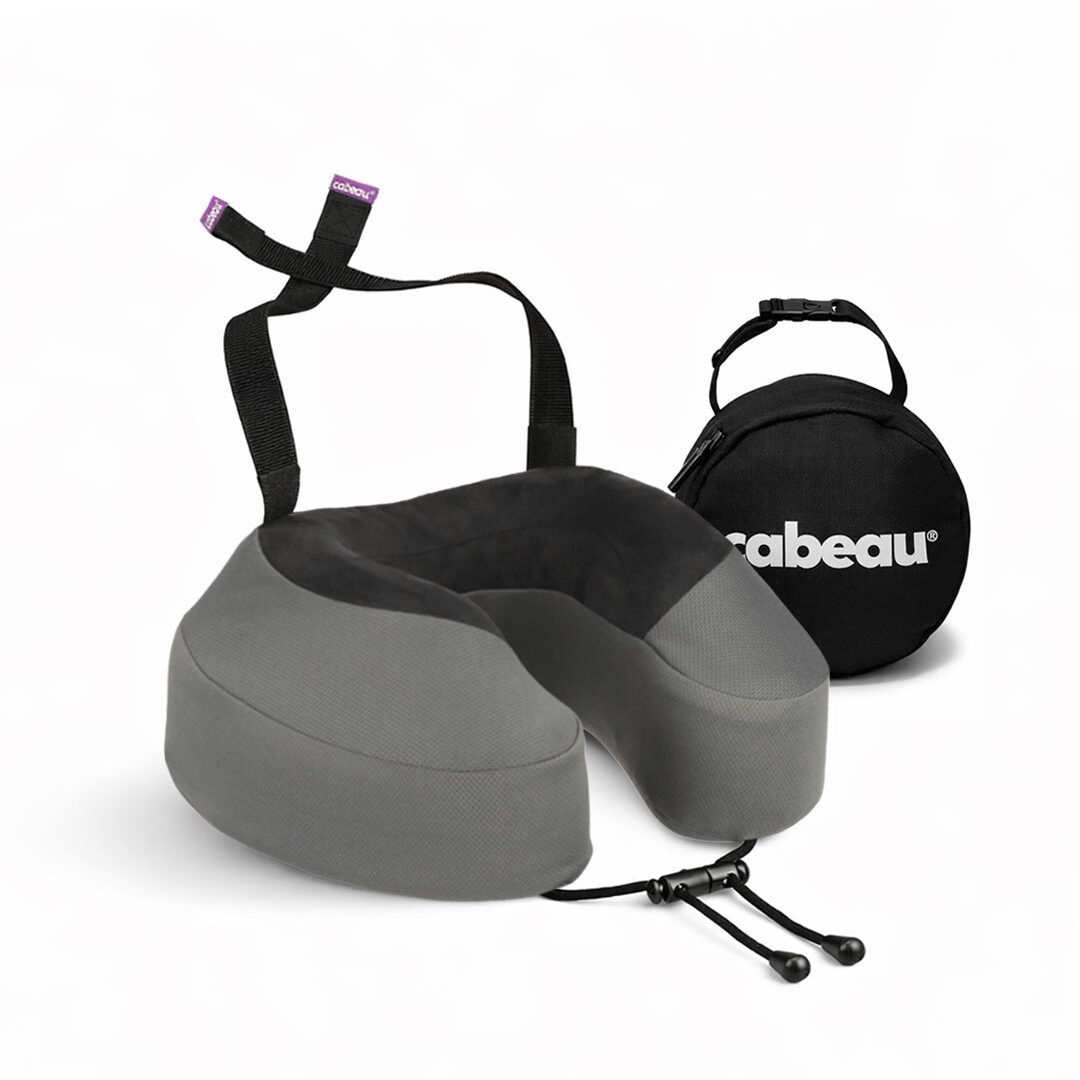
A comparison of the S3’s strap geometry against every friction-fit collar in this roundup shows the mechanical difference is not subtle. Standard foam collars depend on friction against the neck, which is why they rotate and need constant repositioning. The S3 instead anchors to the seat itself, so the support stays aligned with the neck through the whole flight. The raised side walls extend toward the jawline, handling lateral drop as well as the forward drop that ruins most red-eyes. In my analysis, this is the most complete system here for average to tall necks.
| Spec | Value |
|---|---|
| Dimensions (packed) | 9.5 × 10 × 5 in |
| Weight | 11.6 oz |
| Fill | 100% polyurethane memory foam |
| Cover | 100% polyester, removable, machine washable |
| Loft | 5 in (uncompressed) |
| Unique feature | Patented Seat Strap System (attaches to headrest wings) |
| Price (manufacturer) | $39.99 |
Pros
- Velcro seat straps lock the pillow to headrest wings so it cannot rotate.
- Dense polyurethane memory foam that still holds its shape across 10-hour flights. Hour ten looks like hour one.
- Compression case clips to your luggage and squashes the whole thing down to one-third size.
Cons
- The 5-inch height can feel restrictive for petite or short necks.
- Fit is not universal, per Cabeau’s own sizing guidance.
- Straps require a winged headrest to work as designed.
$39.99
Check Price at Cabeau
My analysis started with packed volume, because that is the constraint minimalists actually optimize for. The Trtl wraps like a scarf, except there is a hidden C-shaped brace inside that turns into a lateral shelf between your shoulder and jawline. Foam collars work nothing like that, the mechanism here is fundamentally different. At 9 ounces and packing flat, nothing else here gives window-seat travelers who always lean the same way this much support for so little packed size. The catch is positional, and it is a real one. Back sleepers and anyone who shifts around all night will get almost nothing out of a one-sided frame.
| Spec | Value |
|---|---|
| Packed size | ~paperback book |
| Weight | 9 oz |
| Internal frame | Rigid C-shaped plastic with polyurethane foam padding |
| Outer material | Hypoallergenic polyester fleece (original); polyester-spandex-rayon blend (Plus) |
| Fastening | Velcro (1 strip original, 2 strip Plus) |
| Price (manufacturer) | ~$52.49 |
Pros
- Internal C-shaped frame creates a rigid shelf for side-sleeping.
- Packs flat at 9 oz, lighter than most foam options here.
- Scarf wrap anchors without straps or adjustments.
Cons
- Only supports one side; useless for back sleepers.
- Position-specific design punishes travelers who shift sides.
- Less cushioning than foam for those who prefer soft support.
~$52.49
Check Price at Trtl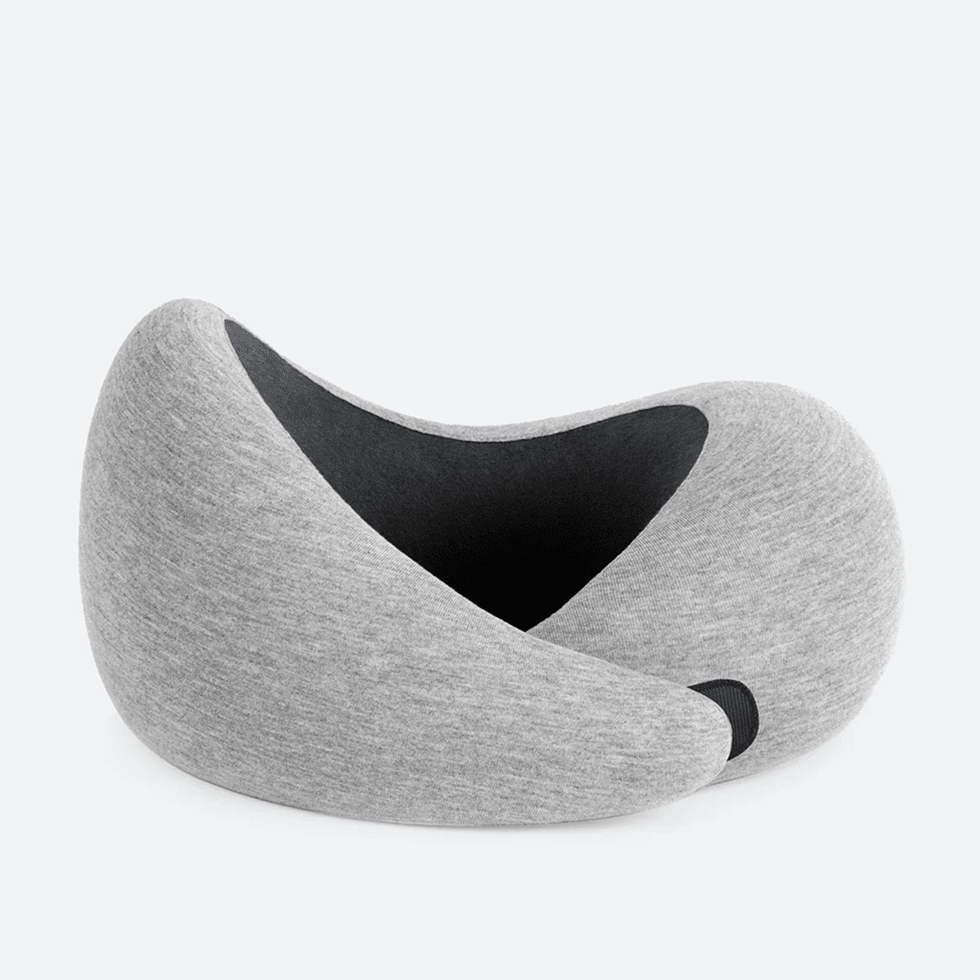
What stood out in my review of the specs was the asymmetric cut. The front of the collar sits higher than the back, keeping the chin from sliding forward while the 360-degree contact spreads pressure. In my analysis, this design solves the forward head-drop problem differently from the strap-based Cabeau: instead of anchoring to the seat, it distributes support around the full neck circumference. At 350g and compressing to 60% in its bag, it sits between the Trtl and Cabeau on portability versus support, with the caveat that short or thick necks may find the collar tight.
| Spec | Value |
|---|---|
| Dimensions (flat) | 25 × 17 × 7 cm (9.8 × 6.7 × 2.7 in) |
| Weight | 350g (12.3 oz) |
| Fill | BASF memory foam core |
| Cover | OEKO-TEX certified; 95% viscose, 5% elastomer; removable, washable |
| Compression | To 60% of full size in included travel bag |
| Price (manufacturer) | ~$69 |
Pros
- Asymmetric 360° wrap distributes head weight evenly around the neck.
- BASF memory foam core maintains loft across long flights.
- Velcro closure adjusts to different neck circumferences.
Cons
- Short or thick necks may find the collar fit tight.
- Heavier than the Trtl at 350g.
- Less compact than scarf-style options when packed.
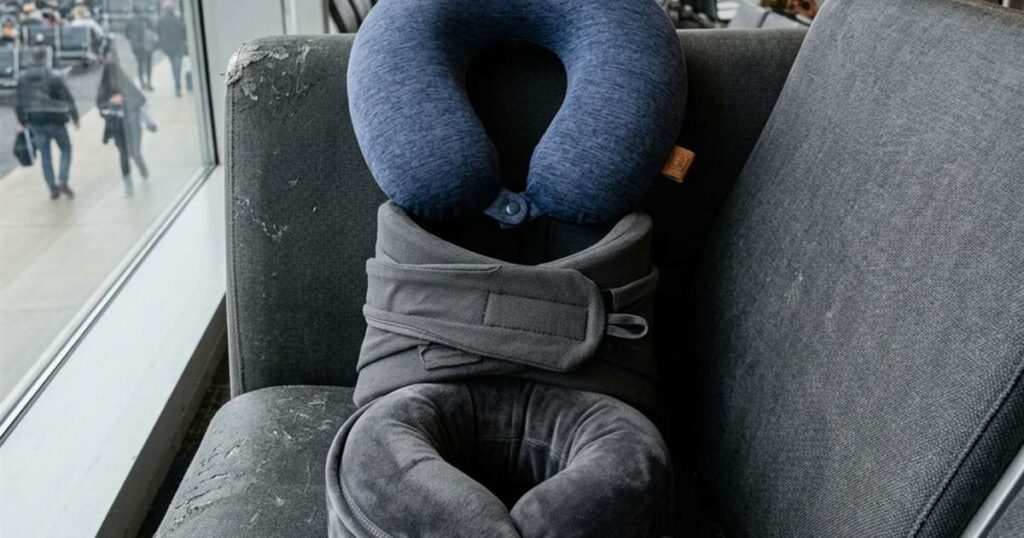
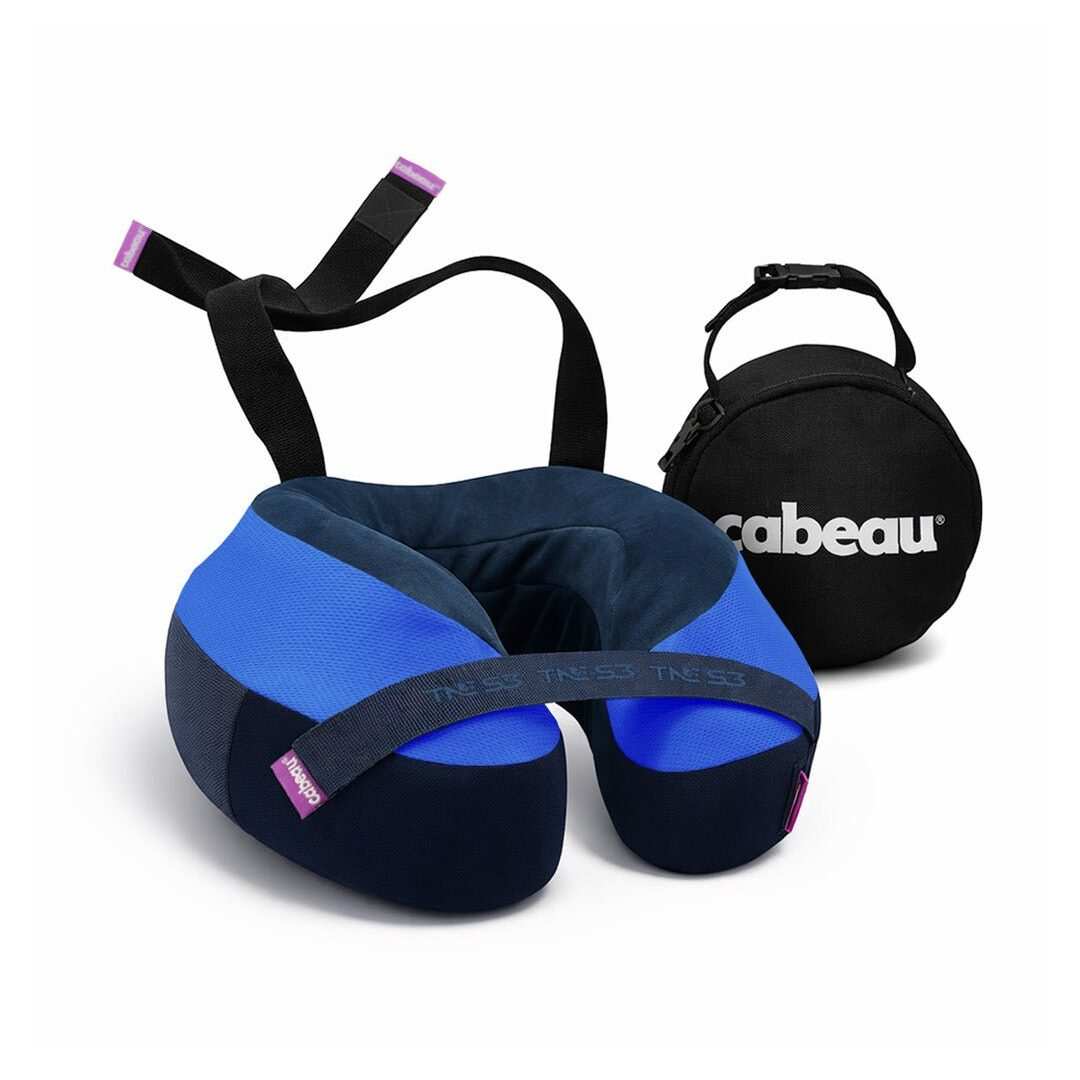
Comparing the TNE S3’s two-anchor system with the single-anchor Evolution S3, the chin strap changes the support geometry entirely. Instead of relying solely on the seat strap to prevent rotation, the TNE S3 adds a second anchor point under the chin that directly opposes forward head drop. In my analysis, this makes it the most mechanically secure option for travelers whose heads fall forward rather than sideways. The trade-off is complexity: the strap needs adjustment, and the 360-degree collar retains the Evolution S3’s bulk.
| Spec | Value |
|---|---|
| Fill | 100% polyurethane memory foam |
| Cover | Removable, machine washable |
| Unique feature | Adjustable chin strap to prevent forward head drop |
| Price (manufacturer) | ~$59.99 |
Pros
- Adjustable chin strap directly prevents forward head drop.
- Dual-anchor design combines chin support with seat-strap stability.
- Memory foam collar that fits average to tall necks properly, no squeezing, no gap.
Cons
- Chin strap takes a few tries to adjust before it feels right, expect some fiddling on flight one.
- May feel restrictive for travelers who dislike chin contact.
- Priced higher than the Evolution S3.
~$59.99
Check Price at Cabeau TNE S3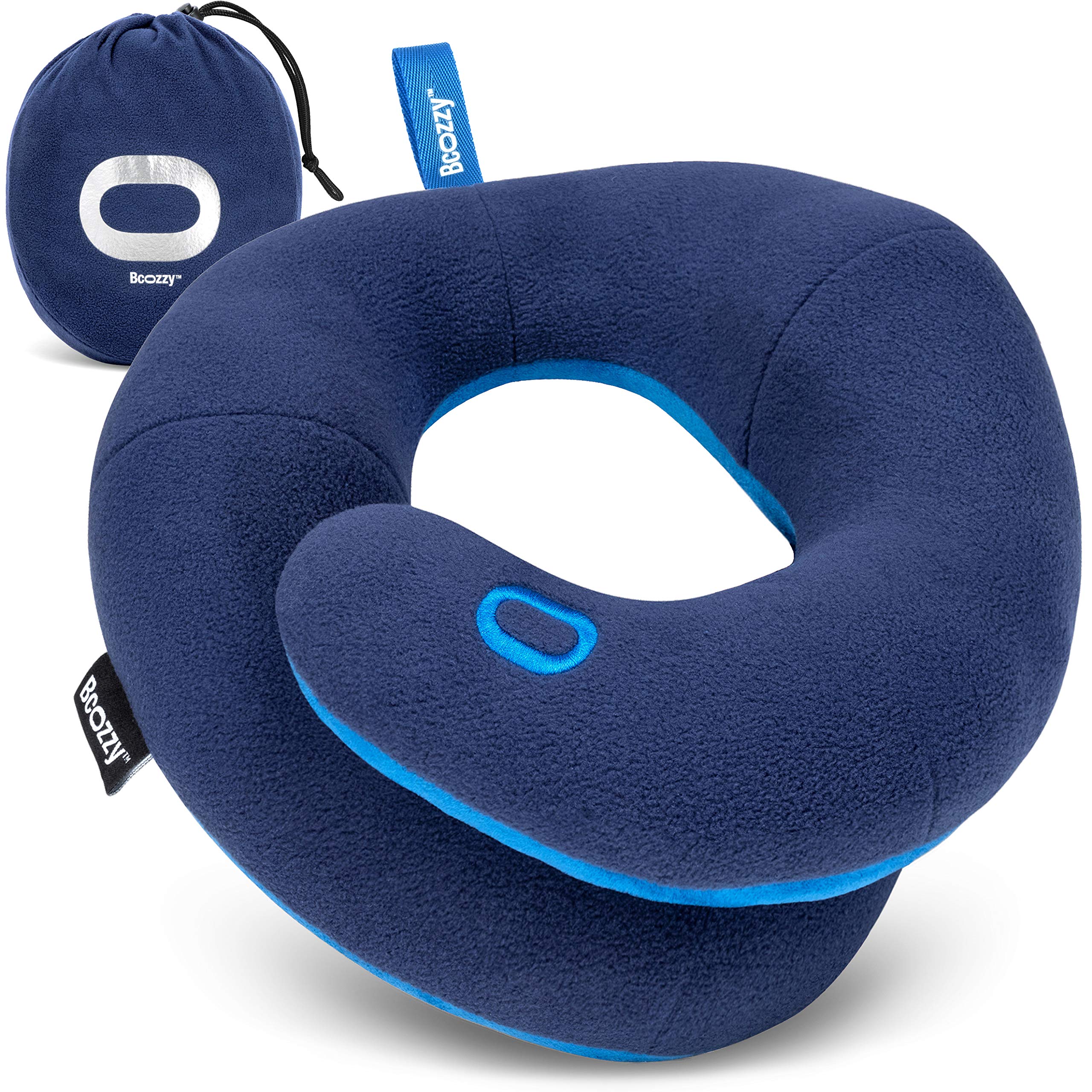
The standout data point is the ~$49.95 price. At roughly a third of the Pluto Pod’s cost, the BCOZZY’s overlapping arm design delivers chin support that no other budget pillow attempts. In my analysis, the polyester fiber fill is the compromise: it compresses over long flights where memory foam holds shape. For travelers who want chin support without paying for the Pluto Pod, the trade-off is reasonable.
| Spec | Value |
|---|---|
| Fill | Polyester fiber |
| Cover | Polyester |
| Neck circumference | Fits up to 16 inches |
| Unique feature | Overlapping arms provide chin rest |
| Price | ~$49.95 |
Pros
- Arm design creates a forward contact point for the chin.
- Fits necks up to 16 inches in circumference.
- Under 6 ounces for lightweight travel.
Cons
- Fiber fill is the weak point for extended use.
- Compresses over 4-6 hours of sustained head weight.
- May not fit necks over 16 inches in circumference.
~$49.95
Check Price at BCOZZY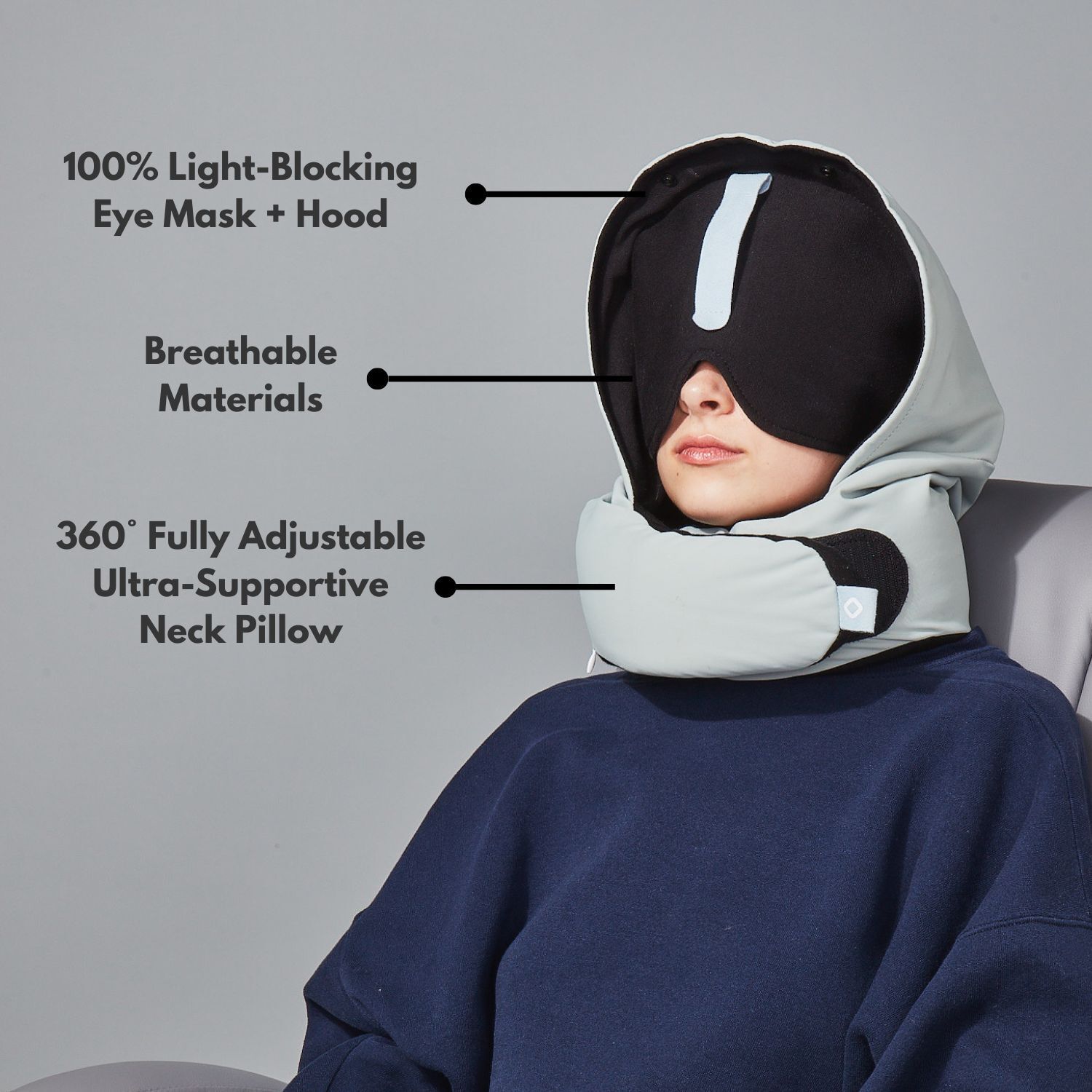
I weighed the sensory isolation against the packed volume, and the Pluto Pod 2.0 occupies a distinct position in this roundup. The integrated hood and drop-down eye mask address light and visual distraction, not just neck support. In my analysis, this makes it the only pick that treats the cabin environment as part of the sleep problem. The trade-off is bulk: at ~14 oz and bulkier than the S3, it demands more carry-on space than the Trtl or BCOZZY.
| Spec | Value |
|---|---|
| Fill | Ergonomic memory foam (same spec as Evolution S3) |
| Unique feature | Built-in hood + integrated drop-down eye mask |
| Cover | Removable |
| Price | ~$145 |
Pros
- Integrated hood blocks cabin light for window-seat sleepers.
- Drop-down eye mask eliminates need for separate sleep mask.
- Memory foam matches Cabeau’s support quality.
Cons
- Bulkiest option at ~14 oz and larger packed size.
- Highest price at ~$145.
- Not ideal for travelers who prioritize minimal packing.
~$145
Check Price at Pluto
From a pure spec standpoint, the Therm-a-Rest is the outlier here. It is not a neck pillow at all, but a rectangular camp pillow that compresses into a sack smaller than any U-shape in this roundup. In my analysis, its value is versatility: the same 15 x 11 x 5 in foam serves as neck support, lumbar cushion, or window lean depending on seat position. For travelers who already carry camp gear, it eliminates a single-use item.
| Spec | Value |
|---|---|
| Dimensions | 15 × 11 × 5 in (small) |
| Fill | Foam (compressible) |
| Packed size | Smaller than most U-shape neck pillows (compression sack) |
| Unique feature | Multi-use: neck, lumbar, window lean, seat cushion |
| Price | ~$34.95 |
Pros
- Multi-use design works for neck, lumbar, or window lean.
- Compresses smaller than any U-shape neck pillow.
- Doubles as camp pillow for dual-purpose packing.
Cons
- Not shaped for dedicated neck support.
- Rectangular form requires positioning adjustment.
- Foam less conforming than memory foam options.
~$34.95
Check Price at Therm-a-RestHead-to-Head Comparison
| Pillow | Best For | Fill | Weight | Packed Size | Price |
|---|---|---|---|---|---|
| Cabeau Evolution S3 | Overall / seat strap stability | Memory foam | 11.6 oz | 9.5×10×5 in | $39.99 |
| Trtl Pillow Plus | Minimalist / window seat side sleepers | Plastic frame + foam pad | 9 oz | Paperback | ~$52.49 |
| Ostrichpillow Go | 360° collar support / no straps | BASF memory foam | 12.3 oz | 60% compressed | ~$69 |
| Cabeau TNE S3 | Head-bobbing / chin drop prevention | Memory foam | ~12 oz | Similar to S3 | ~$59.99 |
| BCOZZY | Chin support | Polyester fiber | ~6 oz | U-shape | ~$49.95 |
| Pluto Pod 2.0 | Light blocking / sensory isolation | Memory foam | ~14 oz | Bulkier than S3 | ~$145 |
| Therm-a-Rest Compressible | Window leaner / multi-use | Compressible foam | 8 oz | Compression sack | ~$34.95 |
The Contrarian Take: Memory Foam Is Not Automatically Better Than an Inflatable
Every premium travel pillow on the market uses memory foam as its primary selling point. The implication is that memory foam is definitively superior to inflatable options. The reality is more specific.
Memory foam provides superior conforming support and does not require management (inflating, adjusting pressure) during the flight. It also weighs significantly more and takes up volume whether compressed or not. An inflatable pillow deflates to the size of a fist . No foam option matches that. For travelers who value pack size above everything and are not doing 14-hour routes regularly, an inflatable adjusted to about 70% capacity (rather than fully inflated, which feels firm and loud) delivers functional neck support at a fraction of the pack volume.
The specific scenario where inflatables fail is extended sleep across multiple sleep cycles. As the traveler shifts position and the foam loses its temperature conforming advantage (memory foam softens at body temperature; an inflatable does not), the inflatable is less forgiving of repositioning. For a 4-hour nap on a 7-hour flight, an inflatable is a legitimate choice. For 8+ hours of attempted sleep, the memory foam options on this list are the more structurally honest recommendation.
What the Standard U-Shape Gets Wrong
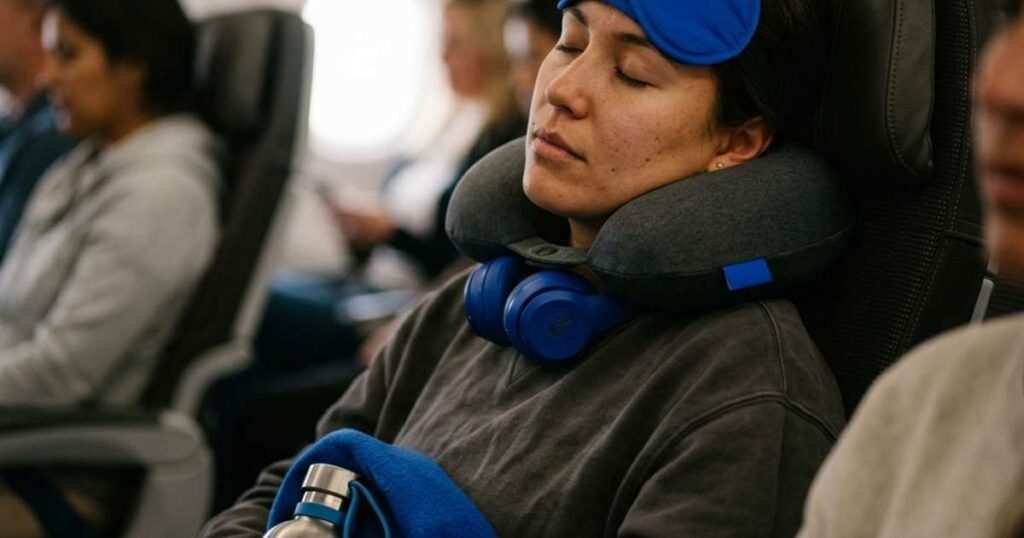
The classic U-shape travel pillow positions foam on the sides and back of the neck. It does not provide anterior (front) support, which means the head can still drop forward once neck muscles relax during sleep. The geometry was designed for seated comfort during waking use , watching a film, reading , not for biomechanical head retention during sleep.
Research in Applied Ergonomics found that headrest support in an aircraft seat significantly reduced the need for active cervical muscle contraction to maintain head position, which is what a travel pillow approximates. The mechanism: without external support, the sternocleidomastoid and trapezius must fire continuously to hold the head at the reclined seat angle. External support offloads that demand and allows the muscles to actually relax. A U-shape that only contacts the sides and back of the neck provides partial support; the options on this list that anchor to the headrest or wrap the full circumference provide structural offloading.
Frequently Asked Questions
Does a standard U-shape travel pillow hurt your neck?
It does not hurt the neck directly, but it fails to support the head during sleep. The U-shape contacts the sides and back of the neck; it does not prevent the head from dropping forward when neck muscles relax. For short naps where you wake up and reposition, it provides minimal function. For 8-14 hours of sleep, the forward drop it allows causes the stiffness most travelers attribute to “sleeping on the plane.”
Foam or inflatable: which is better for long-haul?
Foam for anything over 6 hours. Inflatable options pack to the size of a fist, which is the advantage. On an extended sleep across multiple cycles, foam provides more consistent support as it conforms to the neck at body temperature and does not need manual pressure adjustment. An inflatable at 70% inflation (rather than fully inflated) performs better than fully inflated, but it still does not match the sustained support of solid polyurethane foam on a 14-hour route.
What pillow works best for window seats?
A J-shaped or lateral-support pillow. The Trtl is the clearest example. Window seat travelers consistently lean to the same side and rest against the cabin wall. The Trtl’s C-frame creates a lateral shelf for this specific posture. A full-circumference collar like the Ostrichpillow Go also works for window leaners.
Can you bring a bed pillow on a plane?
A standard 20×26 bed pillow is too wide for an economy seat and too large to use as a neck support. Even a youth pillow (16×22) does not provide the lateral head retention a travel pillow geometry offers. The Therm-a-Rest Compressible Pillow (small) is the closest functional equivalent to a small bed pillow in a compress-to-pack format, and it works better as a window lean or lumbar option than a neck pillow.
How do you pack a bulky foam travel pillow?
Every foam travel pillow on this list except the Trtl comes with a compression carry case. The Cabeau S3 compresses to roughly one-third of its full volume. The Ostrichpillow Go compresses to 60% of its volume. Neither reaches the pack size of an inflatable, but both attach to the outside of a carry-on or clip to a bag strap via the included case hardware, which keeps the interior bag space free.
My seat has no headrest wings. Will the straps still work?
No. The Cabeau S3’s straps need winged headrests to lock onto. Without wings there is nothing to anchor to. Pick a design that does not need the seat: the Trtl’s C-frame braces against your own shoulder, or the Ostrichpillow Go wraps the full neck. Window-seat travelers can also lean on the Therm-a-Rest as a window lean.
Which One Should You Buy?
For most travelers, the answer is the Cabeau Evolution S3: its seat strap system locks the pillow to headrest wings so it cannot rotate, and its 5-inch height suits average to tall necks.
From there, match the pick to the problem. Minimalists and window-seat side sleepers should take the Trtl Pillow Plus; travelers who want 360-degree wrap should take the Ostrichpillow Go; head-bobbing calls for the Cabeau TNE S3; chin support on a budget points to the BCOZZY; light blocking and sensory isolation point to the Pluto Pod 2.0; and multi-use value points to the Therm-a-Rest Compressible Pillow (Small).