
You wake up with a stiff neck for the third morning in a row. The pillow feels fine at first, same weight, same shape, but something is off. You are not sleeping worse because of stress or your mattress. The pillow is the variable that changed, slowly enough that you did not notice until your neck started logging the complaint.
That scenario accounts for most delayed pillow replacements. The signs are there well before the neck pain, but none of them are dramatic. This article covers the five physical checks that actually indicate whether a pillow needs replacing, washing, or just a proper fluff. Starting with the fold test most guides reference, and including the four signals that matter more than the fold test does.
For the full maintenance framework this article feeds into, the pillow care guide covers washing, drying, fluffing, and storage for every fill type. If you already know your pillow needs replacing and want to start there, the commercial pillow carry the category breakdowns by fill type and sleep position.
The Fold Test: What It Measures and Where It Stops
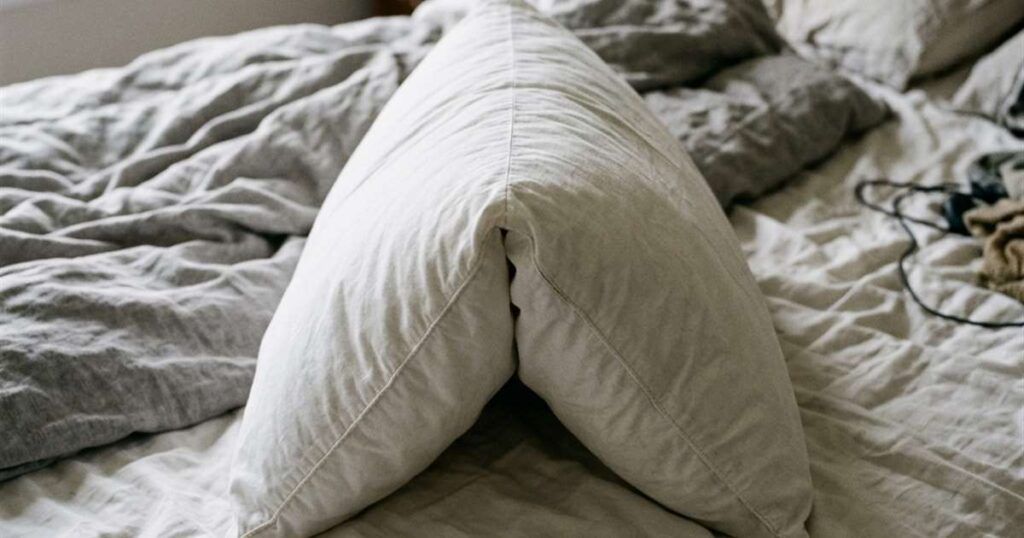
The fold test is the most widely cited pillow check: fold the pillow in half lengthways, hold it for 30 seconds, release it, and watch what happens. A pillow that springs back to its original shape has fill that still has elastic recovery. A pillow that stays folded, or unfolds slowly and unevenly, has fill that has lost meaningful resilience.
That is a real and useful signal. But it only measures one thing: elastic recovery in the fill. It tells you nothing about loft (whether the pillow is still thick enough to support your head at your sleep position), about microbial load (whether dust mite populations have built up to the point of triggering allergic responses), or about structural deformation in specific zones (a pillow can pass the fold test overall while having a compressed dead zone exactly where your head rests).
The fold test is a pass/fail screen. Failing it is a clear replacement signal. Passing it does not mean the pillow is fine. It means one property is still intact.
Fold test by fill type:
| Fill type | Expected result (healthy pillow) | Fail indicator |
|---|---|---|
| Down / feather | Springs back within a few seconds | Stays folded or unfolds unevenly |
| Polyester fiberfill | Springs back within 5-10 seconds | Holds crease or returns slowly in patches |
| Shredded memory foam | Returns slowly, 10-20 seconds is normal | Holds fold completely, or crease stays visible |
| Solid memory foam | Does not apply. Foam does not fold cleanly | Use loft and support zone checks instead |
| Latex | Returns within a few seconds | Holds crease or shows surface cracking |
| Buckwheat | Does not apply. Hull fill does not compress like fiber | Use fill density and odor checks instead |
Check 2: The Loft and Support Zone Test
Stand the pillow upright on its edge on a flat surface. A pillow with adequate loft holds its shape with minimal slumping. A pillow that immediately collapses sideways or into a thin wedge shape has lost fill density to the point where it is no longer providing consistent support across its surface.
Follow that with a zone check. Lay the pillow flat and press firmly with both palms across different areas, center, edges, corners. A pillow in good condition resists compression fairly evenly. One with a worn support zone will feel noticeably thinner and less resistant in the area where your head rests most. That zone compression is the structural failure that causes neck pain in an otherwise intact-seeming pillow, and the fold test will not catch it.
If the center compresses to half the depth of the edges under the same hand pressure, the pillow’s primary support zone is compromised. Washing will not fix this. It is a fill density problem, not a cleanliness one.
Check 3: The Age and Usage Threshold
Pillow fill materials degrade on a known timeline regardless of how well the pillow is maintained. The polymer chains in synthetic fills break down. Down clusters lose fill power. Latex oxidises slowly at the surface. None of this is visible from the outside. Which is why age is a legitimate independent check even when the pillow looks and feels acceptable.
| Fill type | Typical replacement range | Accelerated by |
|---|---|---|
| Polyester fiberfill | 1-2 years | Frequent washing, high heat drying |
| Down and feather | 2-3 years | Moisture exposure, low fill power at purchase |
| Shredded memory foam | 2-4 years | Heat exposure, failure to fluff daily |
| Solid memory foam | 2-3 years | High body weight, heat exposure |
| Latex (natural) | 3-5 years | UV exposure, ozone, dry storage conditions |
| Buckwheat | 3-5 years (hull replacement) | Moisture, infrequent airing |
A pillow at the top of its replacement range that also shows any other signal in this list, uneven support zones, persistent odor, worsening allergy symptoms at night, is past its useful life even if it passes the fold test.
Check 4: The Odor and Hygiene Test
A pillow that smells sour, musty, or stale even after washing is carrying a microbial load that laundering alone cannot fully address. The organic residue, sweat proteins, saliva enzymes, sebum, that causes yellowing also sustains dust mite populations and bacterial colonies inside the fill. At low levels this is manageable with regular washing. At high levels it becomes a hygiene problem that correlates with worsening nighttime allergy symptoms: sneezing on waking, nasal congestion that clears during the day, or itchy eyes in the morning.
Dust mites do not cause structural problems in the pillow. They do not degrade fill. But they are a meaningful health signal when allergy symptoms follow the pattern above. A pillow that smells after washing and is also at or near its age threshold should be replaced rather than washed again.
A pillow that smells but is otherwise new (less than a year old, structurally intact, no support zone failure) is a washing problem, not a replacement problem. The distinction matters because replacement is the right answer in one scenario and an unnecessary expense in the other.
Check 5: The Morning Symptom Pattern
Physical pillow checks tell you about the fill. Morning symptom patterns tell you about the outcome. Three patterns reliably indicate the pillow is the variable:
Neck stiffness that resolves within an hour of waking. The pillow is not maintaining spinal alignment through the night. The neck is compensating for inadequate support, and the muscles are stiff as a result. As you move through the morning, other factors take over and the stiffness resolves, which is why it is easy to attribute to sleeping position or stress rather than the pillow itself.
Worsening allergy symptoms at night or on waking. Dust mite allergen is heaviest in the pillow and mattress, where mites concentrate in the warm, humid microenvironment created by body heat and perspiration. Symptoms that are worse in the bedroom than elsewhere, and that peak on waking before improving through the day, are consistent with dust mite exposure from bedding.
Persistent facial pressure or headaches in the morning. A pillow with a collapsed support zone in the center forces the head into a lower position than the fill depth suggests, which can place the cervical spine in slight flexion or extension through several hours of sleep. The result is muscular tension that manifests as facial pressure or a dull headache on waking, symptoms easy to attribute to other causes, but worth correlating against pillow age and support zone condition.

Wash or Replace? The Decision Framework
Not every signal means replacement. Here is how to triage the checks above:
| Signal | Wash first? | Replace? |
|---|---|---|
| Fold test fail | No | Yes, elastic recovery is gone |
| Center support zone compressed | No | Yes, washing does not restore fill density |
| Odor, pillow under 12 months old | Yes | Only if odor persists after washing |
| Odor, pillow at age threshold | No | Yes, hygiene and fill degradation combined |
| Lumpy fill (polyester or down) | Yes, try hot wash + dryer balls | Replace if lumpiness returns within weeks |
| Morning neck stiffness only | Try fluffing or fill adjustment first | Replace if symptom persists after 2 weeks |
| Allergy symptoms + pillow over 2 years | No | Yes. Dust mite load plus degraded fill |
| Pillow past age range, no symptoms | Judgement call | Recommended, degradation is cumulative |
Why lumpy pillows are a washing problem first: Lumps in polyester fiberfill and down form when moisture binds fibers or clusters together in compressed groups that then dry in that bonded state. A proper hot wash with agitation, dryer balls or wool balls in the drum, can break up bonded fibers and restore even distribution. If the lumpiness returns quickly after washing, the fill has degraded past the point where washing can restore it and replacement is the answer.
Not found your Pillow here? Suggest a pillow for us to Analyze.
Frequently Asked Questions
What is the fold test for pillows?
Fold the pillow in half lengthways, hold it for 30 seconds, release it, and observe the recovery. A pillow that springs back has fill with functional elastic recovery. One that stays folded or unfolds very slowly has lost that property and needs replacing. The fold test is a useful screen, but it only measures elastic recovery; it does not measure loft height, support zone integrity, or microbial load.
How often should you replace your pillow?
Replacement timing depends on fill type: polyester fiberfill typically lasts one to two years, down and feather two to three years, shredded and solid memory foam two to four years, and latex three to five years. These are ranges rather than hard dates. A pillow used with a protective cover, washed regularly, and fluffed daily will last longer than one receiving no maintenance.
Can a pillow make you sick?
Dust mite allergen accumulates in pillows over time, concentrated in the warm, humid environment created by body heat and perspiration. Dust mites do not bite or directly harm the fill, but their waste products trigger allergic responses in sensitive individuals. Common symptoms include sneezing, nasal congestion, and itchy eyes on waking, which improve through the day as you move away from the exposure source.
Why is my pillow lumpy?
Lumps in polyester fiberfill and down form when moisture binds fibers or clusters together during use or washing, causing those bonded groups to dry compressed. A hot wash with agitation using dryer balls or wool balls breaks up bonded fibers in most cases. If lumpiness returns quickly after washing, the fill has degraded past the point where washing restores it and replacement is the correct response.
Should I wash my pillow or buy a new one?
Wash first if the pillow is under 12 months old, structurally intact, and the issue is odor or lumpiness. Replace if the pillow fails the fold test, has a compressed centre support zone, is at or past its fill-type age threshold, or produces persistent morning neck stiffness that washing does not resolve.
Why do I keep waking up to adjust or punch my pillow?
Constantly flipping, folding, or fluffing your pillow overnight is a sign the fill has lost structural density. When fill can no longer support head weight consistently, your body reacts by forcing manual adjustments throughout the night. If you must reshape your pillow more than once per night to fall back asleep, the support core has failed and replacement is required.
Can a pillow protector extend how often you need to replace your pillow?
Yes. A zippered, breathable pillow protector blocks sweat proteins, skin oils, and dust mites from reaching the fill, extending hygienic lifespan by roughly 6 to 12 months. However, protectors only preserve hygiene; they do not stop mechanical fill degradation or polymer breakdown from daily head weight.