
Most pillowcase comparisons start in the wrong place by treating satin and silk as equals with different price tags. The structural reality is clear: silk is a natural protein filament spun by Bombyx mori silkworms, while satin is simply a weave pattern that can be made from synthetic polyester. For a breakdown of momme weight, Grade 6A fibers, and lab testing data, read our specialist review on mulberry silk pillowcase benefits before selecting your fabric.
That distinction is not a technicality. It determines how the fabric behaves against your hair cuticle at 2 a.m., how much of your moisturizer it absorbs before dawn, and whether the pillowcase can regulate temperature or just trap heat.
This article breaks down what each material actually does and gives a plain verdict for every scenario: acne-prone skin, curly and natural hair, hot sleepers, and buyers who need the friction benefits without the cost.
What You Are Actually Buying: Fiber vs. Weave
Silk the fiber has a triangular cross-section that refracts light, which explains the characteristic sheen. Research on silk’s protein composition identifies two proteins: fibroin, which makes up roughly 70-80% of the fiber and provides its mechanical properties, and sericin, which accounts for 20-30% and carries the moisture-management benefits. Both proteins are absent from polyester satin. There is no synthetic substitute.
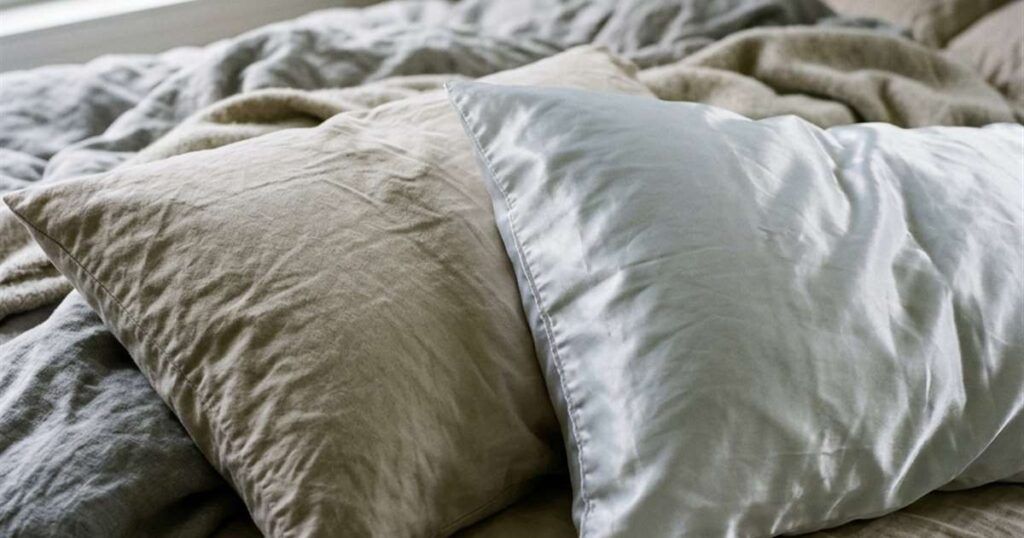
Polyester satin’s smooth surface comes entirely from its weave geometry. The satin weave runs warp threads over four or more weft threads before interlacing, which minimizes the number of points where the fiber crosses over itself. Fewer crossover points mean a flatter, slicker surface. And that surface does reduce friction against hair. TRI Princeton’s friction testing confirmed that cotton produces more friction against hair than silk, and plain cotton’s rough surface put it in a similar category to plain-weave polyester. Polyester satin, by that logic, is a genuine step up from cotton. It just does not bring the biological properties that silk’s fiber structure carries.
The table below captures the spec-level differences so nothing is buried in prose.
| Property | Mulberry Silk (22-25 momme, Grade 6A) | Polyester Satin |
|---|---|---|
| Fiber origin | Natural protein (Bombyx mori silkworm) | Petroleum-based synthetic |
| Quality metric | Momme weight (19-25 mm for pillowcases) | Thread count (200-400 recommended) |
| Surface friction | Low, charmeuse weave + natural protein structure | Low, satin weave geometry only |
| Moisture absorption | Very low. Sericin protein repels moisture | Low to moderate, varies by thread count |
| Temperature regulation | Passive thermoregulation via air-trapping fiber structure | Poor, traps heat against skin |
| Hypoallergenic | Yes, naturally resistant to dust mites and mold | No inherent allergen resistance |
| Machine washable | Yes (cold, delicate cycle; mesh bag required) | Yes (cold or warm cycle; no special precautions) |
| Price range (per pillowcase) | $50-$125+ | $10-$25 |
| Expected lifespan | 1-3 years with correct care | 1-2 years; surface degrades faster with frequent washing |
The Hair Argument: Where Satin Earns Its Place
Friction is what damages hair overnight. When a cotton pillowcase’s rough surface contacts hair repeatedly during sleep, it raises the cuticle, the overlapping scale-like cells along each strand, and that mechanical stress causes breakage, frizz, and split ends. Research published in the International Journal of Trichology (2011) found that friction between hair fibers and pillowcase material can lead to increased breakage, tangling, and moisture loss.
Both silk and polyester satin address that problem. The long floats in a satin weave create fewer contact points between fabric and hair, so a polyester satin pillowcase is a meaningful upgrade from cotton for anyone dealing with frizz, tangles, or overnight breakage. ScienceInsights notes that cotton creates more friction against hair than polyester satin, placing budget satin cases in a “genuinely decent option” category for hair.
For curly and natural hair specifically, moisture retention is the second variable, and this is where silk’s fiber properties pull ahead. Cotton pillowcases absorb moisture from hair throughout the night, leaving dry and textured hair more brittle by morning. Polyester satin is not highly absorbent, so it performs better than cotton on moisture too, but it does not actively support moisture retention the way silk’s sericin protein does. Mulberry Park Silks’ guidance on curly hair puts it plainly: both silk and satin reduce friction, but only silk delivers the full moisture and protein benefits for hair health.
My verdict for hair: if you are on a budget or have straight to wavy hair that tolerates most conditions overnight, polyester satin at $10-$25 handles friction adequately. If you have curly, color-treated, or chemically processed hair where moisture loss is a daily problem, silk at the right momme weight is the better material.
The Skin Argument: The One Scenario Where Silk Has No Equal
For skin, the fiber’s biological properties matter more than the weave pattern. And this is where satin cannot close the gap.
Silk’s sericin protein does two things that polyester cannot replicate. First, it is non-absorbent: rather than drawing moisture out of skin (the way cotton does) or sitting inert against it (the way polyester does), silk’s surface lets skin retain its own oils and any applied serums. Slip’s clinical testing data showed their 22-momme slipsilk fabric absorbed significantly less face cream than cotton pillowcases in laboratory conditions, and created 43% less friction on average compared to cotton with 220-360 thread count. Second, silk carries inherent antimicrobial properties that suppress bacterial growth. A study published in the Journal of Dermatology (2017) found that patients using silk fabric with antimicrobial properties saw a significant reduction in acne lesions over 8 weeks compared to those using cotton.
For acne-prone skin, the combination of lower friction, minimal moisture absorption, and bacterial resistance makes silk a defensible upgrade. Polyester satin reduces friction, which is relevant to acne via reduced inflammation, but it does not carry the antimicrobial profile. A study from the Department of Dermatology at the Medical University of Austria found positive results on acne after six weeks of wearing a silk textile shirt. And while that is not a pillowcase study, it establishes a plausible mechanism for skin improvement.
For hot sleepers, polyester satin introduces a specific problem: it does not breathe. Polyester fibers are petroleum-based and trap heat against the face. Silk’s protein fiber structure traps air in small pockets, providing passive thermoregulation staying closer to neutral temperature through the night. If you run warm at night and currently flip your pillow to find the cool side, polyester satin will make that worse.

The Myth That Needs to Die: “Satin Is Just Cheap Silk”
Every other article on this topic frames satin as silk’s budget substitute. A lesser version of the same thing. That framing is wrong, and it sends buyers in the wrong direction.
Satin is not a cheaper grade of silk. It is a different product category made from a different material with a different mechanism. The only thing silk and polyester satin share is a smooth surface. Silk delivers that surface through fiber biology. Polyester satin delivers it through weave geometry. Understanding that split tells you exactly when to spend the money and when not to.
If your primary concern is hair friction you want to wake up with less frizz and fewer tangles polyester satin handles that job at a fraction of the cost. You do not need to spend $85 on a Slip pillowcase to solve a friction problem. A well-constructed polyester satin case with a thread count in the 300-400 range gets you most of the way there.
If your concerns extend to skin sensitive, acne-prone, or dehydrated or if you are a hot sleeper, polyester’s inability to breathe or support moisture becomes a real liability. That is when the higher cost of silk is structurally justified, not just aesthetically preferable.
How to Read a Silk Label (and What to Ignore)
Most of the confusion in the market comes from label language. Here are the specs that matter and the ones that do not.
Momme weight is the correct quality metric for silk. It measures how much 100 yards of silk fabric 45 inches wide weighs in pounds. For pillowcases, the functional sweet spot is 19-25 momme. Below 19, the fabric is thin and wears quickly. Above 25, durability improves but the cost-to-benefit ratio for a pillowcase specifically flattens out. A 25-momme pillowcase weaves around 750 threads per inch versus roughly 600 in 22 momme, measurably denser, but not transformatively different at skin level for most users.
Grade 6A is the highest silk fiber grade, indicating long, uniform, smooth filaments. Below Grade 5, expect shorter fibers that produce a less consistent surface over time. Every silk pillowcase worth recommending should disclose both momme weight and fiber grade. If a listing says “100% silk” without specifying momme or grade, treat it as a red flag.
Thread count applies to satin and cotton, not silk. For polyester satin, Casper notes a thread count of 200-400 as the practical range for smooth texture and durability. Below 200, the weave is coarse enough to partially negate the satin surface benefit.
“Silk satin” or “silk charmeuse” labels mean the satin weave is executed in actual silk fiber. The most expensive combination. Most silk pillowcases use a charmeuse weave, which is why the terms appear together. This is different from polyester satin marketed with “silk” in the description to imply similarity. Check the fiber content listed in the full product spec, not the marketing headline.
The Practical Picks
My buying logic, distilled: match the material to the problem, not the price tag. Friction-only problem → polyester satin at $10–$20, done. Skin, moisture, or heat problem → silk, and the momme and grade specs I listed above are how you avoid overpaying for under-spec fabric.
I’d pick a 22-momme Grade 6A mulberry silk pillowcase for anyone with acne-prone or sensitive skin, anyone who sleeps hot, or anyone with curly or high-porosity hair where overnight moisture loss is a real problem.
Slip’s queen pillowcases (22-momme slipsilk, $120−$125) are the most widely tested option in this category, with published clinical data on friction and moisture absorption. Fishers Finery’s 25-momme Grade 6A pillowcase is consistently named Best Overall by Good Housekeeping and CNN Underscored, with a more accessible price point than Slip for the same fiber grade. Both are machine-washable on a delicate cycle in cold water with a mesh laundry bag, more maintainable than their reputation suggests.
For the friction benefit at low cost, straight to wavy hair, no particular skin sensitivities, or budget constraint, a polyester satin case in the 300-thread-count range at $10-$20 is a rational buy. It solves the cotton friction problem. Just set care expectations accordingly: the surface smoothness degrades faster than silk under frequent washing.
The Care Gap Is Real, Plan for It
Silk requires cold water only (no higher than 86°F per most manufacturer care guides), a pH-neutral enzyme-free detergent, a mesh laundry bag, and air drying away from direct sunlight. The Sleep Foundation’s silk care guidance confirms most silk pillowcases can be machine-washed on a delicate cycle using cold water, as long as a mesh bag is used and enzyme-free detergent applied. High heat in a dryer, even a low cycle, can shrink fibers, strip sheen, and accelerate wear. Bleach and fabric softeners both damage the protein structure.
Polyester satin is machine-washable and dryer-safe without special precautions, which is a genuine practical advantage if you want to wash your pillowcase every few days alongside regular laundry. That washing frequency matters for acne-prone skin; if maintaining a separate gentle wash cycle feels like friction (the behavioral kind), polyester satin washed frequently beats silk washed infrequently.
Frequently asked Questions
What is the actual difference between silk and satin?
Silk is a natural protein fiber produced by silkworms, whereas satin is a weave pattern that creates a smooth, glossy surface. Satin can be woven from polyester, nylon, or silk itself. A budget satin pillowcase is almost always polyester woven in a satin pattern, offering surface slip without silk’s natural temperature regulation or protein properties.
Is satin as good as silk for reducing hair frizz and breakage?
Yes, for friction reduction alone. Both silk and polyester satin feature smooth surfaces that minimize mechanical drag against hair cuticles overnight, reducing morning frizz and tangles compared to cotton. However, silk outperforms satin for dry or textured hair because silk’s natural sericin protein supports moisture retention, whereas polyester does not.
Which is better for acne-prone skin: silk or satin?
Silk is significantly better for acne-prone skin. Pure silk is non-absorbent, letting your skin retain applied facial serums while resisting bacterial accumulation. Synthetic polyester satin reduces surface friction against inflamed skin, but it traps facial heat and does not possess silk’s inherent antimicrobial resistance.
Is satin good for hot sleepers?
No. Polyester satin is made from synthetic petroleum-based fibers that trap body heat against your face overnight. Silk provides passive thermoregulation because its natural protein filament structure traps small air pockets that stay neutral in temperature. If you sleep hot, polyester satin will worsen heat retention.
What momme weight should I look for when buying a silk pillowcase?
Look for a momme weight between 19 and 25 momme in Grade 6A mulberry silk. Below 19 momme, silk fabric is thin and degrades quickly under washing. Above 25 momme, durability increases, but the cost climbs significantly without providing a noticeable improvement in skin or hair feel.
Can you machine wash a silk pillowcase?
Yes, provided you use cold water on a delicate cycle, a mesh laundry bag, and a pH-neutral enzyme-free detergent. Avoid regular heavy-duty detergents, bleach, and fabric softeners, as they break down natural silk proteins. Always line dry away from direct sunlight rather than using a tumble dryer.
Fabric versus weave changes the setup. Our Pillow Setup & Adjustment section explains which cases suit which pillows.