
The washing machine kills more memory foam pillows than anything else. Neither damage is reversible. This guide gathers the full-spectrum pillow care methods from the pillow care guide and walks through what memory foam tolerates, what it refuses to tolerate, and the exact steps that lift out sweat, odor, and stains without shortening the pillow’s working life.
Polyurethane sits at the heart of memory foam. Its slow, sinking feel comes from viscoelastic polymer chains, and those chains answer pressure and temperature at their own pace. Dunk them in water and agitate them, though, and they stretch past their elastic limit and tear. That is why a machine-washed pillow comes out lumpy, compressed in patches, or hollow in places. No spin cycle setting prevents this; the problem is agitation, not speed.
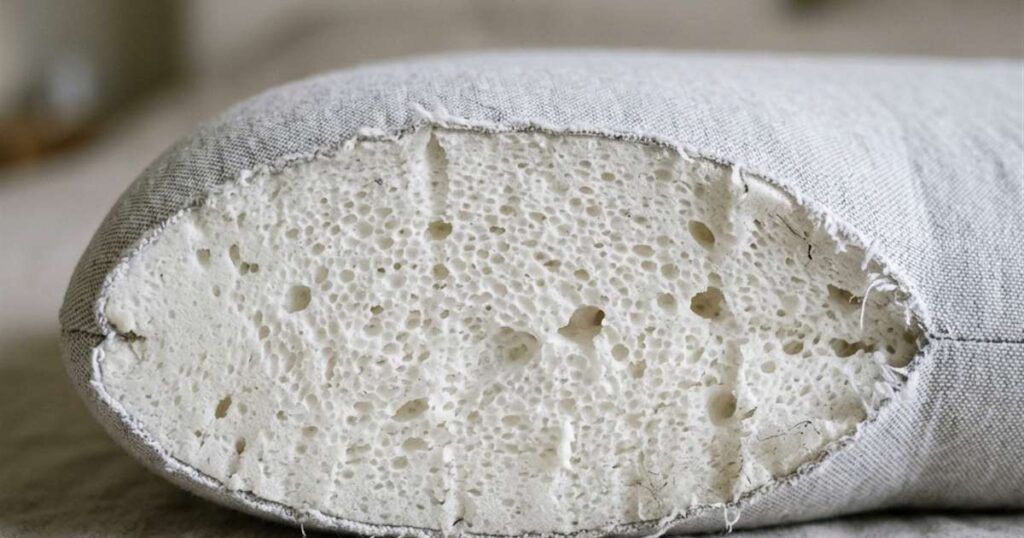
My rule, stated bluntly: never machine-wash solid memory foam. I treat the open-cell structure as the thing you’re paying for — agitation shears it, heat collapses it, and neither is reversible. A washing machine is where most of them die young. Spot-treat and hand-wash instead. Leave the dryer alone.
What the Specs Reveal About Memory Foam and Water
Start with density. It decides how much punishment the foam takes before it deforms, and you measure it in pounds per cubic foot. Most consumer pillows land in the 3-5 lbs/ft³ range. At that density the foam drinks water in easily and gives it back slowly. Two problems follow. Drying drags, so mildew gets a foothold. Saturation lingers, so the polymer matrix weakens.
ILD tells the same story. The rating measures the force needed to compress foam by 25% of its thickness, and it drops after water exposure when the foam never dries out fully. A pillow rated at 10-14 ILD is typical for memory foam. After a bad wash, the compressed zones can feel noticeably softer than the rest.
That is the reality of the material. Every step below works inside those limits. None of them tries to get around them.
The Myth Worth Naming Directly
Most articles in this category tell you to put memory foam pillows in the washing machine on a “delicate” cycle, and the reasoning sounds sensible enough, lower agitation, cooler water, a shorter cycle, but it gets the failure mode wrong. The problem is not temperature or cycle length. It is mechanical agitation applied to a saturated open-cell matrix. Delicate cycles still agitate. The foam still tears. The only fix is getting rid of agitation altogether, which means hand washing and spot treating and nothing else.
How to Spot-Treat Memory Foam (For Localized Stains)
For an isolated yellow patch, a small sweat stain, or a patch of surface discoloration, spot treatment wins. It uses the least water. It carries the lowest drying risk.
What you need:
- Mild liquid detergent (fragrance-free preferred, as fragrances can linger in foam)
- Two clean white cloths or microfiber towels
- Cold water
- Baking soda (optional, for odor)
Steps:
- Take the pillowcase off first, along with any cover. Wash those separately, following their care labels.
- Stir roughly half a teaspoon of mild detergent into one cup of cold water. Hot water stays off the list. Heat speeds up polymer breakdown in memory foam, and that is damage you cannot undo.
- Dip one cloth in and wring it until it is damp, not wet. Dab the stain with light pressure. Do not rub. Rubbing spreads the stain and pushes moisture deeper into the foam.
- Now take the second cloth. Dampen it with clean cold water and dab the same spot again to lift the detergent out. Keep rinsing until no soapiness remains at all, because detergent left in foam pulls new dirt in faster than a clean pillow ever would.
- Press a dry towel hard against the treated area. Hold it there for 30-60 seconds. It soaks up the surface moisture before the foam has to.
- Wait until the pillow is completely air dry before the cover goes back on. That usually takes 12-24 hours, depending on the humidity in the room. Skip the hair dryer. Skip long stretches in direct sunlight too. Sustained heat above around 130-140°F breaks down the viscoelastic properties the pillow was bought for.
How to Hand-Wash a Memory Foam Pillow (Full Clean)
A full hand wash is for real trouble, when the pillow has soaked up months of sweat, when spot treatment no longer cuts it, or when an odor has settled in and will not leave. Even then, keep it to once every 3-4 months. Any more often than that, and the cell structure wears out faster.
What you need:
- Bathtub or large basin
- Mild liquid detergent
- Cold water
- Several dry towels
Steps:
- Run just enough cold water to cover the pillow. A few inches does it. Not a full bath. And keep it cold.
- Add roughly one teaspoon of mild detergent per full pillow. Skip anything with optical brighteners or fabric softeners. Both leave residues behind, and those residues change how the foam feels.
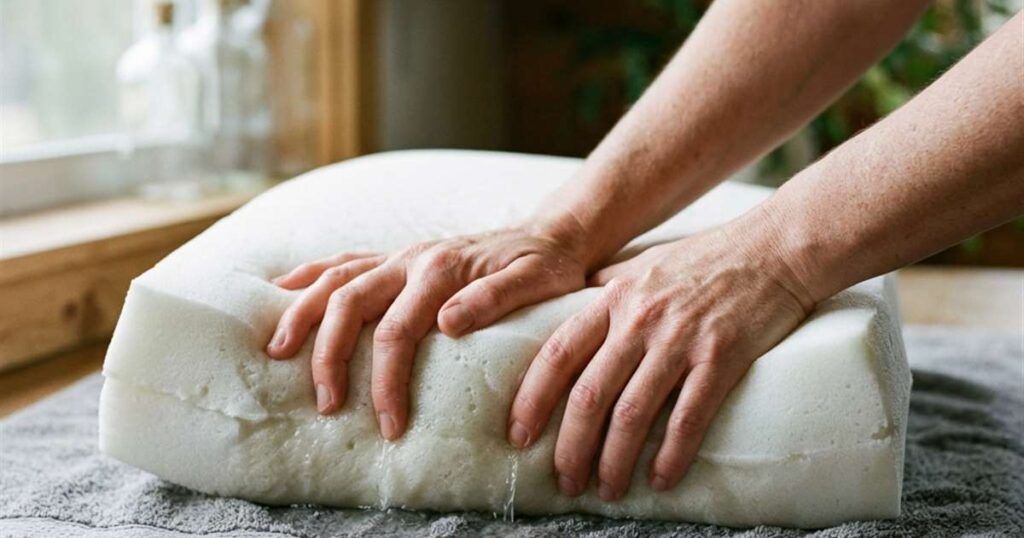
- Push the pillow under and squeeze it gently. Compress and release. Compress and release again. Never twist it, never wring it. The gentle squeeze moves soapy water through the foam without shearing it. Work across the whole surface for 3-5 minutes.
- Drain the tub. Refill it with clean cold water and squeeze through another cycle to rinse. Plan on 2-3 rinse cycles before the water runs clear and soap-free. Do not rush this. Detergent left in foam is one of the main reasons the smell keeps coming back.
- When the rinsing is done, press the pillow between both hands and push out as much water as you can. Do not wring it, and do not twist it. Then lay it flat on several dry towels, roll the towels around it, and press firmly to draw out more moisture.
- Move it to a flat, ventilated surface. A drying rack works well. Then leave it alone to air dry completely, which takes anywhere from 12 to 48 hours, depending on the thickness of the pillow and the humidity in the room. Flip it every few hours so it dries evenly. Do not use it until it is dry all the way through, not just dry on the surface. Press the center. If it feels cool or dense, it is still wet inside.
Eliminating Odor Without Water
Some pillows smell without showing a stain. Memory foam does that after months of absorbing ambient humidity and body heat. A dry deodorizing method handles the smell without any drying risk at all.
Dust a light, even layer of baking soda over both surfaces. Let it sit for 4-6 hours. Strong odor takes longer. Then vacuum it off with an upholstery attachment on low suction. The baking soda pulls odor compounds out without adding moisture, so repeat the whole thing monthly between full washes.
Drying: The Step Most People Get Wrong
Most washed memory foam pillows fail for one reason. They never dried all the way through. Mildew can start growing inside the foam within 24-48 hours when the interior stays damp, and the outside dries first, so a pillow can feel ready while its core is still wet.
Every shortcut here carries risk. Tumble drying on low heat dries the surface faster, but the heat lands unevenly and the denser zones can compress in patches, while steady air drying on a flat ventilated surface, flipped regularly for as long as the foam needs, stays the safest route, and a dryer, if you insist on one, stays on its lowest heat setting with a check every 20 minutes. No dryer balls. They create the same localized impact stress as machine washing.
Washing Frequency and Maintenance Schedule
| Pillow type | Full wash frequency | Spot treat | Dry deodorize |
|---|---|---|---|
| Solid memory foam | Every 3–4 months | As needed | Monthly |
| Shredded memory foam | Every 2–3 months | As needed | Monthly |
| Gel-infused memory foam | Every 3–4 months | As needed | Monthly |
| Memory foam with phase-change cover | Cover only, every 1–2 months | Foam: spot-treat only | Monthly |
Covers and pillowcases follow their own care labels. Most of them are machine washable. For more on how washing frequency ties into pillow replacement timing, the guide on how often to replace your pillow covers the data on foam lifespan in detail.
Frequently Asked Questions
Can you put a memory foam pillow in the washing machine?
No. Machine washing pushes the open-cell polymer matrix past its elastic limit, and that tears the foam and compresses it for good. Hand washing or spot treatment are the only safe options.
How long does a memory foam pillow take to dry after washing?
Somewhere between 12 and 48 hours. Thickness matters, and so does the humidity in the air. Before you use it again, press the center. Cool or denser than usual means it is still wet inside.
How often should you wash a memory foam pillow?
A full hand wash every 3-4 months is enough for most people, and monthly dry deodorizing with baking soda takes care of odor in between, which also means you need a full wash less often.
Can you use a dryer on memory foam?
Only with extreme caution. A dryer goes on its lowest heat setting, gets checked every 20 minutes, and runs without dryer balls. Air drying flat is still the safer method, and it carries no heat-damage risk at all.
What detergent should you use on memory foam?
A mild, fragrance-free liquid detergent, used sparingly. Roughly a teaspoon covers a full pillow. Stay away from optical brighteners, fabric softeners, and strong fragrances, because they leave residues that change how the foam feels or attract new dirt.
Memory foam and water are a tricky combination. Our Pillow Materials section explains what the foam can and cannot handle.