
Most advice about fluffing a shredded memory foam pillow treats it as a down-pillow problem. It is not. Down goes flat because clusters lose their three-dimensional structure over time as fill power degrades. Shredded memory foam goes flat for a different reason entirely: the foam pieces compress and stick to each other under sustained body weight, trapping residual body heat that keeps the viscoelastic material in a softened, compressed state overnight. Shaking and squeezing the pillow the way you would a down pillow does not fully solve this. Airing it first does.
Understanding that distinction changes how you approach the fluff. And how often you need to do it. For the full care picture including washing this fill type, how to wash a memory foam pillow covers the spot-treat and hand-wash methods in detail. For context on why shredded foam is worth maintaining rather than replacing frequently, the adjustable pillow category page covers fill volume, loft adjustment, and lifespan benchmarks.
Why Shredded Memory Foam Compacts, The Material Reason
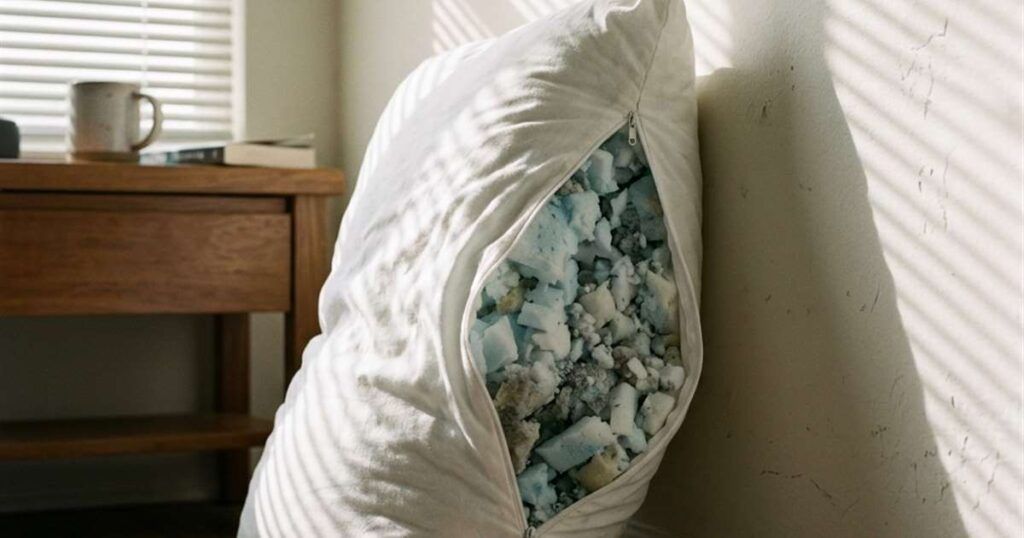
Shredded memory foam is viscoelastic polyurethane cut into irregular pieces, typically ranging from roughly thumbnail-size chunks down to fine crumbles depending on the manufacturer. Viscoelastic means the material responds to both pressure and temperature: it softens under body heat and firms as it cools.
During a night of sleep, sustained body weight and heat push the foam pieces together and hold them compressed in that softened state. When you lift your head in the morning, the foam pieces are still warm enough to stay slightly adhered and compacted. At that point the pillow has little loft and poor pressure distribution. Not because the fill has degraded, but because it is still in its thermally softened, compressed state.
The fix is cooling and aeration before mechanical fluffing. Cooling allows the viscoelastic polymer chains to return to their firmer ambient-temperature state, at which point the pieces separate more readily. Aeration redistributes the fill and breaks the surface-to-surface adhesion between pieces. Mechanical manipulation (kneading, shaking) then finishes the job.
This is what most guides skip: if you knead a warm, freshly slept-on shredded foam pillow, you are working against the material’s own physics. The pieces are still soft enough to compress further rather than separate.
The Two-Minute Fluff Method (Daily)
This works on any shredded memory foam pillow regardless of brand. It takes about two minutes and, done consistently each morning, prevents the compaction from becoming permanent over months.
Step 1: Air it first (30-60 seconds) Pull the pillow off the bed immediately after waking and stand it upright or prop it against the headboard or a wall. Do not squeeze or knead it yet. Allow it to cool to room temperature for 30 to 60 seconds. This is the step most people skip, and it is the one that makes the mechanical steps easier. As the foam cools from body temperature toward room temperature, the viscoelastic material firms slightly and the pieces begin to separate on their own.
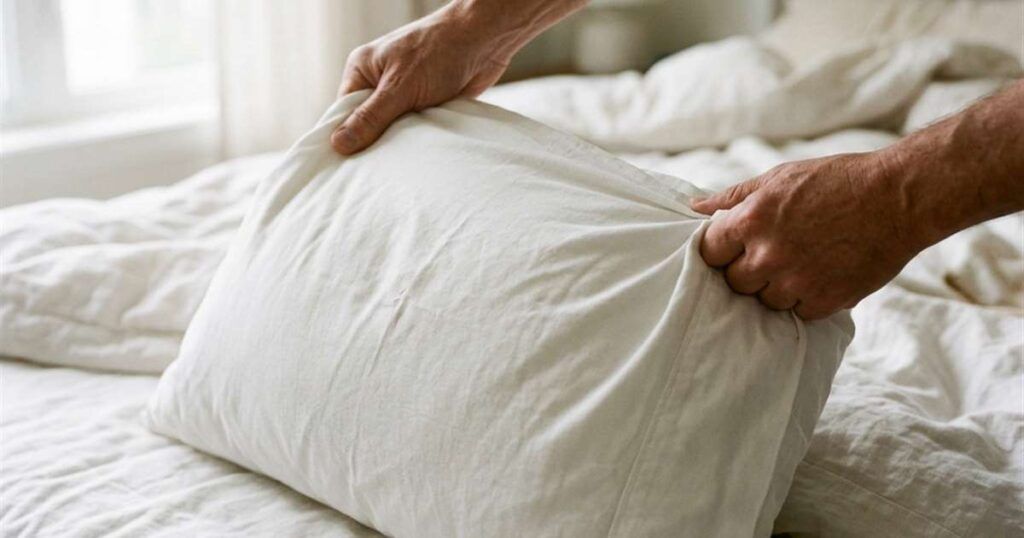
Step 2: Knead from the outside (30-45 seconds) With both hands, grip the pillow firmly through the cover and work the fill in a kneading motion, pressing and releasing across the whole surface. Move from the center outward. The goal is to break up any remaining adhered clusters and redistribute the fill toward the edges and corners, which tend to be fill-light after a night of compression in the center.
Step 3: Shake and stretch (20-30 seconds) Hold the pillow at two corners and give it three to four firm shakes. Not a gentle wave, but a deliberate snap that sends a wave of movement through the fill. Follow that with a brief stretch: hold opposite corners and pull gently outward to expand the pillow horizontally. This redistributes fill that the kneading may have pushed into the center.
Step 4: Stand to finish Set the pillow upright again for a further minute before placing it back on the bed. The combination of gravity and continued cooling settles the fill into an even distribution and allows any remaining compressed clusters to separate fully.
What Causes Permanent Compaction (and How to Avoid It)
Daily fluffing handles overnight compression. Permanent loft loss. Where the pillow does not recover fully even after the steps above. Has different causes.
Sustained compression without recovery time. A shredded foam pillow stored flat under heavy bedding all day, every day, gives the fill no opportunity to decompress. The same physics that cause overnight compression apply throughout the day: sustained pressure keeps the foam pieces together. Storing the pillow upright or loosely during the day when not in use slows permanent loft loss measurably.
Heat exposure above the material’s comfortable range. Viscoelastic foam softens significantly at temperatures above roughly 30-35°C (86-95°F). A pillow left in a hot car, stored in a non-air-conditioned space during summer, or dried on high heat after washing can experience accelerated softening and compaction. Drying shredded foam on the lowest dryer heat setting, or air drying flat, prevents this.
Fill volume depletion. Most shredded foam pillows have a zippered cover that allows fill to be added or removed. Over 12 to 18 months, some fill pieces do break down into finer particles that pack more densely. If the fluff method stops restoring adequate loft, the most direct fix is adding fresh shredded foam fill rather than replacing the whole pillow. The adjustable pillow guide covers fill volume adjustment in detail.
Age of the foam. Polyurethane foam does degrade over time: the polymer chains break and the material loses some of its elastic recovery. A pillow that has been in use for more than three to four years may have reached the point where no fluffing method restores full loft. That is replacement territory, not a maintenance problem.
| Compaction type | Cause | Fix |
|---|---|---|
| Morning flatness | Overnight heat and body weight compression | Daily two-minute fluff method above |
| Persistent low loft after fluffing | Fill volume depletion or fine particle breakdown | Add fresh shredded foam fill via zipper |
| Fill will not separate after fluffing | Residual body heat. Pillow still warm | Air for 60+ seconds before kneading |
| Permanent loft loss across whole pillow | Foam age (3-4+ years) or heat damage | Replace pillow or fill entirely |
Weekly and Monthly Maintenance
Daily fluffing handles the compression. Two additional steps slow the fill degradation that causes permanent loft loss.
Weekly: Remove the pillowcase and cover if the design allows separate laundering. Lay the inner fill bag flat on a ventilated surface for 20 to 30 minutes. Exposure to ambient airflow. Not sunlight, not heat, helps dissipate any accumulated moisture from the fill and slows the buildup of odor compounds. If the fill is not in a separate bag (single-piece construction), air the whole pillow this way.
Monthly: Dry deodorize the pillow. Sprinkle a light layer of baking soda across both sides of the pillow cover, allow it to sit for four to six hours, then vacuum off with an upholstery attachment on low suction. This removes odor compounds without introducing moisture and reduces how often a full spot-clean or hand wash is needed.
Frequently Asked Questions
Why does my shredded memory foam pillow go flat so quickly?
Viscoelastic foam softens under body heat during sleep and the pieces compress and adhere together under sustained body weight. The pillow is not degrading; it is still in its thermally softened state when you wake up. Airing it for 30 to 60 seconds before kneading allows the foam to cool and firm slightly, which makes the pieces separate more readily.
Can you put a shredded memory foam pillow in the dryer to fluff it?
Only on the lowest heat setting and only briefly. Heat accelerates the softening that causes compaction, so high dryer heat makes the problem worse rather than better. Air drying flat or a very short low-heat dryer run after washing is the safe range. Daily fluffing by hand is the correct routine for ongoing loft maintenance.
How do I add fill to a shredded memory foam pillow?
Most shredded foam pillows have a zippered inner cover. Open the zipper and add shredded polyurethane foam purchased separately. Add small amounts at a time and test loft after each addition. Overfilling reduces pressure relief and makes the pillow feel rigid. Remove fill through the same zipper to reduce loft if needed.
How long do shredded memory foam pillows last?
With consistent daily fluffing and monthly deodorizing, most shredded foam pillows maintain usable loft for two to four years. Fine particle breakdown in the fill and gradual polymer degradation eventually reduce elastic recovery to the point where fluffing no longer restores adequate loft. At that point, replacing the fill or the whole pillow is the correct response. The fold test and four other checks will tell you definitively which situation you’re in.
Fluffing shredded foam is a technique, not luck. Our Pillow Setup & Adjustment guides walk through the method that works.