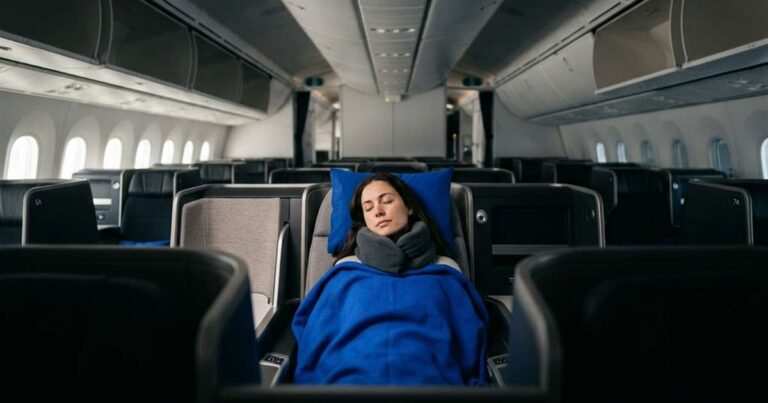
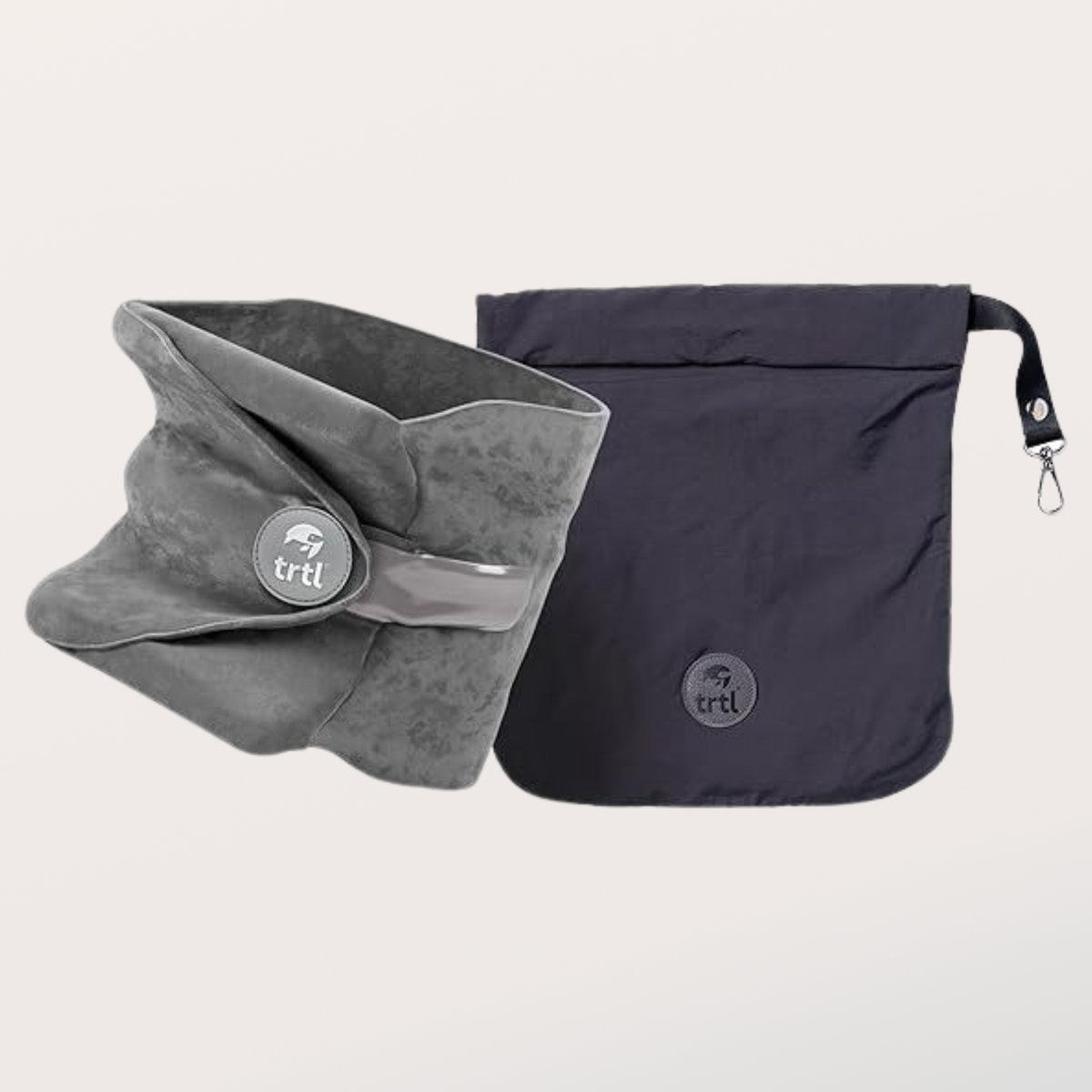
Stop. Before the specs, before the price, one thing needs clearing up. What Trtl sells you is not a pillow in any sense your grandmother would recognize. Think neck brace. Fleece on the outside, hard plastic on the inside. Once you see it that way, softness stops being the question. Structure is. And on structure, the Trtl has a real argument. Most reviewers do the obvious thing. They set it next to a foam U-pillow and squeeze both. Wrong test. Feel is not the contest here. The contest is whether the thing still holds its shape hours into the flight.
Foam gives. That is the whole pitch of foam, and also its whole failure. The Trtl refuses to give. A plastic rib either holds or it does not, and there is no middle ground to hide in. Does it fix your problem? That comes down to three things, the shape of your neck, which way you lean when you sleep, and how long the flight is. I would call its approach the most structurally honest one in the whole category, and I would also say its marketing stays quiet about some real limits.
What the Rib Actually Does (and Why Foam Fails First)
Your head, held straight, is 10-12 lbs of dead weight on a stack of small bones. That is the starting point. Everything after it gets worse. Then it tilts forward, and the load on your neck climbs fast. Kenneth K. Hansraj, an orthopedic surgeon, actually measured the penalty. His numbers, published in Surgical Technology International, are blunt: tip forward just 15 degrees and your neck is carrying 27 lbs. Tip to 30 degrees and it is 40 lbs. More than triple the weight of the head itself, from a tilt you barely notice. Now the plane. Seat back a few degrees. Muscles off. You drift. And where does your head go? Right into that 15-30 degree range. Every time. Not sometimes. Every time. That is not a minor postural issue. It is a predictable mechanical event.
A foam U-pillow tries to answer that by piling material in front and on the sides, something for your head to sink into. The problem is physics: soft foam compresses under sustained load. After 30-60 minutes of sustained head weight, most foam travel pillows have lost a meaningful portion of their resistance, and the head begins to drift forward anyway.
Travel Insider’s review of the Trtl describes the internal support as a firm yet pliable plastic insert developed through more than 80 prototypes by former mechanical engineers Michael Corrigan and David Kellock. The Trtl’s C-shaped thermoplastic rib does not compress. Here is the mechanism. The rib wedges between your shoulder and your jawline on one side, and it turns into a rigid cantilever, your head rests on it and the load moves straight down to your shoulder. Because the support is structural and nothing in it can squash, your cervical spine stays far closer to neutral than foam ever gets it.

The Myth Worth Calling Out: “Scientifically Proven” Means Something Specific
The phrase “scientifically proven” appears on every Trtl product page and packaging. The biomechanical principle behind the product is sound. Rigid structure resists forward head flexion more durably than compressible foam, and that is consistent with the Hansraj data cited above. But the phrase implies a controlled clinical trial comparing the Trtl to alternatives on cervical spine outcomes. Trtl has not published such data. What they have is sound engineering logic applied to a real structural problem. That is worth buying. The clinical claim on the box is marketing.
This distinction is not minor. Want a peer-reviewed trial showing the Trtl beating foam on cervical alignment? Good luck with that search. Hours of it. Because the paper is not out there. Nobody has run it. Nobody has published it. Buy it for a simpler reason. Plastic does not squash. Foam does. That is not a claim that needs a trial, it is a property of the material, and the whole product hangs on it.
Who the Trtl Fits Well (and Who It Does Not)
Sleep Advisor’s review of the Plus specifically notes that shorter and taller users frequently find the fixed rib position does not land correctly, which is the core reason the adjustable Plus was developed. The Original is a fixed-size product. There it is. The catch. Small sentence, big consequences. Trtl built the rib around an average adult neck. Average. Yours shorter? Yours longer? Then the rib sits where nobody ever measured, high or low against your jaw, and the support it promises lands in the wrong place entirely.
Another limit, and this one is absolute. The rib works sideways. Window side, aisle side, either one, so long as your head tips and the plastic wedges between shoulder and jaw on that side. That is the only direction it knows. Sleep facing straight ahead and it gives you nothing, because the support is directional by design. The scarf wrap adjusts to fit plenty of neck sizes, sure, but no amount of adjusting changes the direction it works in.
Sleep Advisor’s reviewer describes the plastic “flipper” as repositionable to either side of the head or below the chin, though switching sides requires fully unwrapping and reversing the pillow. On a long-haul flight where you might shift position multiple times, that is a real friction point.
Good fit:
- Side-leaning sleepers with average to larger neck circumference.
- Warm-weather travelers who run hot and want the Cool version’s mesh wrap.
- Travelers who prize pack size, since the Original folds flat at roughly half the footprint of a U-pillow, which is a real difference in a stuffed carry-on.
- Earbuds users, because the wrap stays clear of the ear canal instead of pressing against it the way a U-pillow does.
- Anyone who has confirmed that compression foam travel pillows fail on flights over 4 hours.
Poor fit:
- Straight-ahead sleepers.
- Over-ear headphone users (the wrap does create contact around the ear).
- Travelers who shift lean direction frequently mid-flight.
- Anyone with a very short neck: the fixed rib on the Original is the highest-risk version for fit mismatch.
For long-haul flights, the structural durability advantage of the rib matters more the longer the flight. 90 minutes? Foam barely has time to give up. Short hop, short problem. Hardly worth worrying about. Now make it 10 hours, overnight, lights out. That is where the two designs split for good. A rib that still holds at hour ten and you wake up fine. Foam that went soft hours ago? Stiff neck. Ruined morning. Same seat, same flight, completely different landing.
The Care Reality Nobody Mentions
Mattress Clarity’s reviewer notes that the care instructions tag is tucked into the internal rib pocket and easy to miss, and that the plastic support must be removed before washing. The fleece wrap is machine washable at 30°C / 86°F. That is a two-step process that most users skip on the first wash. And the rib itself, the actual plastic piece doing all the work, you cannot wash it at all, just wipe it down with a cloth and keep it out of water entirely, because submerging it is the one thing the instructions warn against and it is easy to forget after a long flight when everything goes in the laundry pile.
Glenn Said’s review of the Trtl notes that the velcro produces an audible tearing sound when adjusted, which can disturb neighboring passengers. The velcro closure is the other durability flag. In a quiet cabin at 2 a.m., this is worth knowing before you buy.
Verdict
Best for:
I approached this review as a structural question, not a comfort test. My analysis compared the Trtl’s plastic rib against the foam U-pillows that dominate the category, and the engineering trade-off is clear: you gain rigid support but lose the forgiving fit of foam. That trade-off is why neck geometry decides everything here. If your lean matches the rib’s arc, the mechanism works; if it does not, no amount of fleece will fix it.
| Trtl Original | Trtl Plus | Trtl Cool | |
|---|---|---|---|
| Weight | 4.5 oz (manufacturer-stated) | ~9 oz (manufacturer-stated) | Not publicly disclosed |
| Outer fabric | Hypoallergenic polyester fleece | Polyester/spandex/rayon blend with fleece lining | Lightweight mesh/breathable fabric |
| Inner support | Fixed C-shaped plastic rib with thin polyurethane foam padding | Adjustable C-shaped plastic rib with toggle height system | Same rib as Plus; mesh wrap for ventilation |
| Fastening | 1 velcro closure | 2 velcro closures | Not publicly disclosed |
| Fit adjustment | Fixed (one size) | Adjustable via rib toggles | Adjustable |
| Machine washable | Yes, remove rib first, 30°C / 86°F, tumble dry | Yes, remove rib first, cold water, low heat dry | Yes |
| Price (MSRP) | $49.99 | $89.99 | Not publicly disclosed |
Sources: Trtl manufacturer product pages; Sleep Advisor product review citing manufacturer pricing; Mattress Clarity reviewer care label report.
Pros
- Board with a rib that holds, land with a rib that holds. Ten hours later the support is exactly where you left it, no sag, no drift, no slow collapse halfway across the Atlantic.
- Folds almost flat. In a carry-on that is already stuffed to the zip, that thin little package earns its space in a way a fat foam ring never could.
- Pop the fleece off, throw it in the machine, done. Ten minutes of effort, maybe less, and the thing smells like new again.
Cons
- Side leaners only. Head tips forward and this thing just sits there, useless, a scarf with a plastic stick in it.
- The fixed Original comes in one neck size, which means shorter or longer necks can end up genuinely uncomfortable.
- The wrap sits against the ear, and for over-ear headphone users that contact gets annoying fast.
$49.99
Check Price on TrtlIs the Trtl travel pillow comfortable?
It all comes down to fit, honestly, nothing else matters as much. If you lean to the side and your neck runs average to larger, the rigid rib gives you firm support that lasts the whole flight, but sleep facing straight ahead and you get nothing from it at all. The fixed-size Original can feel plain wrong on a shorter or longer neck, and the wrap pressing around the ear is a real irritant if you wear over-ear headphones.
Which Trtl model should I choose?
For this Trtl travel pillow review, my call is simple. The Original at $49.99 is the budget pick if your neck is average, while the Plus at $89.99 earns its price with adjustable toggles that fit far more neck sizes. Run hot? Pick the Cool, because its mesh wrap breathes noticeably better than fleece. Match the model to your neck size and how warm you sleep, and you will not go far wrong.
How do I wash the Trtl travel pillow?
First step, and do not skip it: take the plastic rib out, then machine wash the fleece wrap at 30°C (86°F). After that the two models split. The Original can go in the tumble dryer, while the Plus wants cold water and low heat drying.
I bought the Trtl Original and the rib sits wrong on my neck. What do I do?
The Original is built around an average adult neck, so if the rib lands high or low on your jaw, it is the wrong fit. Swap to the Plus, because its adjustable toggles fit far more neck sizes. If you sleep facing straight ahead, no Trtl model helps, because the rib only works when your head tips to one side.