
These seven differences cut through the marketing language and address what actually changes when you switch from down to kapok. Or when you’re choosing between them for the first time. Both fills appear in our guide to the best organic pillows, where our individual product recommendations live, but this article is strictly a material-level comparison to help you choose the core fill.
7 Differences Between Kapok and Down That Actually Matter
Difference 1, The Fiber Structure and Why It Determines Nearly Everything Else
Down is animal-derived: the soft undercoating clusters from the breast of ducks and geese, harvested after slaughter or , in some operations , from live birds. Each cluster is three-dimensional, branching, and interlocking, which is why down lofts so effectively and why it moves fluidly to accommodate head position during the night.
My framing for this comparison: kapok is the ethical-vegan answer to down, not a performance upgrade. I compared the fiber structures, and down’s 3D interlocking clusters still loft better — kapok wins on supply-chain ethics and washability, not on feel. If avoiding animal products matters to you, kapok is the honest substitute; if pure loft is the goal, down remains the benchmark.
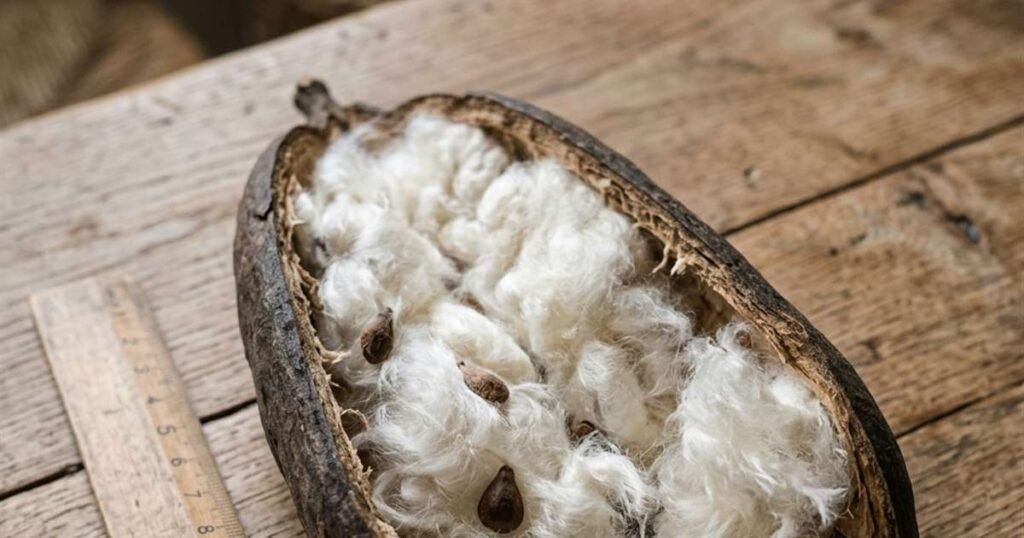
Kapok is a plant fiber from the seed pods of Ceiba pentandra, a tropical tree native to Southeast Asia, Central America, and parts of Africa. Textile School’s materials science review of kapok describes each fiber as a unicellular, hollow microtube with a lumen that is 80-90% air by volume. The wall of each fiber is only 1-2 micrometers thick. The Oriental Journal of Chemistry’s review of kapok fiber properties gives its bulk density as approximately 0.305 g/cm³ . Making it one of the lightest natural fibers known, lighter even than down.
This structure explains why kapok feels similar to down on first contact. Both are predominantly air trapped inside very fine material. The difference is that down clusters are three-dimensional and entangled, while kapok fibers are smooth, straight cylinders with a waxy surface. That waxy surface is the source of most of kapok’s practical tradeoffs.
Difference 2, Allergen Behavior (and Why “Hypoallergenic” Needs Context)
Kapok is genuinely hypoallergenic. Its natural lignin content and waxy fiber surface provide innate resistance to dust mites, mold, and bacteria . Confirmed in the same Textile School materials review, which identifies the fiber’s natural bitterness and high lignin as antimicrobial properties. There is no processing required to achieve this. Raw kapok from the tree is inherently resistant to the conditions that allow mite colonization.
Down’s allergen picture is more complicated. True allergy to down protein itself is uncommon. As the scientific literature reviewed by multiple bedding researchers confirms, the usual trigger in “down allergies” is dust mites . Which can colonize any pillow , or residual organic material in inadequately processed fill. Premium down that has been triple-washed and manufactured to certified standards is largely free of the residue that causes reactions. NOMITE-certified down bedding specifically uses a tightly woven ticking that functions as a physical barrier against mite penetration.
The practical summary: kapok has a structural advantage for allergy sufferers that requires no certification and no special processing. Down can be made allergy-compatible, but the outcome depends on the specific product’s cleaning standard and casing construction. For someone with confirmed dust mite sensitivity, kapok is the lower-risk choice without needing to evaluate individual product specs.
Difference 3, Vegan Status and the Supply Chain Question
Kapok is 100% vegan. The fiber is collected from seed pods that fall naturally or are hand-picked from standing trees. The tree is not harmed. No animals are involved at any point in the supply chain.
Down is not vegan and carries supply chain concerns that are difficult to fully audit. Most commercial down is a byproduct of duck and goose meat production, primarily from China, which accounts for the majority of global supply. A more serious concern is live-plucking , pulling feathers from conscious birds , which ScienceInsights’ reporting on down supply chains confirms remains a real practice in parts of the industry, including within some Responsible Down Standard (RDS) certified supply chains where enforcement gaps have been documented.
The RDS, administered by Textile Exchange, explicitly prohibits live-plucking and force-feeding. It is the most credible third-party standard available for down. But for consumers for whom animal use is a firm constraint, no certification resolves the fundamental issue: down requires killing or using birds.
Difference 4, Temperature Regulation
Kapok’s 80-90% hollow air-filled lumen structure makes it one of the most breathable natural fills available. The waxy, smooth surface of each fiber resists moisture absorption, which means the fill does not trap heat through sweat or humidity the way down can when damp. Air circulates freely through the loose, non-interlocking fibers.
Down’s breathability depends on fill power. High fill power down (700+) traps more air in larger clusters and allows more airflow between them. Lower fill power down compresses into a denser mass with less inter-cluster air movement. Down also tends to clump when exposed to moisture , sweat or humidity during sleep , which reduces its breathability and insulation quality simultaneously, and can take hours to fully recover.
For hot sleepers or people in warm climates, kapok has a structural advantage. For cold sleepers or people in cold environments who need warmth, high fill power down’s three-dimensional cluster structure provides better thermal insulation than kapok’s loose cylinder fill.
Difference 5, Feel, Loft, and the Compression Difference
Both fills are soft and light. The feel difference becomes apparent after the first few weeks. Down clusters interlock in three dimensions, meaning each cluster resists compression from multiple directions. When you move your head on a down pillow at night, the fill redistributes smoothly and conforms. When you lift your head, the fill springs back.
Kapok fibers are smooth cylinders with a waxy surface that reduces inter-fiber friction. They compress under head weight and redistribute . But they do not interlock. Over weeks and months of use, the fibers break into shorter pieces (kapok is brittle by fiber structure), and the fill gradually compresses into a denser, lower-loft profile. A kapok pillow that starts at 5 inches of loft may settle toward 3.5 to 4 inches within a few months. Regular fluffing restores some loft, but the compression trend is real and irreversible without adding new fill.
Down maintains its loft longer per use cycle . But it requires daily fluffing after being compressed under head weight overnight, and it clumps when damp. Neither fill is maintenance-free.
Difference 6, Care Rules
Down pillows can be machine-washed on a gentle cycle in a large-capacity washer and tumble-dried with dryer balls at medium heat. The three-dimensional cluster structure survives immersion and mechanical agitation better than most fills, and thorough drying restores loft. Most quality down pillows should be washed every 6 months.
Kapok fill cannot be machine-washed. The waxy fiber surface makes kapok fibers highly susceptible to clumping when wet . Once clumped, the fill rarely recovers its original loft. The correct care method for most kapok pillows with a zippered cover: remove the fill, machine-wash the cover only, air-dry the cover completely, and return the fill. The fill itself should be spot-cleaned only, aired in sunlight (UV exposure naturally refreshes and sanitizes the fibers), or placed in a dryer on no-heat air-only cycle with dryer balls for 10-15 minutes to redistribute compacted fibers.
For buyers who want a pillow they can wash simply and completely, down has a significant practical advantage.
Difference 7, Environmental Footprint and the Organic Certification Path
Kapok production is low-impact by most material science measures. The Ceiba pentandra tree grows in tropical regions without requiring irrigation, synthetic fertilizers, or pesticides. Pods are hand-harvested. No chemical processing is required to produce the fiber. The fill is biodegradable. Organic certification for kapok covers the farming practices and the pillow’s casing material (typically GOTS-certified organic cotton) . And because kapok itself needs no chemical processing, certified organic kapok pillows are achievable without the supply chain complexity of organic latex or certified down.
Down’s environmental picture depends on how it is sourced. As a byproduct of meat production, it makes use of material that would otherwise be waste. This is a genuine efficiency argument. But the carbon footprint of the duck and goose meat industry, combined with the significant water and chemical use involved in washing and processing raw down at scale, makes it a more resource-intensive supply chain than kapok, even before accounting for certification status.
For genuinely organic certification, kapok has the simpler and more verifiable path. For full traceability without live-plucking, RDS-certified down is the credible standard available for animal-based fill.
A Note on the “Feels Like Down” Claim
Most kapok marketing includes the phrase “feels like down.” On first contact, this is accurate: both fills are light, soft, and lofty, and the initial sleep experience on a new kapok pillow is genuinely comparable to a mid-range down pillow.
The distinction shows up over time. Down’s three-dimensional cluster structure means it conforms dynamically to head position and springs back predictably. Kapok’s smooth cylinders move more freely but compress more permanently. A kapok pillow that has been in use for six months feels noticeably different from a down pillow at the same age , typically flatter and denser in the sections under most head pressure.
This is not a reason to dismiss kapok. For the right buyer , a vegan, someone with confirmed allergy concerns, someone in a warm climate who prioritizes breathability . Kapok is the better fill. The comparison just needs to be honest: kapok approximates down’s initial feel. It does not replicate down’s long-term loft behavior.
Frequently Asked Questions
Is kapok better for allergies than down?
For most allergy sufferers, yes. Kapok’s natural lignin and waxy fiber surface provide innate resistance to dust mites and mold without chemical treatment. Down can be made allergy-compatible through thorough washing and tight-weave casing construction, but the outcome depends on specific product standards. Kapok’s hypoallergenic properties are structural, not process-dependent.
Is kapok cooler to sleep on than down?
For most sleepers, yes. Kapok’s 80-90% hollow fiber structure allows excellent airflow and the waxy surface resists moisture absorption, so it does not trap heat through sweat the way down can when damp. High fill power down is breathable when dry, but kapok has a structural breathability advantage.
Can you wash a kapok pillow?
Not the fill. Kapok fibers clump when wet and rarely recover their original loft after machine washing. The correct method: remove the fill, wash the cover only, then return the fill. Spot-clean the fill surface when needed and air the whole pillow in sunlight monthly. For a no-heat air-only dryer cycle of 10-15 minutes with dryer balls, shredded or loose kapok can be partially refreshed.
Does kapok feel exactly like a traditional down pillow?
Kapok closely mimics the light, malleable sensation of down without using animal products. This plant-based fiber feels incredibly silky and allows you to easily mold the pillow around your neck. You will not experience any sharp quills poking through the fabric, though kapok lacks the bouncy resilience of feathers.
Will a kapok pillow go flat faster than down?
Yes, kapok fibers tend to compress and form dense lumps much quicker than high-quality down. While down can be easily fluffed to restore its original volume, packed kapok often stays flat. You should look for a pillow with a zippered casing so you can add fresh fill when needed.
Is a kapok and shredded latex blend better than pure down?
A kapok and latex hybrid solves the primary structural flaw of both pure kapok and down. The latex pieces provide necessary pushback and prevent the pillow from pancaking under your head. This combination gives you the soft, cloud-like feeling while ensuring your cervical spine remains aligned all night.
Kapok versus down is the newest materials debate. Our Pillow Materials section compares both on the same seven specs.