
Low-density memory foam (the kind in most pillows under $40) has a density of about 2 to 3 lbs per cubic foot. At that density, the viscoelastic cell structure breaks down within 1 to 2 years of nightly use. High-density foam, at 4 to 6 lbs per cubic foot, holds up for roughly 3 to 4 years. Most people have no idea which they bought, because foam density is almost never printed on the label. They go by feel, use the pillow until something feels off, and then wonder why. How you wash it affects how long it lasts too. Our guide on how to wash a memory foam pillow covers the methods that don’t wreck the cell structure.
What happened is chemistry. Memory foam is viscoelastic polyurethane that degrades through mechanical fatigue and oxidation from night one. Understanding those mechanisms helps predict when a pillow needs replacing and how to slow degradation down. To clean foam safely without destroying cell structure, follow our guide on how to wash a memory foam pillow without wrecking it.
The Two Mechanisms That End Every Memory Foam Pillow
Mechanical Fatigue
Every compression cycle every night you sleep on it stresses the open-cell walls inside the foam. The cell compresses under head weight and re-expands when you lift your head. Over thousands of cycles, those cell walls weaken and eventually stop recovering fully. The result is a permanent depression: the pillow holds the shape of your head even when nothing is on it, and the loft at that point is lower than it was when you bought it.
My take after reviewing the material science: density is the number that matters and it’s the number nobody prints. I treat any memory foam pillow under $40 as a 1–2 year product regardless of what the marketing claims — the 2–3 lb density foam in that price tier can’t survive nightly compression longer. If a brand won’t disclose density, I assume the worst and price it per year accordingly.
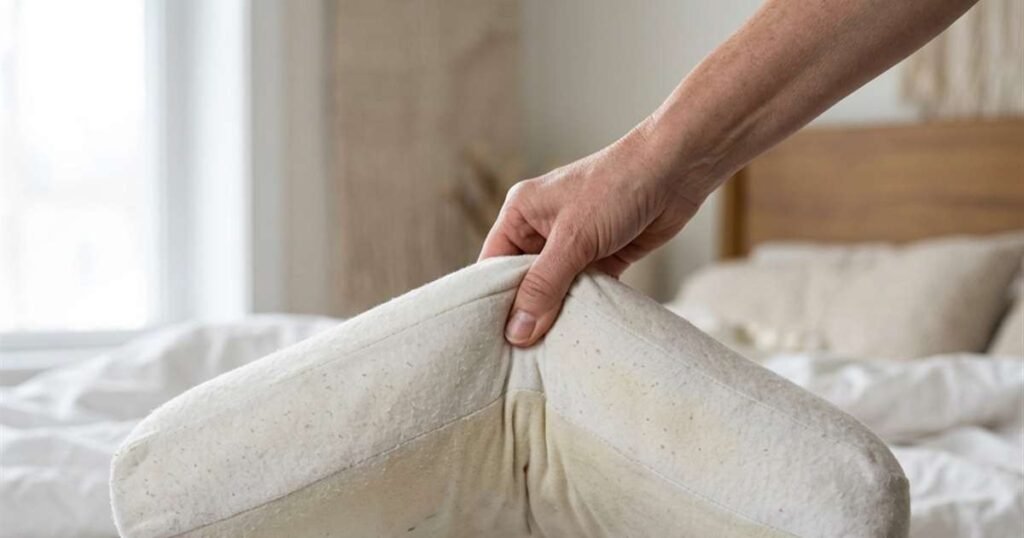
The rate of mechanical fatigue is directly tied to foam density. Denser foams have thicker cell walls and more material per unit volume to absorb repeated loading. Lower-density foams have thinner walls that collapse faster under the same load. A pillow used every night accumulates roughly 2,500 to 3,000 compression cycles per year. At low density, meaningful cell wall collapse begins within that first year. At high density, the structure holds through roughly 3 years before the same pattern of collapse becomes measurable.
Oxidative Degradation
Memory foam is polyurethane a polymer built from polyols and diisocyanates, typically toluene diisocyanate (TDI) or methylene diphenyl diisocyanate (MDI). When these aromatic isocyanate compounds are exposed to oxygen, UV light, heat, and moisture, they undergo a chain reaction: the aromatic bonds break, free radicals form, and quinone-imide structures develop inside the polymer. Those structures absorb blue light and appear yellow. The yellowing is the visible signal of a chemical change that started long before you could see it.
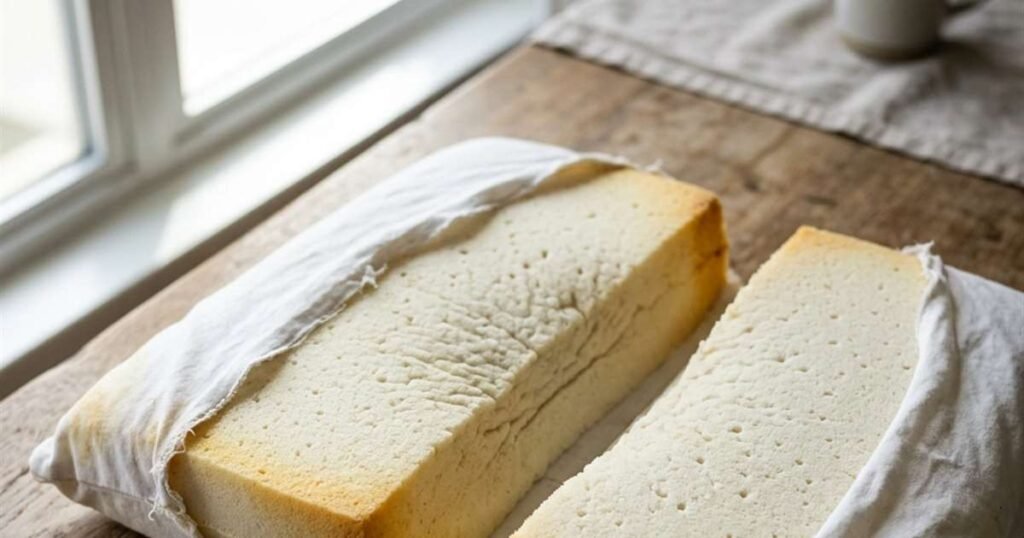
By the time a memory foam pillow shows visible yellowing, the polymer chains have already lost measurable elasticity. The foam responds more slowly to pressure (the “memory” effect feels sluggish), and it no longer recovers to its original loft between uses. The hardening that happens in older pillows where the foam feels stiffer and less responsive than it did new is a separate but related effect: sebum, sweat, and skin cell oils penetrate the foam over time and partially fill the open-cell structure, changing how the cells respond to load.
The lifespan ranges below are based on daily use a pillow used every night without a pillow protector, in an average bedroom environment. A pillow protector, consistent cover washing, and a cooler, drier bedroom environment each extend lifespan toward the upper end of the range.
| Foam Type | Density | Expected Lifespan (Daily Use) |
|---|---|---|
| Low-density solid memory foam | ~2-3 lbs/ft³ | 1-2 years |
| Standard-density solid memory foam | ~3-4 lbs/ft³ | 2-3 years |
| High-density solid memory foam | ~4-6 lbs/ft³ | 3-4 years |
| Shredded memory foam | Varies by fill mix | 2-3 years (fill can be replaced) |
| Gel-infused memory foam | Typically standard density | 2-3 years (gel layer degrades independently) |
Shredded memory foam is the exception in this table: the fill is composed of individual pieces rather than a continuous block, which means the mechanical fatigue is distributed across more surface area and the fill can be partially replaced. Some manufacturers sell replacement fill, which can extend the functional life of the pillow cover indefinitely. The foam pieces themselves still oxidize and harden, but because each piece is small, the degradation is more gradual and more evenly distributed.
The 4 Signs Your Memory Foam Pillow Has Failed
Sign 1: Permanent Depression That Does Not Recover
Press the center of the pillow firmly with your palm for five seconds, then release. On a structurally intact pillow, the foam should return to its original profile within a few seconds. If the depression persists for more than 10 seconds, the cell walls in that area have collapsed beyond their recovery threshold. This is mechanical fatigue at an advanced stage, and no amount of care or airing will reverse it. The structural support that pillow was providing to your cervical spine while you slept is now compromised.
Sign 2: Loft Loss Without Recovery
A pillow that fails to rebound quickly when pressed has lost structural support, putting excessive strain on cervical vertebrae overnight. For physical diagnostic tests you can perform at home, review our guide on 5 ways to tell if you need a new pillow.
Measure the uncompressed loft of your pillow when it is new or use the stated loft on the packaging as a reference and compare it to its current height when laid flat on a hard surface. A pillow that has lost more than roughly half an inch of loft from its original stated height has degraded past useful performance for most side and back sleepers. At that point the pillow may still feel comfortable because your body has adapted to the lower loft, but the cervical support it is providing has changed.
If you never measured it new, a practical test: does the pillow feel noticeably flatter than it did in the first few months? Any fill that has lost obvious height from its original profile visible without measuring has typically crossed the replacement threshold.
Sign 3: Yellowing Through the Cover
Remove the pillow cover and inspect the foam. Light surface yellowing that is confined to the outer inch of the foam is early-stage oxidation – the foam still has useful life. Yellowing that extends into the core, or discoloration that is accompanied by a change in the foam’s feel from its original texture toward something stiffer, crumblier, or slower to respond, means the oxidative degradation has advanced to a point where the viscoelastic properties are meaningfully compromised.
Yellowing alone does not require immediate replacement. Yellowing plus sign 1 or sign 2 does.
Sign 4: Persistent Odor That Does Not Dissipate
Memory foam naturally produces a faint chemical scent from VOC off-gassing when new this dissipates within a few days to weeks. A persistent musty, sour, or earthy odor developing on a pillow that is more than a year old is a different problem: moisture has penetrated the foam and created conditions for microbial growth. Memory foam’s open-cell structure makes thorough drying nearly impossible once moisture reaches the core. If airing the pillow for 24 to 48 hours in a well-ventilated area does not eliminate the odor, the source is likely biological contamination inside the foam that cannot be adequately addressed without risking structural damage from washing.
Use a Pillow Protector From Day One
Adding a zippered pillow protector over the foam (underneath your decorative pillowcase) is the single most effective lifespan intervention. It intercepts sweat, sebum, and skin cells before they reach the foam, preventing the oil buildup that hardens the open-cell structure and creating a washable barrier against moisture. A pillow without a protector accumulates years of skin oils directly in the foam; a pillow with one catches them in the protector cover instead, which you can easily wash every week.
Never Machine-Wash Solid Foam
Solid memory foam cannot be machine-washed. The mechanical agitation of a wash cycle applies asymmetric stress to the foam’s open-cell walls stress the material was not engineered to handle and physically tears or collapses cells in an irregular pattern. The result is foam with inconsistent compression behavior: lumpy in some areas, permanently depressed in others. The water absorption problem is separate and equally severe: a solid foam pillow absorbs water deep into its structure, and drying to the core takes 24 hours or more even in optimal conditions. Any residual moisture becomes a source of microbial growth.
For solid foam: spot-clean surface stains with a barely damp cloth and mild detergent, then air dry the spot completely before replacing the cover. Vacuum the foam monthly using an upholstery attachment to remove surface debris. Wash the cover and pillow protector weekly.
For shredded memory foam: the fill’s fragmented nature means it tolerates gentle machine washing better than a solid block. Check the manufacturer’s instructions many shredded foam pillows specify a large-capacity front-loading washer on a gentle cycle, with air drying only, never a dryer.
Never Use a Dryer on Any Memory Foam
Dryer heat even on a no-heat or air-only setting accelerates the oxidative degradation that breaks down the polymer chains. Sustained heat at temperatures above roughly 40°C begins to alter the viscoelastic properties. What comes out of a dryer after even one cycle will be measurably stiffer and slower to recover than what went in. There is no reversing heat damage to memory foam.
For shredded memory foam that the manufacturer specifies can be refreshed in a dryer, the instruction is dryer on low heat or no heat, 10 minutes maximum, with dryer balls to prevent clumping. This is a periodic refresh to redistribute the fill pieces – not a drying method after washing.
Store in a Cool, Dry Place When Not in Use
Oxidative degradation accelerates with heat and humidity. A memory foam pillow stored in a warm, humid environment a sealed bag in a closet, a guest room without climate control degrades faster than one stored flat in a cool, ventilated space. If storing long-term, keep the pillow in a breathable cotton bag in a climate-controlled room, not compressed in plastic.
The Contrarian Position on Memory Foam Durability
The memory foam industry consistently markets its products as “durable,” “long-lasting,” and superior to down or polyester. On a per-year cost basis, this is sometimes true at the high-density end. On a performance-over-time basis, it is broadly misleading. Latex pillows, specifically solid natural latex, hold their structural properties with far less degradation across the same timeframe. A natural latex pillow at a comparable price point consistently outlasts a memory foam pillow by several years, and its performance curve is flatter: it does not show the same progressive loft loss and hardening that memory foam exhibits past the 18-month mark.
The reason memory foam degrades faster is not a manufacturing defect it is the viscoelastic mechanism itself. The same slow-response behavior that makes it feel conforming and pressure-relieving requires a cellular structure that is inherently more vulnerable to both mechanical fatigue and oxidative attack than the open-cell latex structure. You cannot have the slow-contouring property without the faster degradation. This trade-off is rarely disclosed at the point of purchase.
Frequently Asked Questions
Why is my memory foam pillow flattening out?
Mechanical fatigue is the primary cause: repeated compression cycles collapse the foam’s cell walls until they no longer recover to their original loft. This process accelerates in low-density foam. A secondary cause is oxidative degradation the polyurethane polymer chains break down over time, reducing the foam’s elasticity. Neither process is reversible.
Why has my memory foam pillow gotten harder?
Sebum and skin oils penetrating the open-cell structure over time partially fill the cells, changing how they respond to pressure effectively stiffening the foam. Oxidative degradation of the polymer chains contributes a separate hardening effect as the foam ages. A pillow protector slows the first mechanism. Nothing slows the second except replacing the pillow.
How do I know when it is time to replace my memory foam pillow?
Your pillow needs replacing when it no longer springs back after being compressed or folded in half. Most dense memory foam degrades significantly after two to three years of nightly use. If you start waking up with sudden shoulder pain, the structural integrity of the foam has likely failed.
Can I wash the memory foam to extend its lifespan?
No, you should never put solid memory foam in a washing machine. Water exposure breaks down the cellular structure of the polyurethane and makes it almost impossible to dry completely. This creates a high risk of internal mold growth. Always use a high-quality zippered protector and only wash the outer casing.
Why is my shredded memory foam pillow going flat so quickly?
Shredded foam compresses faster than a solid block because there is empty space between the pieces. Sweat and natural body oils also break down the material if it lacks a protective barrier. You can often restore the loft by manually fluffing the pieces or adding new fill through the zipper.
Lifespan comes down to density numbers. Our Pillow Materials section shows how to read foam specs before you buy.