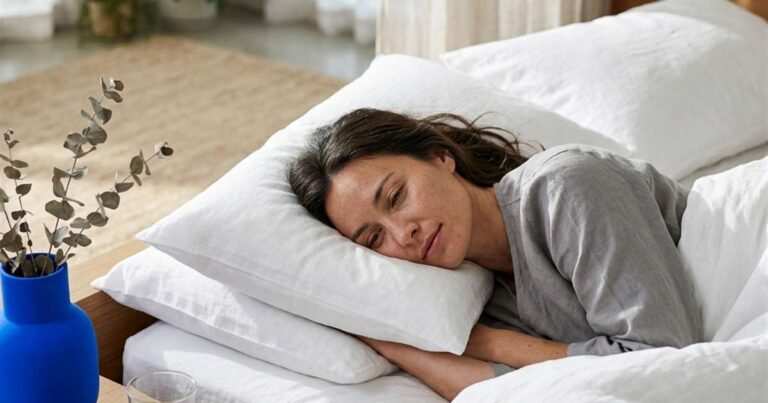
Everyone reaches for the flip. Then they reach for it again twenty minutes later, and again at 2 a.m. The cool side isn’t a solution. It’s borrowed time. The uncontacted side of any standard pillow stays cooler for exactly one reason: it hasn’t absorbed your body heat yet. Touch it to your face, and thermodynamics finishes the job in minutes.
The fridge is worse. The freezer is worse still. These two approaches come up constantly in search results and sleep forums, but neither addresses the actual problem, and the fridge method actively damages foam cores by introducing moisture it wasn’t built to handle.
Why the Standard Methods Don’t Last
Your head generates and radiates heat continuously during sleep. The average adult produces roughly 80-100 watts of metabolic heat during rest, and a significant portion of that heat dissipates through the scalp and face. The head’s role as the body’s primary radiative surface. A pillow absorbs that heat at the contact surface and, if the fill has low airflow or high thermal mass, the heat accumulates rather than dispersing.
The cool side works because the bottom surface of the pillow has been insulated from your body heat by the pillow’s own thickness. It’s genuinely cooler, but only until you load it with the same heat source. Dense foam returns to thermal equilibrium in minutes. Down and polyester fiberfill take longer but follow the same arc. Neither fill has a mechanism for shedding heat continuously; they can only absorb it until they’re saturated.
The fridge method is the most common piece of advice that causes actual damage. Foam cores, whether memory foam, latex, or polyester fiberfill, are porous. A refrigerator’s interior is cold and humid. When a foam pillow is removed from the fridge and placed in a warmer bedroom, condensation forms on and inside the fill as the cold surface meets warm ambient air. That moisture doesn’t evaporate quickly from a compressed foam interior; it persists. Solid memory foam is particularly vulnerable because its low airflow traps moisture rather than allowing it to evaporate. Repeat this enough times and you create exactly the sustained-moisture, low-light conditions that favor mold growth inside the fill, invisible from outside, dangerous to breathe against all night.
Chilling only the pillowcase is marginally safer, but the cooling effect at the surface lasts roughly as long as the first-touch sensation, under five minutes against a warm face.
What Actually Keeps a Pillow Cold: A Method-by-Method Breakdown
There are four approaches that produce a meaningful, durable cooling effect. They work through different mechanisms and suit different situations.
1. Lower the room temperature first.
This is the highest-leverage single change available, and it’s the one most people skip because it seems too simple. Sleep research cited by the Cleveland Clinic and the Sleep Foundation consistently places the optimal bedroom temperature range at 60-67°F (15.5-19.5°C) for adult sleep. Within this range, the body’s natural core temperature drop at sleep onset proceeds without interference. A pillow placed in a 65°F room is not fighting ambient heat, it’s supported by it.
A pillow in a 75°F bedroom will re-warm faster than the same pillow in a 65°F room, regardless of its fill material, regardless of whether you just flipped it or chilled it. Room temperature is the baseline that every other method builds on. Cooling the pillow while leaving the room warm is trying to bail out a boat without closing the hole.
2. Switch the pillowcase to a moisture-wicking fabric.
The pillowcase is the first interface between your skin and the pillow. A standard polyester or low-count cotton case traps sweat at the surface, which then forms a warm, humid layer between your face and the pillow. Bamboo-derived viscose (rayon from bamboo) has a microporous fiber structure that draws moisture away from the skin and releases it into the air rather than absorbing it into the fabric. This keeps the contact surface drier and reduces the heat-retention feedback from sweat moisture.
This is a cover-level fix, not a fill-level fix. It improves the first-contact experience and manages moisture at the interface, but it cannot overcome a fill that traps heat structurally. Pair it with one of the fill-level approaches below for sustained results.
3. Use a cooling gel pad under the pillowcase.
A gel pad placed between the pillow and the pillowcase acts as a thermal mass. It absorbs conducted heat from the face before that heat reaches the fill. At room temperature, a gel pad provides roughly 1-3 hours of cooling via conduction, depending on room conditions and individual heat output. Products like the AlphaCool Ice Gel Cooling Pad (approximately 11.75 × 15.75 inches) are designed specifically for this application, placed under the pillowcase rather than over it, so the fabric provides a comfortable surface while the gel absorbs heat beneath.
The mechanism is conduction: heat moves from your warmer face to the cooler gel until both reach the same temperature. Once the gel reaches equilibrium with your skin temperature, the effect ends. In a cooled room, the gel dissipates absorbed heat back into the ambient air and partially resets; in a warm room, the reset is slower and less complete. For sleep-onset heat specifically, a gel pad in a 65°F room can cover the most thermally active period of early sleep.
Do not refrigerate a gel pad and then slide it inside a pillowcase. The cold surface will condense moisture from the warm, humid air onto the gel pad surface. That moisture then deposits onto the pillowcase and pillow fill beneath it over the course of the night. Gel pads work at room temperature; chilling them accelerates cooling but adds condensation risk inside the case.
4. Change the fill material.
This is the only approach that addresses the structural root cause. Every method above is a workaround for a fill that doesn’t move air. Fills that do:
Shredded latex uses an open-cell structure that allows air to move through the material rather than around it. The inter-piece gaps between shredded pieces create additional ventilation pathways. Talalay latex specifically has higher airflow than Dunlop due to its manufacturing process, which creates a more uniform open-cell matrix. The cooling here is passive and continuous. It doesn’t charge, discharge, or reset; it just maintains airflow as long as the fill isn’t compressed into a solid mass.
Buckwheat hulls (Fagopyrum esculentum) create the highest-airflow fill available in consumer pillows. The polygonal hull geometry produces air channels between hulls that remain open under head weight. The fill shifts to distribute pressure but does not compress into a heat-trapping mass. The effect is structural and permanent; there is no gel coating to degrade or PCM capsule to rupture.
PCM-coated covers, using Outlast technology or similar microencapsulated phase-change compounds, add a charge-and-discharge layer on top of any fill. The PCM absorbs heat during the transition from solid to liquid, holding the surface temperature close to its calibrated transition point. As the room cools and the material re-solidifies, stored heat is released and the PCM is ready to absorb again. This extends effective cooling past the simple conduction window of plain gel, but it is still time-limited per cycle.
For sustained all-night cooling, the fill change is the only permanent fix. For sleep-onset heat with a fill you’re not ready to replace, the combination of room temperature control + moisture-wicking pillowcase + gel pad covers most of the functional window.
Use the Pillow Cooling Cheat Sheet
| Method | How Long It Lasts | Risk | Verdict |
|---|---|---|---|
| Flip The Pillow | 3–5 minutes | None | Skip physics, not a fix |
| Fridge / Freezer The Pillow | <10 minutes | Condensation → mold in foam | Avoid damages foam cores |
| Fridge / Freeze The Pillowcase Only | 2–4 minutes on face | Low (if fully dry) | Skip negligible effect |
| Lower Room To 60–67°F | All night | None | Do This First highest leverage |
| Bamboo / Moisture-Wicking Pillowcase | All night (moisture control) | None | Do This cover-level fix |
| Cooling Gel Pad Under Pillowcase | ~1–3 hours at room temp | Condensation if pre-chilled inside case | Useful for sleep onset; don’t pre-chill inside case |
| Shredded Latex Fill | All night (continuous) | None | Best Mid-Range Fix structural airflow |
| Buckwheat Hull Fill | All night (continuous) | Firm feel; audible rustle | Best Sustained Cooling if firmness tolerated |
| PCM-Coated Cover (e.g., Outlast) | Per thermal cycle; resets as room cools | Degrades if microcapsules rupture | Useful better than gel; limited by fill underneath |
The One Combination That Covers the Full Night
No single surface-level method sustains cooling from lights out to morning for a genuinely hot sleeper. The approach that covers the most ground is a layered system:
Set the room to 65°F before bed. Put a bamboo-derived viscose pillowcase on whatever pillow you currently use. If sleep-onset warmth is the main problem, slide a gel pad (at room temperature) inside the case before bed. If mid-night waking is the problem, the gel pad alone won’t reach it, that’s when fill material is the right next step, either shredded latex or buckwheat depending on feel preference and severity.
Frequently Asked Questions
Why does my pillow get so hot at night?
Your head and neck radiate heat continuously during sleep, and the pillow absorbs it at the contact surface. Standard fills, dense memory foam, down, polyester fiberfill, have low airflow when compressed under head weight. Heat accumulates at the surface faster than it disperses into the fill or into the ambient air. The denser the fill and the warmer the room, the faster saturation occurs.
Does putting your pillow in the fridge work?
Briefly, and at a cost. A refrigerated foam pillow creates condensation when it meets warm bedroom air. Moisture forms inside the fill, where it cannot easily evaporate. Repeated cycles of chilling and re-warming with any foam fill introduce cumulative moisture that increases mold risk over time. Chilling only the pillowcase is safer but produces a cooling effect that lasts under five minutes against a warm face.
What is the best room temperature for sleeping?
Sleep research cited by both the Cleveland Clinic and the Sleep Foundation supports a bedroom range of 60-67°F (15.5-19.5°C) for adult sleep. Within this range, the body’s natural core temperature drop at sleep onset is not impeded by ambient heat. Temperatures above 70°F are associated with more nighttime awakenings and shorter time in restorative sleep stages.
Does a cooling gel pad work under a pillowcase?
Yes, for roughly 1-3 hours depending on room temperature and individual heat output. The gel absorbs conducted heat from the skin via a temperature gradient. Heat moves from your warmer face to the cooler gel until both reach the same temperature. Once equilibrium is reached, the cooling effect fades. In a cooled room the gel partially resets; in a warm room it doesn’t. It is most effective as a sleep-onset tool, not an all-night solution. Do not pre-chill it inside the pillowcase. The condensation risk outweighs the additional cooling.
Is the other side of the pillow actually cold?
Only because it hasn’t been loaded with your body heat yet. The bottom surface of a standard pillow is insulated from the contact surface by the pillow’s thickness. It starts at room temperature and stays there until pressed against a heat source. Once you flip to it, it warms at the same rate as the side you just left. There is no permanent “cool side”, there is only the side that hasn’t been used yet.
Every method above comes back to what the pillow is made of. Our Pillow Materials guides break down each fill’s cooling behavior spec by spec.