That’s the accurate summary of gel-infused memory foam. And the fact that most product listings leave out the second sentence is the source of almost every disappointed review you’ll find from hot sleepers who expected more. Understanding why the cooling works, and why it stops, is the only way to know whether a gel-infused pillow or mattress is actually solving your problem.
What Memory Foam Actually Is (and Why It Runs Hot)
Memory foam is viscoelastic polyurethane: a polymer network with additional chemicals that increase its density and viscosity. The two properties that define it, contouring under pressure, slow recovery when pressure releases, both depend on the same physical mechanism. Higher-density memory foam softens in reaction to body heat, which is what allows it to mold to the shape of a skull within a few minutes of contact, as described in published material science documentation on viscoelastic foam behavior.
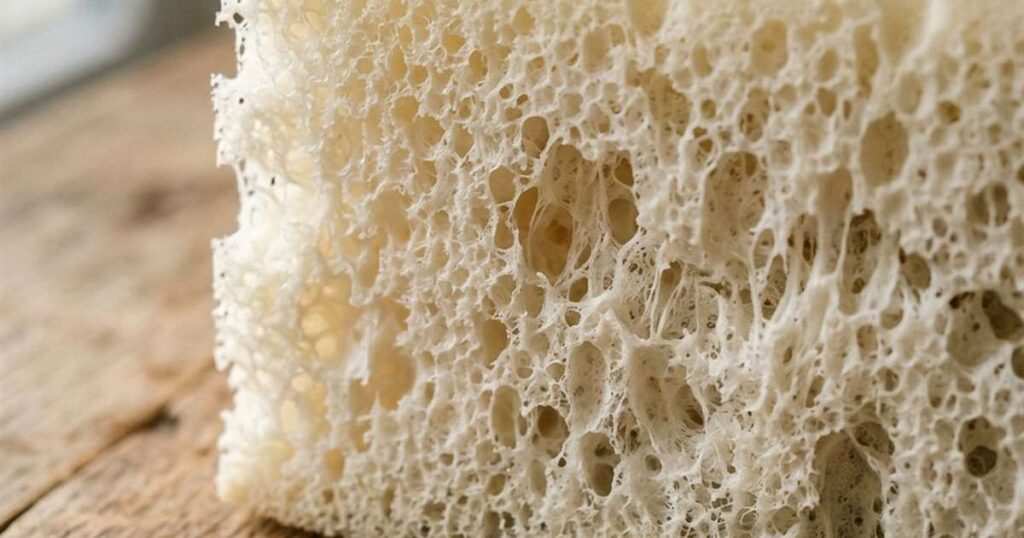
That temperature-sensitive softening is exactly what makes standard memory foam retain heat. The foam doesn’t just respond to warmth; it traps it. Dense foam has a smaller, more numerous cell structure that limits airflow through the material. When you press your head into a solid block of memory foam, air has nowhere to go. Body heat accumulates at the contact surface and stays there, because there’s no pathway for convective exchange with cooler ambient air.
Open-cell processing addresses this partly. Modern memory foam pillows are generally open-cell: the foam bubbles are interconnected rather than sealed, creating a matrix through which air can move. Open-cell construction reduces heat retention compared to the original closed-cell formulations, but the cells compress under head weight, which closes those air pathways when you actually need them most.
How Gel Infusion Changes the Equation
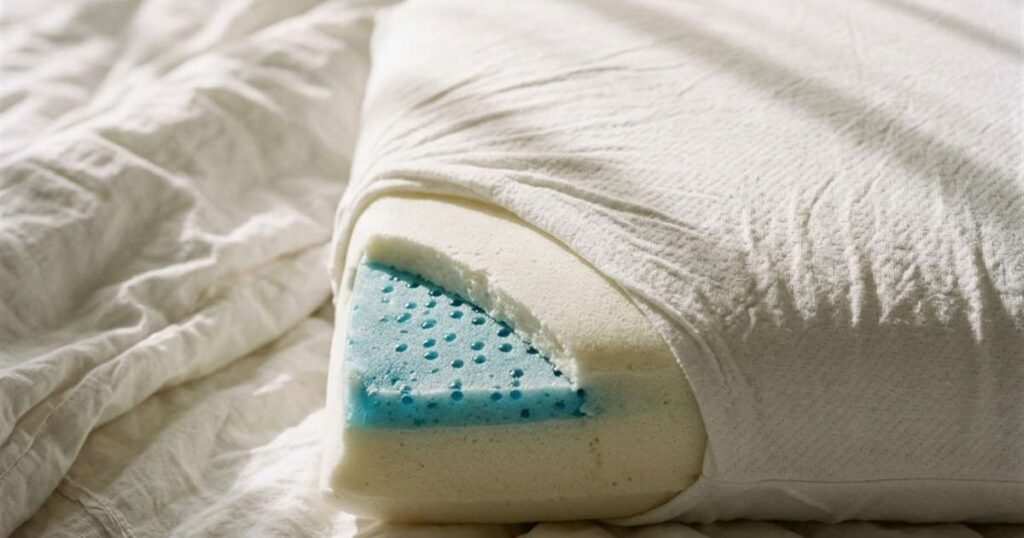
Gel is added to memory foam in one of two ways during manufacturing: as liquid gel swirled through the foam before it sets, or as discrete gel beads distributed through the foam matrix. The material result is different depending on which method the manufacturer uses, though both are commonly labeled “gel-infused.”
Swirl gel distributes a thin layer of gel-like material through the foam. It improves thermal conductivity, the rate at which heat moves through the material, compared to foam alone. Gel beads do the same, and when formulated as true phase-change material (PCM-grade beads), they add a second mechanism: latent heat absorption as the beads transition from solid to liquid at a defined temperature threshold.
Both forms cool via conduction: heat moves from the warmer surface (your head) toward the cooler gel particles, spreading it across a wider area rather than concentrating it where you’re lying. This is a genuine physical effect. Independent thermal analysis cited by Mattress Miracle found that gel infusion in memory foam improves airflow (measured by cubic feet per minute, or CFM) by roughly 3-10x compared to non-gel foam. Though that still leaves it 10-50x below the airflow of latex, per the same analysis.
The Sleep Foundation tested multiple gel-infused memory foam mattresses across all-foam models and found temperature neutrality ratings ranging from “fair” to “good”. And concluded that for all-foam products, gel memory foam is “likely not a feature that you need to specifically seek out.” Their best temperature neutrality scores came from hybrid models where coil systems provide continuous airflow beneath the foam, not from gel infusion itself.
The Equilibrium Problem
Here’s the structural limit that gel marketing glosses over: conduction works by moving heat from a warmer object to a cooler one. When the gel particles reach the same temperature as the surrounding foam and your skin. When they’ve absorbed as much thermal energy as their mass allows. The conduction stops. The gel has reached equilibrium with your body temperature, and it no longer has a thermal gradient to drive heat transfer.
For standard swirl-gel foam, most independent assessments place this equilibrium window at roughly 60-90 minutes after first contact. PCM-grade beads extend that window somewhat because the phase-change mechanism (solid to liquid) absorbs additional latent heat during the transition, which delays equilibrium. But most budget and mid-range gel pillows use swirl gel or basic beads, not true PCM-grade formulations. And the cooling effect of those fades before most people hit their first deep sleep cycle.
This is why gel-infused memory foam helps at sleep onset and fails mid-night. It’s not a defect. It’s thermodynamics. The question is whether your heat problem happens at 10 p.m. or 2 a.m.
| Regular Memory Foam | Gel-Infused Memory Foam | |
|---|---|---|
| Cooling mechanism | None (passive insulator) | Conduction (heat redistribution) |
| Cooling duration | None | ~60-90 min (swirl/basic gel); longer with PCM-grade beads |
| Feel vs. regular foam | Reference point | Slightly softer and more responsive |
| Airflow (CFM) | Low baseline | Roughly 3-10x higher than non-gel foam; still far below latex |
| Care | Spot-clean; cover washable | Same, spot-clean foam only; machine-wash cover |
| Price premium | Lower | Modest; gel adds manufacturing cost |
| Best for | Pressure relief, support, neutral sleepers | Warm sleepers with sleep-onset heat; not suited for mid-night sweating |
The Feel Difference: Slightly Softer, More Responsive
Gel infusion changes the tactile character of memory foam in a consistent, if subtle, way. Regular memory foam contours deeply. You sink into it. Which some sleepers describe as a “stuck” feeling. Gel-infused foam tends to be slightly more responsive because the gel particles interrupt the continuous foam matrix and introduce a small amount of mechanical spring-back. The feel shifts from “in the pillow” toward “on the pillow.”
This is partly why gel pillows get positive reviews from people who ran warm on a regular foam pillow: both the cooling effect and the feel improvement register together, so it’s difficult to separate which change matters more. The softer, less enveloping surface may reduce heat buildup simply by conforming less tightly around the head, regardless of how much the gel itself is doing.
That’s not a reason to dismiss gel infusion. It’s a reason to be honest about which mechanism is driving the improvement in any specific case.
Caring for Gel-Infused Memory Foam
The care rules for gel-infused foam are the same as for regular memory foam, and both are more restrictive than most sleepers expect.
The foam core itself should never go in a washing machine. The agitation cycle, particularly the spin, generates enough mechanical force to tear the foam cell structure apart. High heat from a dryer can damage both the foam matrix and the gel particles. For most solid gel-infused pillows, spot cleaning with a mild detergent solution is the correct approach for stains; baking soda left for an hour and then vacuumed away handles odors without moisture.
The removable cover. Which most gel-infused pillows include. Is machine washable on a gentle cycle with cold water. Wash covers monthly; wash them more often in warmer months or if you skip a pillow protector. The pillow itself benefits from airing out without a cover every few weeks to prevent moisture accumulation inside the foam.
Gel particles can degrade with repeated exposure to harsh detergents or bleach, which is why mild detergent is the correct choice if spot cleaning involves any cleaning solution at all.
When Gel-Infused Makes Sense (and When It Doesn’t)
Gel infusion earns its price premium in a specific scenario: you run warm at sleep onset, the heat is a mild-to-moderate problem rather than severe night sweating, and you want memory foam’s pressure relief and motion isolation without the standard foam’s heat buildup during the first hour or two of sleep.
It doesn’t solve the right problem if you’re waking soaked at 2 a.m. or 3 a.m. At that point, the gel reached equilibrium hours earlier. What you need is a fill that moves air continuously, shredded latex, buckwheat, or a grid-over-latex construction, not a material that spreads heat more efficiently at the start of the night.
The structural question to ask is: when does the heat wake you up? Sleep-onset warmth is a gel problem. Mid-night soaking is an airflow problem. Most marketing for gel-infused products never draws that distinction, which is why so many hot sleepers cycle through cooling pillows without finding one that actually works.
Frequently Asked Questions
Does gel-infused memory foam stay cool all night?
No. The cooling effect from standard gel infusion works via conduction and lasts roughly 60-90 minutes before the gel reaches thermal equilibrium with body temperature. After that point, the material’s heat behavior is similar to regular memory foam. PCM-grade gel beads extend this window somewhat, but most mid-range pillows and mattresses use basic gel rather than true PCM formulations.
Is gel memory foam softer than regular memory foam?
Slightly. Gel particles interrupt the continuous foam matrix and add minor mechanical springback, making the material marginally more responsive and reducing the “sinking” sensation associated with standard memory foam. The difference is real but subtle.
Can you wash a gel memory foam pillow?
The foam core should not go in a washing machine. The agitation can tear the cell structure and damage the gel particles. Spot-clean the foam with mild detergent and water; remove and machine-wash the cover on a gentle cold cycle. Air-dry the foam completely (at least 24 hours) before replacing the cover.
Is gel memory foam good for hot sleepers?
For sleepers who run warm at sleep onset, yes. Gel infusion meaningfully reduces early heat buildup compared to regular foam. For sleepers who experience mid-night waking from heat or sweating, gel infusion is unlikely to solve the problem, because the cooling effect has expired by then. The Sleep Foundation found no consistent evidence that gel infusion improved temperature neutrality across all-foam models in their testing.
Does gel infusion affect how long a memory foam pillow lasts?
Gel particles don’t substantially affect durability one way or the other. Foam density (measured in lb/ft³) remains the primary predictor of lifespan. Harsh detergents can degrade gel over time, which is why mild cleaning agents are recommended. Expect a well-maintained gel-infused foam pillow to last roughly 18-36 months, consistent with standard memory foam.