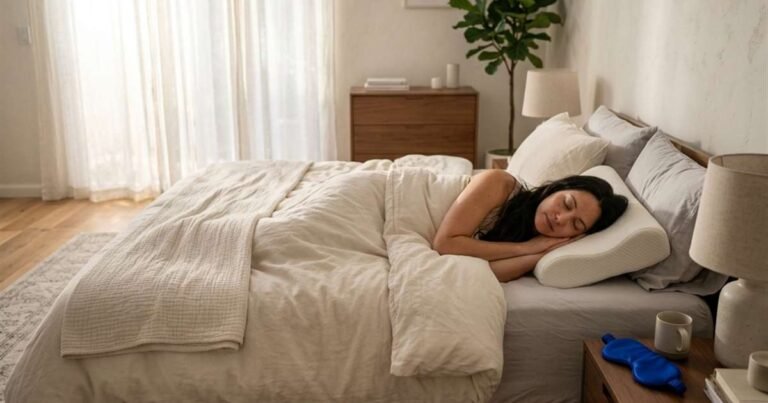
A standard 20×54-inch body pillow fits most adult side sleepers from chin to mid-shin. That number is repeated everywhere in this category. What almost no one mentions is that 54 inches solves only the length problem. It does nothing about the three mechanical failures that actually wake side sleepers up: shoulder collapse, top-arm drift, and fill compression by hour four.
Side sleeping creates a specific load pattern. The bottom shoulder bears the body’s full lateral weight against the mattress. The top arm, with nowhere to rest, drags the shoulder girdle forward and rotates the thoracic spine. The hips drop toward each other without support between the knees, tilting the pelvis. A body pillow interrupts all three failure points when it is the right fill, the right firmness, and actually long enough to reach from the chest to between the knees simultaneously. For a deeper look at how loft and shoulder width interact in this position, the best pillows for side sleepers covers the cervical piece in detail.
Why 54 Inches Became the Standard (And When It Is Not Enough)
The 20×54-inch format is the default because it covers a 5’4″ to 5’10” adult from chin to mid-shin in a straight line. That span puts the pillow in contact with the chest, the top arm, and the gap between the knees simultaneously. Below roughly 5’2″, 54 inches runs past the feet and becomes awkward to hug consistently. Above 6’0″, the pillow either reaches the chest or the knees, not both.
A 2021 systematic review in the European Journal of Integrative Medicine found moderate evidence that contoured pillow designs with higher sides to accommodate lateral sleeping and sufficient total length to support the hip and knee produced better spinal alignment outcomes than standard flat formats. The mechanism is straightforward: without something between the knees, the top knee drops forward, internally rotating the hip and increasing shear load at L4-L5. A body pillow long enough to reach between the knees closes that gap.
C-shaped pillows like the Snoogle solve the length problem differently. Instead of a straight 54 inches, the curved format wraps one end behind the back and tucks the other between the knees, with the midsection supporting the front of the body. For sleepers who roll onto their back during the night, the C-shape’s back panel is the more reliable option. The straight pillow just falls away when you roll, where the C-shape rolls with you.

The 6 Picks
1. Goods Original Body Pillow
The adjustable fill makes this the most structurally precise option here. If the standard amount of foam is too firm for your shoulder contact point, you open the zipper and pull some out. No other mainstream body pillow in this price range offers that. CertiPUR-US and GREENGUARD Gold both verified. Worth the premium over polyester fiber fills for anyone who sleeps hot or compresses pillows by morning.
| Spec | Disclosed value |
|---|---|
| Dimensions | 20 in × 54 in |
| Fill | Shredded memory foam + microfiber (Oomph Fill) |
| Fill adjustability | Yes, zippered, add or remove fill |
| Cover | Lulltra fabric (polyester/rayon blend), removable, machine washable |
| Certifications | CertiPUR-US, GREENGUARD Gold |
| Firmness | Medium-firm (adjustable) |
The Coop body pillow’s core advantage for side sleepers is the zipper. Shredded memory foam compresses under lateral pressure. Specifically at the shoulder contact point where the top arm loads into the pillow all night. With a sealed pillow like the Snuggle-Pedic, compression is a one-way street. With the Coop, you can add fill back as the foam breaks in, or reduce it if the initial loft pushes the shoulder too high.
The Lulltra cover runs slightly cooler than cotton or straight polyester because the rayon component moves moisture. For sleepers whose shoulder contact generates heat, that difference is noticeable across a full night.
For broad-shouldered side sleepers, I’d start with the full fill and give it two to three weeks before deciding whether to reduce. The shoulder gap on a wide frame is deeper, and under-filling is the more common error than over-filling.
2. Snuggle-Pedic Body Pillow
A sealed shredded foam body pillow with a consistent medium-firm profile and a bamboo-blend cover that reduces heat at the contact point. The Kool-Flow cover is not marketing: bamboo viscose wicks moisture faster than straight polyester, which matters when your shoulder presses into the pillow all night. The sealed design removes the adjustment option but delivers a predictable feel from night one.
| Spec | Disclosed value |
|---|---|
| Dimensions | 20 in × 54 in |
| Fill | Proprietary shredded memory foam blend (sealed) |
| Fill adjustability | No, sealed; firmness adjustments available via manufacturer request |
| Cover | Kool-Flow: 43% bamboo viscose, 56.4% polyester, 0.6% Lycra |
| Certifications | CertiPUR-US |
| Origin | Made in USA |
The Snuggle-Pedic uses a proprietary blend of foam offcuts from larger mattress and topper manufacturing. The mix produces a fill that is slightly denser and more responsive than single-grade shredded foam. Because the pillow is sealed, fill distribution is consistent from edge to edge, there is no void at the center like you sometimes get with loosely packed fills.
A 2024 Beihang University study on individualized pillow height for side sleepers confirmed that thermal comfort at the contact interface directly affects perceived sleep quality. The same principle applies at the shoulder contact point of a body pillow, and the Kool-Flow cover addresses it more directly than a standard polyester shell.
For average-frame side sleepers who want a medium-firm body pillow without the maintenance of an adjustable fill, this is the cleaner option.
3. Leachco Snoogle Original
The only pick here that supports the back, the belly or chest, and between the knees at the same time. The C-shape eliminates the back-roll problem that straight pillows cannot solve. When you roll to your back at 2am, the back panel of the Snoogle comes with you and stops the rotation. Polyester fiber fill is softer and less durable than foam, but the structural geometry of the C-shape is the point. Best single pick for pregnancy and for chronic back-rollers.
| Spec | Disclosed value |
|---|---|
| Total length | Approx. 60 in (C-shape arc) |
| Fill | 100% polyester fiber |
| Inner liner | 65% polyester, 35% cotton |
| Cover | Zippered, removable, machine washable |
| Pillow washability | Spot clean only, do not machine wash |
| Shape | C-shaped (head-to-toe contour) |
The Snoogle’s geometry was designed by a registered nurse to follow the body’s lateral contour from the head through the knees. The horseshoe-shaped head end allows height adjustment by rotating the curved section. The midsection provides back or belly support depending on which way you face the opening.
The polyester fiber fill is the Snoogle’s weakest point mechanically. Polyester fiber compresses faster than shredded foam under sustained lateral load, and the fill is not adjustable or replaceable. For non-pregnant side sleepers who want the C-shape geometry, this is a trade-off worth knowing before purchase. For pregnancy use, where back-panel support and belly-front contact matter more than long-term foam durability, the geometry outweighs the fill limitation.
4. Leachco Snoogle Signature
The extended version of the Snoogle at 62.5 inches and 8.25 inches of thickness, designed for taller sleepers and broader frames who find the Original too short to cover both the head and the knee gap. Woven cotton cover rather than jersey, which most sleepers find cooler. The same polyester fiber fill limitation applies, but the geometry suits a frame the Original was never built for.
| Spec | Disclosed value |
|---|---|
| Dimensions | 62.5 in length, 8.25 in thick |
| Fill | Medium-density polyester fiber |
| Cover material | Woven cotton |
| Shape | C-shaped |
| Cover washability | Machine washable (removable) |
At 62.5 inches, the Signature adds roughly 2.5 inches over the Original, enough for a 5’11” to 6’2″ sleeper to get knee-to-head coverage the Original misses. The 8.25-inch midsection thickness also means the back-panel support is more substantial against a broader back.
For taller side sleepers who have already tried a straight 54-inch pillow and found it slips below the knee gap by morning, the Signature’s C-shape geometry is worth the step up.
5. Parachute Down Alternative Body Pillow
Recycled polyester microfiber in a cambric cotton shell, the softest and most compressible fill in this lineup. For side sleepers who want a plush hug rather than structured foam support, and who are not fighting active shoulder collapse or hip drop, this is the right pick. OEKO-TEX Standard 100 certified. Not the right choice if your shoulder is actively collapsing. The fill gives too easily under sustained lateral load.
| Spec | Disclosed value |
|---|---|
| Dimensions | 20 in × 54 in (insert) |
| Fill | 100% recycled polyester microfiber |
| Shell | Cambric cotton |
| Certifications | OEKO-TEX Standard 100 |
| Cover | Sold separately (pairs with Parachute body pillow covers) |
| Washability | Machine wash cold, tumble dry low |
The microfiber fill mimics the loft and give of down without the allergen risk. It compresses more readily than shredded foam under sustained lateral shoulder pressure. A meaningful difference for side sleepers who press into the pillow with their top arm for most of the night. Where this pillow wins is texture and thermal breathability. The cambric cotton shell moves heat away from the contact point better than a synthetic shell, and the microfiber fill does not trap body heat the way memory foam does.
6. Utopia Bedding Body Pillow
A 20×54-inch polyester fiber pillow at under $30. Spot-clean only is a real maintenance limitation for a pillow in contact with your body all night. Fill compression is faster than any foam option in this list. For budget-first buyers who want to test whether a body pillow helps their side sleeping before committing to a foam fill, this is a reasonable starting point, not a long-term solution.
| Spec | Disclosed value |
|---|---|
| Dimensions | 20 in × 54 in |
| Fill | 100% polyester fiber |
| Cover | Polyester blend shell |
| Washability | Spot clean only |
| Price tier | Budget (typically under $30) |
| Certifications | None disclosed |
The Utopia pillow delivers the standard straight format at the lowest verified price point in this list. Polyester fiber fill at this price point compresses at the center shoulder contact point within a few months of regular side sleeping, that is standard behavior for this fill class, not a defect. The spot-clean-only instruction is the biggest practical limitation: a body pillow that contacts your chest, shoulder, and inner thighs overnight needs a washable body pillowcase added to it, which shifts the effective cost.
Use this as a trial pillow. If a body pillow solves your shoulder or hip alignment problem, upgrade to the Coop or Snuggle-Pedic. If it does not help, you have spent under $30 rather than over $80 on the experiment.
What the Fill Type Actually Does to Shoulder Support
The marketing language around body pillow fills clusters around “soft,” “supportive,” and “cooling.” None of those words describe the mechanical property that matters for a side sleeper’s shoulder: recovery rate under sustained lateral load.
Shredded memory foam recovers slowly. Press your shoulder into it, and the foam distributes the load across a wider surface, reducing peak pressure at the contact point. This is the same reason shredded foam outperforms polyester fiber in head pillow ratings for side sleepers. The slower recovery means the foam does not push back against the shoulder. It conforms, then holds.
Polyester fiber compresses quickly and recovers quickly. Under the sustained load of a side-sleeping shoulder for six to eight hours, polyester fiber migrates toward the edges of the pillow, leaving a central void. By hour four, you are often pressing through a depleted fill zone.
Down and microfiber fills fall between the two. They compress more readily than shredded foam but recover more uniformly than polyester fiber because the fill clusters redistribute rather than migrate. The Parachute insert behaves this way, softer than foam picks, but more durable than straight polyester.
The Myth This Category Keeps Repeating: “Body Pillows Align Your Spine”
Every body pillow listing, from sub-$20 polyester fiber inserts to $90 adjustable foam picks, claims to “align your spine.” This is repeated without qualification across the entire category.
A body pillow does not align your spine. It supports the structures that prevent misalignment. The distinction changes what you are actually shopping for.
Spinal alignment during side sleeping depends on three contact points: the shoulder-to-mattress interface, the head pillow’s loft relative to shoulder width, and the gap between the knees. A body pillow addresses the second and third of those. It gives the top arm a resting position that reduces anterior shoulder drag, and it fills the inter-knee gap that causes hip tilt. The cervical alignment, the first contact point, is governed by your head pillow, not your body pillow.
The confusion leads people to expect a body pillow to eliminate neck pain when the neck pain is actually caused by a head pillow with the wrong loft. If your neck still hurts after adding a body pillow, check the pillow loft and mattress firmness guide before concluding the body pillow is wrong. The two tools solve different problems.
How to Position a Body Pillow Correctly
Place the pillow along your front, running from chest height to between your knees. The top arm rests over the pillow. The bottom arm extends forward along the mattress or tucks under the head pillow. The pillow between your knees should hold enough loft that the top knee stays at roughly hip height. If the top knee drops significantly below the bottom knee by morning, the fill has compressed below functional threshold.
Shoulders stay on the mattress. The pillow contacts your chest and the inner surface of your arm. If your shoulder is riding on top of the pillow, the pillow is positioned too high or needs a lower-loft fill.
C-shaped Snoogle positioning is different: one curved end supports the head, the midsection wraps in front (belly support) or behind (back support, your choice), and the lower curved end tucks between the knees. The back panel sits against your lower back. It is a passive backstop against rolling, not active lumbar support.
Frequently Asked Questions
Are body pillows good for side sleepers?
They address two of the three mechanical failure points of side sleeping: top-arm drift and inter-knee hip tilt. The third, cervical alignment, requires a properly fitted head pillow. Used together, a body pillow and a correctly lofted head pillow cover the full positional geometry of side sleeping.
Where does a body pillow go when side sleeping?
Along your front, running from chest height down between your knees. Your top arm rests over it. Your bottom arm extends forward on the mattress. Your shoulder stays on the mattress surface, not on top of the pillow.
What is the best fill for a body pillow for side sleepers?
Shredded memory foam holds up better under sustained lateral shoulder load than polyester fiber. Adjustable shredded foam (Coop) is the most mechanically adaptable option; sealed shredded foam (Snuggle-Pedic) is the next step down.
What length body pillow do side sleepers need?
54 inches covers most adults from 5’2″ to 5’10” from chest to between the knees. Above 6’0″, a C-shaped pillow like the Snoogle Signature at 62.5 inches is more likely to reach both contact points simultaneously.
Can a body pillow help with shoulder pain?
It gives the top arm a resting point, which reduces the anterior shoulder drag that side sleeping creates when the arm has no support. The body pillow does not correct the underlying cause of shoulder pain, but removing the sustained forward-rotation load across a full night reduces the mechanical stress that accumulates in that position.