
Latex outlasts wool by roughly 5 years under normal use conditions. A natural latex pillow Talalay or Dunlop maintains its cell structure under sustained compression for typically 8-10 years; a well-maintained wool pillow runs 3-5 years before fill degradation meaningfully reduces loft and moisture management capacity. That longevity difference is the first thing a spec-based comparison should establish, because it changes the cost-per-year calculation considerably even when latex’s upfront price is higher.
The second decisive differential: wool wicks moisture vapor from the skin surface before the sensation of dampness registers, while latex dissipates radiant body heat through its open-cell foam structure. The 2019 International Journal of Environmental Research and Public Health study on wool bedding documented measurably lower skin temperature and reduced waking frequency compared to synthetic controls, attributing the effect to wool’s hygroscopic capacity the ability to absorb moisture vapor into the fiber cortex before it accumulates at the skin surface. Latex does not have this mechanism. It does not absorb moisture; it transfers heat away from the contact surface through its interconnected cell network.
The distinction matters because “sleeping hot” means two different things. If you wake damp humidity is the problem wool is the right fill. If you wake from radiant heat buildup against a dense surface heat conduction is the problem latex’s open-cell ventilation addresses it more directly.
Everything else in this comparison firmness, loft retention, dust mite resistance, certification, care follows from those two primary differentials.
Firmness and Feel: Bounce vs. Mold
Latex and wool produce fundamentally different compression responses under head weight, and neither is objectively better the right one depends on what kind of support the sleeper wants.
My bottom line from the spec comparison: latex wins on longevity and cost-per-year by a wide margin — 8–10 years versus 3–5 changes the math completely. But I ranked wool as the moisture winner for sweaty sleepers; the 2019 study data on lower skin temperature is real. Choose latex for durability and side-sleeping support, wool if night sweats are your primary problem.
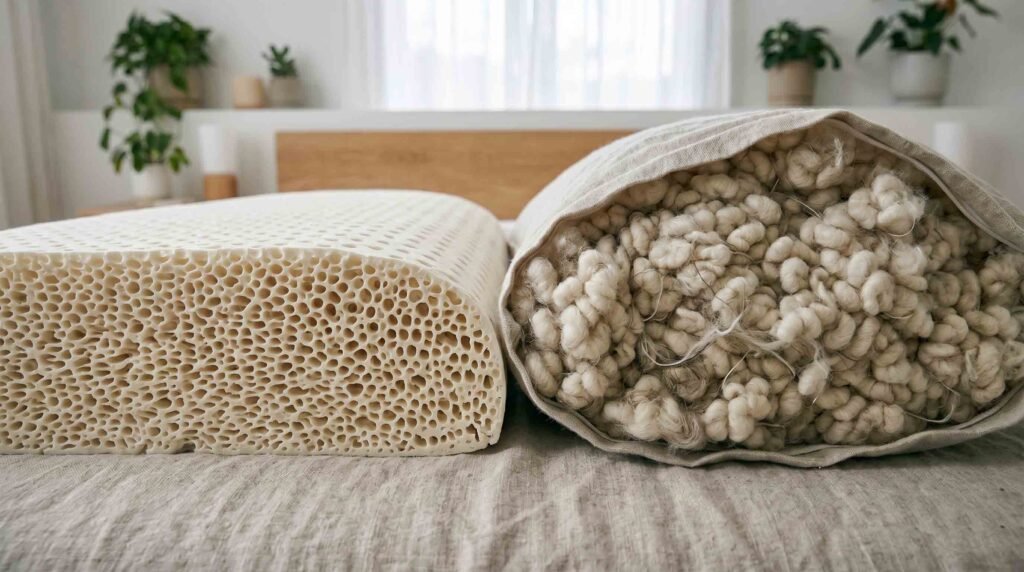
Latex is viscoelastic in the sense that it deforms under load, but its primary property is elasticity it pushes back. Natural latex foam has a defined ILD (Indentation Load Deflection) value that measures the force required to compress the foam by 25% of its thickness. Talalay latex for pillow fills typically falls in the 14-19 ILD range for soft variants and 28-36 ILD for medium-firm. Published latex foam mechanics data confirms that natural latex maintains this ILD range through sustained compression cycling with minimal permanent set meaning the pillow returns to its original height after each night’s use, consistently, across years of use.
Wool compresses and molds rather than bouncing back. Wool pearl clusters the carded fiber balls that make up a wool fill interlock under compression and stay in the compressed orientation longer than latex returns. The mold-and-hold behavior suits sleepers who want a fill that settles around the head and neck rather than pushing upward. Weekly fluffing by hand redistributes the pearls and restores loft; without it, flat zones develop and become permanent over months.
For side sleepers specifically, the bounce distinction is consequential. Side sleeping requires consistent fill height across the lateral edge of the pillow the shoulder gap must be filled reliably through the full night. Latex maintains that height through compression cycling without manual intervention. A wool pillow at adequate fill weight (roughly 28-32 oz for a queen) can achieve the same loft initially, but requires more maintenance to sustain it. The best latex pillows guide covers ILD selection for side sleepers in more detail.
| Property | Wool Fill | Natural Latex Fill |
|---|---|---|
| Compression Response | Molds and holds shape | Bounces back (elastic) |
| ILD Range | N/A – not measured by ILD | ~14-36 depending on grade |
| Loft Retention Without Maintenance | Moderate – needs weekly fluffing | High – remains consistent without intervention |
| Best for Side Sleepers | With adequate fill weight + maintenance | Yes – preferred for reliable loft |
| Best for Back / Stomach Sleepers | Yes – dense micro-cushion suits lower loft needs | Yes – with correct ILD selection |
| Feel Description | Dense, micro-cushioned | Springy, responsive |
Temperature and Moisture: Two Different Thermal Problems
This is the comparison point where most content gets it wrong by treating “breathable” as a single property both materials share equally. They do not share it equally, and the mechanism difference determines which fill solves which problem.
Wool’s thermal mechanism: moisture vapor absorption. Wool fiber cortex cells absorb moisture vapor from the microclimate between the head and the pillow surface. The fiber pulls vapor in before it condenses on skin, releases it slowly into the ambient air, and maintains a drier contact surface throughout the night. The result is a pillow that sleeps dry not cold. Wool does not reduce skin temperature through conduction; it reduces the perceived heat of dampness by removing the moisture that makes heat feel more intense.
Latex’s thermal mechanism: open-cell ventilation. Natural latex foam both Talalay and Dunlop has an interconnected cell structure that allows air to circulate as the foam compresses and decompresses under head weight. Talalay latex, which is produced through a vacuum and freeze process, has a more uniform cell distribution than Dunlop and generally offers slightly better airflow. Neither latex type absorbs moisture – the foam surface stays dry because it does not take moisture in at all, and heat dissipates through the cell network rather than accumulating at the contact surface.
The practical decision: A side sleeper who wakes because the pillow surface feels damp against their cheek benefits more from wool’s hygroscopic mechanism. A back sleeper who wakes from a sensation of radiant heat radiating up from a dense surface benefits more from latex’s open-cell airflow. Both fills perform better in this regard than most synthetic alternatives the question is which mechanism matches the sleeper’s specific thermal complaint.
Longevity: Where Latex Wins Decisively
A natural latex pillow lasts roughly 8-10 years under normal use. A well-maintained wool pillow lasts roughly 3-5 years. The gap is roughly 5 years, and it has a mechanical explanation.
Latex foam maintains its cell structure through compression cycling because the cross-linked polymer network of vulcanized latex is inherently resilient. The ILD measured on a new latex pillow is close to the ILD of the same pillow after three years of use. Permanent set the technical term for irreversible compression is low in natural latex compared to polyurethane foam and wool.
Wool fill degrades through two parallel processes: physical compression of the pearl structure under sustained head weight, and progressive saturation of the fiber cortex with oils and particulates from skin contact. The first process reduces loft over time even with correct maintenance; the second reduces the hygroscopic capacity that makes wool thermally effective. Both processes accelerate with heavier use and slower maintenance cycles.
The cost-per-year calculation typically favors latex despite its higher upfront price. A quality natural latex pillow in the $80-$130 range over 10 years costs roughly $8-$13 per year. A quality wool pillow in the $60-$100 range over 4 years costs roughly $15-$25 per year. The comparison is not exact because individual use patterns vary, but the direction is consistent across the price tiers.
Dust Mite Resistance: Both, Different Mechanisms
Both materials maintain microclimate conditions that are hostile to dust mite survival, but through different mechanisms.
Wool’s hygroscopic property keeps microclimate humidity below roughly 50% relative humidity the threshold dust mites require to survive and reproduce. The fiber actively buffers humidity rather than passively allowing it to accumulate. No chemical treatment is required; it is a fiber property.
Latex has an inherently inhospitable surface chemistry for mites. The protein structure of natural latex and its non-porous foam surface do not provide the substrate mites require to colonize. Some individuals with latex protein allergies should note that natural latex contains Hevea brasiliensis proteins that can trigger reactions in sensitized people the dust mite resistance property and the latex protein allergen risk are separate considerations.
Both fills also benefit from the reduced allergen accumulation that comes from low moisture environments – mold, mildew, and the secondary allergens associated with them are suppressed by the same conditions that suppress mite populations.
Certifications: GOTS vs. GOLS
Neither fill type has a single universal organic certification each has its own applicable standard, and a wool pillow’s certification structure differs from a latex pillow’s by design.
Wool is certifiable under GOTS (Global Organic Textile Standard) when sourced from organic livestock management. GOTS covers the full supply chain from farming through manufacturing, including processing chemical restrictions and ILO labor compliance. Our guide to the best organic pillows covers GOTS verification and chemical restrictions in full.
Natural latex is certifiable under GOLS (Global Organic Latex Standard), which requires that at least 95% of the raw latex content comes from certified organic rubber tree cultivation. GOLS does not cover labor conditions with the same scope as GOTS. A latex pillow can additionally hold GOTS certification for its cotton shell separately from the GOLS certification for the latex fill both can and should appear on the same product.
A well-certified latex-wool blend pillow (such as the Avocado Green Pillow covered in the best wool pillow guide) typically holds GOTS for the wool and cotton components and GOLS for the latex component the most complete certification stack available in this fill category.
| Certification | Applies to | Covers farming | Covers labor | Public database |
|---|---|---|---|---|
| GOTS | Wool, cotton, kapok | Yes | Yes | Yes – global-standard.org |
| GOLS | Natural latex | Yes | No (limited) | Yes – gols.info |
| OEKO-TEX STANDARD 100 | Both (finished product) | No | No | Yes – oeko-tex.com |
Care: Wool Demands More, Latex Demands Less
The care differential between the two fills is significant and should factor into the purchase decision.
Wool requires hand washing in cold water with a pH-neutral, enzyme-free detergent typically every 6 months for a pillow used nightly. Machine washing felts the fill permanently and irreversibly. Weekly hand-fluffing maintains loft distribution. Monthly airing (2-3 hours near an open window) resets the hygroscopic capacity and suppresses odor accumulation. A pillowcase and pillow protector reduce the interval between full washes.
Latex requires spot cleaning only the foam structure cannot be submerged or machine washed because it absorbs water and takes an extremely long time to dry completely, creating mold risk in the interior. The cover (typically organic cotton) is removable and washable. The latex core itself only needs occasional airing. No weekly maintenance is required; the cell structure does not migrate the way wool pearls do.
If care simplicity is a meaningful constraint households with children, high-turnover sleep environments, or limited time for textile maintenance latex is the lower-maintenance choice by a substantial margin.
The Contrarian Claim This Article Is Not Making
Most wool vs. latex comparisons end with a declaration of an overall winner. This one does not, because the “winner” framing is wrong for a comparison where the two fills solve different problems at different price-per-year points for different sleepers.
Latex wins on longevity, side-sleeper loft reliability, and care simplicity. Wool wins on moisture vapor management and, in organic-certified form, on supply chain transparency (GOTS covers farming and labor; GOLS for latex does not cover labor to the same depth). Neither win is unconditional.
The sleeper who benefits most from wool: a hot sleeper whose primary complaint is nighttime dampness, who maintains a consistent hand-wash schedule, and who values a fill that actively manages microclimate humidity rather than just ventilating heat.
The sleeper who benefits most from latex: a side sleeper who wants consistent loft without weekly maintenance, a longer fill lifespan, and a feel that pushes back rather than molding. Budget-conscious buyers calculating cost-per-year rather than upfront cost tend to land on latex for the same reason.
Frequently Asked Questions
Which is firmer: wool or latex?
Latex is bouncier and more measurably firm in the ILD sense it pushes back against head weight with a defined resistance that is consistent across the pillow’s lifespan. Wool molds under compression and holds the compressed shape rather than returning immediately. The perceived firmness of wool is dense and conforming; the perceived firmness of latex is springy and resistant. Neither is objectively firmer in a way that makes one universally better the preference depends on whether the sleeper wants a fill that conforms or one that rebounds.
Which lasts longer: wool or latex?
Natural latex lasts roughly 8-10 years under normal use. A well-maintained wool pillow lasts roughly 3-5 years. The difference traces to latex’s cross-linked polymer network, which resists permanent compression set, versus wool’s organic fill structure, which degrades through compression cycling and fiber saturation over time. Cost-per-year calculations typically favor latex despite its higher upfront price.
Are wool and latex pillows safe for dust mite allergies?
Both maintain microclimate conditions hostile to dust mite survival through different mechanisms. Wool’s hygroscopic property keeps humidity below the roughly 50% threshold mites require. Latex’s surface chemistry and non-porous foam structure do not support mite colonization. Neither fill requires chemical treatment to achieve this. Note that natural latex contains Hevea brasiliensis proteins that can trigger reactions in individuals with latex protein allergies this is separate from the dust mite question and should be confirmed before purchasing a latex pillow.
Do wool pillows eventually go flat?
Yes, wool fibers naturally felt and compress over time due to the weight and heat of your head. You can expect a wool pillow to lose about 30 percent of its initial loft. You must regularly manually pull apart the fibers or place the pillow in the sun to restore its volume.
Do latex pillows sleep hotter than wool?
Latex generally sleeps cooler than traditional memory foam but still retains more heat than natural wool. Wool fibers excel at wicking away moisture and regulating temperature, making it a superior choice for hot sleepers. If you choose latex, ensure you use a breathable 100 percent cotton pillowcase to prevent heat buildup.
Is wool or latex better for side sleepers?
Latex is typically better for side sleepers because it offers consistent, springy support that prevents the head from sinking. Wool pillows often compress too much during the night, forcing your cervical spine out of alignment. If you prefer wool, make sure you choose an adjustable option and overfill it slightly to compensate for flattening.
Five years of lifespan difference starts with the material. Our Pillow Materials section compares wool and latex on durability specs.