Most people assume their bedroom is quiet enough if they can’t hear obvious noise. That assumption is where sleep optimization goes wrong. The WHO actually sets the sleep-safe ceiling at 30 dB(A), and noise is just one of five environmental variables this guide covers. Scent is another, backed by a 628-patient study on lavender inhalation. We cover the full research breakdown in our guide to essential oils for sleep. If you’re more interested in smart sensors or anti-snore technology, check our review of best smart pillows instead.
The World Health Organization’s own guidance for a bedroom during sleep is 30 A-weighted decibels. A running refrigerator hits about 40. A quiet conversation is closer to 60. Most people never check where their bedroom lands on that scale, they just assume a “quiet” room is quiet enough, and that assumption is where sleep environment optimization actually starts going wrong.
Most bedding sites treat the sleep environment as an afterthought to the mattress: buy the right pillow, buy the right mattress, and if you’re still not sleeping, maybe try a diffuser. That ordering gets it backward. Environmental noise disrupts sleep architecture at low sound levels, and relying solely on hardware ignores real-time tracking data. Read our analysis of best AI sleep apps to evaluate which stage-tracking and sound-masking algorithms deliver verifiable sleep quality improvements. This guide breaks the sleep environment into five variables that have real research behind them, ranks them by strength of evidence, and tells you which tool actually addresses each one, as opposed to which tool is easiest to sell.
Why “Dark, Quiet, Cool” Is a Testable Claim, Not a Slogan
Sleep hygiene lists have repeated “keep your bedroom dark, quiet, and cool” for years without explaining why those three words carry more mechanical weight than the rest of the advice around them. Here’s the reason: each one maps to a specific physiological pathway that researchers can and do measure directly.
Noise triggers autonomic nervous system arousal during sleep, even at levels too low to cause a full awakening. Light suppresses melatonin production through photoreceptors that respond to wavelength, not just brightness. Temperature and humidity both interfere with the body’s overnight thermoregulation, the process that has to happen for you to move through sleep stages normally. None of that is marketing copy. It’s the mechanism section of peer-reviewed sleep science, and it’s why this guide treats “environment” as five separate engineering problems instead of one vague mood.
The Real Problem: People Buy Tools in the Wrong Order
The standard advice path goes: try melatonin, try a new pillow, try a white noise machine, try blackout curtains, in whatever order a targeted ad happens to reach you. That’s a marketing-driven sequence, not a physiologically-driven one. If your bedroom is sitting at 45 to 50 dB(A) from a busy street, a $40 essential oil diffuser is not going to move your sleep quality in a way you can feel. If your room is already near-silent but you’re falling asleep with a lamp on, a sound machine addresses a problem you don’t have.
The fix is to identify your actual disruptor before buying anything. The category guides below route you to whichever category is actually worth your money first.
| Noise Source | Approximate Level | Sleep Impact |
|---|---|---|
| WHO bedroom target | 30 dB(A) | Baseline for undisturbed sleep |
| Running refrigerator | roughly 35-40 dB | Near the upper edge of the WHO target |
| Quiet residential street | roughly 40-50 dB | Above target, associated with measurable disturbance |
| Normal conversation | roughly 60 dB | Well above sleep-safe threshold |
White noise machines don’t lower the ambient sound level, they raise the floor so that individual noise events (a door, a car, a partner’s snoring) don’t create as sharp a contrast against the background, which is the mechanism actually tied to awakenings. That distinction matters when choosing a device: continuous, evenly-distributed sound matters more than raw volume, and [our breakdown of white, pink, and brown noise](/white-noise-vs-pink-noise-for-sleep/) covers which frequency profile suits which kind of disruption. For buying a device itself, [our tested picks for white noise machines](/best-white-noise-machines-for-sleep/) go through the volume range and timer features worth prioritizing.
Light: The Cheapest Fix With the Strongest Mechanism
If noise has the deepest evidence base, light has the cleanest one. A [landmark study in the Journal of Clinical Endocrinology and Metabolism](https://pmc.ncbi.nlm.nih.gov/articles/PMC3047226/) found that exposure to ordinary room light before bedtime measurably suppressed melatonin onset and shortened its overall duration compared to dim light, and a [more recent systematic review of evening light exposure](https://academic.oup.com/sleepadvances/article/1/1/zpaa002/5851240) confirmed that even moderate, non-blue light levels can trigger acute melatonin suppression.
That’s the physiological argument for blackout curtains, eye masks, and light-blocking film, and it’s a stronger one than most sleep tech categories can make. A device doesn’t need to do anything clever here, it just needs to remove light, which is why [full blackout instructions](/how-to-black-out-a-bedroom/) tend to outperform a lot of paid gadgets on a strict cost-to-benefit basis. Where light control does get more nuanced is at the low end: a small amount of warm-spectrum light, in the red or amber range, appears to have [less impact on melatonin production](https://www.sleepfoundation.org/bedroom-environment/what-color-light-helps-you-sleep) than blue or white light of the same brightness, which is why nightlights marketed for sleep tend to skew amber rather than white.
Humidity and Air Quality: The Most Overlooked Variable on This List
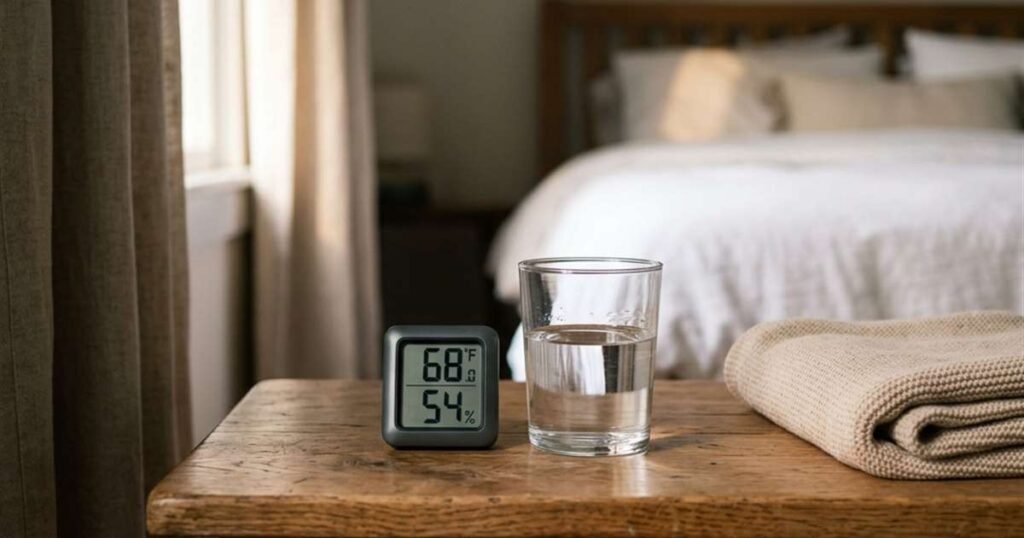
Bedroom temperature gets constant coverage. Humidity almost never does, despite [Sleep Foundation’s guidance](https://www.sleepfoundation.org/bedroom-environment/humidity-and-sleep) putting the ideal indoor relative humidity range at 30 to 50 percent, a figure that lines up with EPA recommendations for indoor air generally. Outside that range, the effects are concrete rather than vague: air that’s too dry irritates the throat and nasal passages, while air above roughly 55 percent relative humidity creates conditions where dust mites, a common allergy trigger, reproduce more readily.
The complicating factor is that the air right against your skin and bedding, sometimes called the sleep microclimate, tends to run meaningfully more humid than the room-level reading on a hygrometer, since the body sheds moisture overnight that traditional bedding traps close to the skin. That’s a real mechanism, but it’s also where affiliate marketing tends to overstate what a $30 humidifier can measure or fix; a room-level device manages the room, not the six inches of air between you and your sheets, so treat aggressive precision claims about “microclimate humidity” with some skepticism unless the product actually measures it. A basic hygrometer is the honest first purchase here, before a humidifier or dehumidifier, because you can’t fix a range you haven’t measured.
Scent: Real Evidence, But It Solves a Different Problem Than People Think
Aromatherapy is the category most likely to get dismissed as pure marketing, and some of that skepticism is earned, plenty of diffuser copy implies scent alone fixes insomnia. The more accurate read is narrower: lavender in particular has real, published research behind it as a mild relaxant that supports the wind-down process before sleep, not as a tool that changes the physical environment the way noise masking or blackout curtains do.
That distinction is the whole Contrarian Reality of this guide. Scent tools get bundled into “sleep environment” marketing next to white noise machines and blackout curtains as if they’re interchangeable, but they’re not solving the same problem. Noise and light are physical disruptors with dose-response relationships you can measure in decibels and lux. Scent works on the psychological transition into sleep, which is real and worth addressing, but it will not fix a 45 dB(A) bedroom or a streetlight through a thin curtain no matter how strong the diffuser. If your actual disruptor is physical, spend the money on blackout or masking first; treat aromatherapy as an addition, not a substitute. Our [full breakdown of essential oils for deep sleep essential oils for deep sleep covers which specific oils have research behind them versus which are mostly folklore, and our diffuser picks best aromatherapy diffusers for sleep focus on auto-shutoff and noise level, since a diffuser that hums all night undermines the noise half of this guide.
Smart Fabric and Sleep Tech: Where the Category Is Actually Headed
The newest layer of the sleep environment category is textiles and systems that respond automatically rather than requiring a nightly manual routine, phase-change fabrics that regulate temperature passively, and home automation that ties lighting, temperature, and sound together on a schedule instead of three separate devices you have to remember to set. [Our breakdown of smart fabric bedding](/smart-fabric-bedding/) covers which claims about these materials are backed by real thermal research versus which are marketing extrapolation, and [our guide to smart home sleep integration](/smart-home-sleep-integration/) walks through what’s actually worth automating first.
The honest caveat, which most coverage in this space skips: automation doesn’t create a new physiological mechanism, it just removes friction from doing the same four fixes above (noise, light, humidity, and, to a lesser extent, scent) consistently instead of only on the nights you remember. That’s a genuine benefit for consistency, but it’s not a sixth variable with its own independent research base the way noise or light is, so don’t let smart-home framing convince you it deserves the first dollar of your budget.
Buy in This Order, Not the Order Ads Suggest
Ranked strictly by depth of evidence and cost-to-benefit, not by category size: blackout comes first, because the mechanism is direct and the fix is often under $50. Noise masking comes second, with WHO’s own thresholds backing the case and a wide range of price points to work with. Humidity and air quality come third, mainly because most people have never measured their baseline and are guessing. Scent comes fourth, as a real but narrower tool aimed at the wind-down process rather than the room itself. Smart-fabric and automation come last, not because they’re ineffective, but because they’re a convenience layer on top of the first four rather than a fix in their own right.
If you only fix one thing this month, fix the one the WHO already put a number on, because it’s the variable most bedrooms fail without anyone noticing.
Frequently asked Questions
What are the best earplugs for side sleepers?
Silicone putty earplugs are the safest and most comfortable option for side sleepers. They seal over the outer ear opening instead of pushing deep into the ear canal. Traditional foam plugs create painful pressure points when you press your ear into a pillow. You do have to replace silicone putty plugs frequently as they lose stickiness.
Do contoured sleep masks block more light than flat masks?
Contoured sleep masks block significantly more light while protecting your eyes. The 3D molded cups create a physical seal around your orbital bone without touching your eyelids. This prevents friction against your eyelashes during REM sleep. Just verify the mask has a recessed nose bridge, or light will leak in from the bottom.
Can you comfortably sleep with headphones on your side?
You can only sleep comfortably on your side using flat headband headphones. Standard earbuds press painfully into your ear canal under the weight of your head. Cloth headbands distribute the speaker hardware across your skull. The downside is that they trap heat and shift out of place if you toss and turn.
Environment only goes so far. Once the room is dialed in, the pillow is usually the next bottleneck, and our side-sleeper options roundup matches loft to shoulder width first.
The WHO’s 30 dB ceiling is measurable with a phone. Our Sleep Measurements & Tracking section shows which readings to trust.