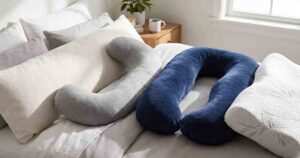
A standard pillow is 20 by 26 inches, but that’s where the simplicity ends. Seven named sizes exist, each tied to a specific bed width or age group. Sham, encasement, and insert sizing follows its own set of rules covered in our pillow accessories guide. If you’re shopping for a child, CPSC safety specs and the 13×18 inch toddler loft range are in our best toddler pillows guide.
Two standard pillows on a queen bed leave roughly 20 inches of exposed headboard on either side. That’s not a styling opinion, it’s arithmetic: a queen bed is 60 inches wide, two standard pillows at 20 inches each cover 40, and the remaining 20 inches is why the bed looks unfinished even with the sheets tucked and the corners pulled tight. Most people solve this by buying a third standard pillow. The better fix is usually a size change, not a quantity change, and that distinction is what this guide covers.
Pillow sizing has seven named categories in common US use, and each one exists to solve a specific mismatch between pillow, bed, pillowcase, or purpose. This guide runs through the exact dimensions of each, which bed width they’re built for, how sizing changes for kids, and the three designer arrangement formulas that turn a correctly-sized pillow set into a bed that reads as intentional instead of accidental.
The Full Pillow Size Chart
| Size | Dimensions (inches) | Dimensions (cm) | Best For |
|---|---|---|---|
| Youth | 16 x 22 | 41 x 56 | Children roughly 3-7 years old |
| Standard | 20 x 26 | 51 x 66 | Twin and full beds, budget sleeping pillows |
| Super Standard | 20 x 28 | 51 x 71 | Combination sleepers who move a lot |
| Queen | 20 x 30 | 51 x 76 | Full and queen beds, extra shoulder coverage |
| King | 20 x 36 | 51 x 91 | King and California king beds, side sleepers |
| Body | 20 x 54 | 51 x 137 | Side sleepers, pregnancy support, queen/king beds |
| Euro/Square | 26 x 26 | 66 x 66 | Decorative layering, propping up to read, not for nightly sleep |
Two sizes on this list deserve a closer look because they’re the ones people get wrong most often: Super Standard and Euro.
Super Standard sits only 2 inches longer than Standard, and that’s easy to dismiss as a rounding error. It isn’t. Standard vs. Super Standard is its own dedicated comparison, but the short version is that the extra 2 inches gives a pillow enough surface area to stay under your head through a position change, where a true Standard pillow can leave your head hanging off the edge by the time you roll from your back to your side.
Euro pillows are the one entry on this chart that isn’t meant for nightly sleep at all. At 26 by 26 inches, they’re square, decorative, and sized to fit a European sham rather than a standard pillowcase. Euro Sham vs. Standard Sham breaks down why the case, not the insert, is where people usually get this wrong.
How Many Pillows Per Bed Size
Pillow count isn’t really about how many pillows you want to sleep on, it’s about covering the width of the mattress without gaps or overhang. Here’s the count that spans each bed width cleanly:
| Bed Size | Mattress Width | Standard/Queen Pillows Needed | King Pillows Needed |
|---|---|---|---|
| Twin/Twin XL | 38-39 in | 1 | 1 (will overhang slightly) |
| Full/Double | 54 in | 2 | 1 |
| Queen | 60 in | 2-3 | 2 |
| King | 76 in | 3-4 | 2 |
| California King | 72 in | 3-4 | 2 |
Queen vs. King Pillow goes deeper into the size-versus-bed-width math above, including why a King pillow on a Queen bed isn’t automatically wrong, it’s a styling choice with a specific tradeoff (more headboard coverage, less width to spare on either side).
Pillow Loft Changes With Mattress Firmness, Not Just Sleep Position
Size covers width and length. Loft, the pillow’s height, is a separate variable that most size guides skip, and it depends on more than sleep position alone. A softer mattress lets your shoulder and hip sink further, which closes the gap between your ear and the mattress surface, meaning you need less pillow loft to stay neutral. A firmer mattress keeps you higher on the surface, widening that gap and requiring more loft to fill it. Pillow Loft and Mattress Firmness covers the full mechanism and how to measure your own shoulder gap, but the short version for this guide: don’t buy loft based on sleep position alone without accounting for what mattress you’re putting the pillow on.
When the Standard Size Doesn’t Apply: Kids’ Pillows
Every dimension above is scaled for an adult frame, and applying it to a young child’s bed causes a real, physical mismatch rather than just an aesthetic one. A Standard pillow’s 26-inch length is built for an adult shoulder-to-head span; on a child under roughly 7 years old, that surface area is disproportionate to their body and can push the neck into an unsupported angle. Youth vs. Standard Pillow covers the 16 by 22-inch youth dimension in detail and the rough age range where a switch to Standard makes sense.
Three Designer Formulas for Layering Pillows
Once the sleeping pillows are sized correctly, arrangement is what separates a bed that looks staged from one that looks like it just has pillows on it. There are three repeatable formulas, not an infinite number of options:
The Full Layer: Two Euro pillows against the headboard, two King or Queen sleeping pillows in front of those, one lumbar pillow (roughly 14 by 36 inches) laid horizontally in front of everything. This is the formula behind most hotel and showroom beds. How to Arrange Pillows on a King Bed walks through the exact spacing.
The Minimalist Stack: Four matching sleeping pillows stacked in two pairs, one lumbar accent in front, no Euro layer. Lower cost, less setup, still reads as intentional because the pairs are uniform.
The Sculptural Accent: A round or bolster-shaped pillow placed front and center instead of a lumbar rectangle. This is a newer styling move covered in our breakdown of the ball pillow trend, and it works because a curved shape breaks up an otherwise rectangular arrangement without adding another full-size pillow to the count.
Whichever formula you use, remember that Euro pillows are sized for a Euro sham, not a standard pillowcase, which is the single most common styling mistake covered in Euro Sham vs. Standard Sham: buying a 26 by 26-inch insert and trying to force it into a rectangular Standard case.
The Real Problem With Most Pillow Advice: It Treats Size as Purely Cosmetic
Most bedding guides frame pillow size as an aesthetics question exclusively, and that framing misses the sleeping half of the equation. A queen pillow is not just “a bigger standard pillow for a nicer-looking bed”, it’s 4 extra inches of length that changes shoulder coverage for side sleepers who move around at night. A king pillow on a smaller bed is not automatically a styling upgrade, it’s overhang if the bed is under 76 inches wide. Treat size as a functional spec first, decoration second, and the aesthetic side sorts itself out because a correctly-sized pillow set has less overhang and gap to disguise in the first place.
FAQs
Do I have to use king pillows on a king bed?
No, you do not need king pillows for a king bed. Many people prefer the cozy feel of sleeping on a standard or queen pillow because they are easier to move around. A common trick is using two king pillows against the headboard for aesthetics and sleeping on standard sizes in front.
Is a queen pillow too big for a full bed?
Queen pillows fit perfectly on a full bed without hanging over the edges. Two standard 20×26 inch pillows leave a gap, while two 20×30 inch queen pillows fill the width exactly. Just avoid king pillows here. They will definitely hang off the sides and look completely out of proportion.
Why do my pillowcases never fit my pillows?
Sheet sets usually come with standard pillowcases that do not fit queen or king pillows properly. A tight pillowcase compresses the fill and ruins the loft you need for spinal alignment. This matters even more with adjustable pillows, where you’ve dialed in a specific fill level. A too-small pillowcase forces that fill into a compressed shape and defeats the calibration. Buy your pillowcases separately to ensure they match the actual dimensions of your pillow.
Between standard and queen sits a size most stores do not stock. Our super standard pillow explainer covers the 20×28 middle ground and which cases actually fit it.
Once you have picked a size, the case has to match. Our Pillow Guides cover encasement and sham sizing for all seven standards.