A Cochrane review of house dust mite avoidance measures found that impermeable bedding covers, used alone, are unlikely to meaningfully improve allergy or asthma symptoms, even though they reliably cut allergen exposure. That’s not the same as “hypoallergenic pillows don’t work.” It means the pillow is one part of a larger control plan, not a standalone fix. This guide breaks down what the evidence actually supports, material by material. Take the quiz below to find your starting point.
“Hypoallergenic” on a pillow label doesn’t mean what most shoppers assume it means. The term is not regulated by the FDA or any standards body, so a manufacturer can print it on packaging without independent testing to back it up. That gap between the word and the evidence behind it is the entire reason this guide exists, and it’s also why the research is more interesting, and more useful, than a simple buy-this-not-that list.
The most cited body of research on this exact question is a series of Cochrane systematic reviews on house dust mite avoidance, the most recent covering trials through 2021. The consistent finding across them: allergen-impermeable bedding, used as an isolated intervention, is unlikely to produce a clinically meaningful improvement in asthma or allergic rhinitis symptoms, even in trials where it clearly reduced the amount of allergen present. National asthma guidelines still recommend encasements anyway, and that disagreement between the guidelines and the pooled trial evidence is worth understanding before you spend money assuming a pillow alone will fix a symptom problem.
What “Hypoallergenic” Actually Means (and Doesn’t)
Strip away the marketing language and a hypoallergenic pillow claim usually rests on one or more of three real mechanisms: a fill material that doesn’t provide food or habitat for dust mites, a woven barrier fabric with a pore size small enough to block allergen particles physically, or an antimicrobial treatment that limits bacterial and fungal growth on the surface. Those are three different problems with three different solutions, and a lot of product copy blurs them together as if any hypoallergenic pillow addresses all three equally. It doesn’t. Hypoallergenic vs. Regular Pillows breaks down which claim maps to which mechanism in more detail than fits here.
Dust mites (Dermatophagoides pteronyssinus and Dermatophagoides farinae) feed on shed human skin cells, not on the pillow material itself, and they thrive in warm, humid conditions, roughly 68 to 77°F with relative humidity above 50%, which describes most occupied bedrooms. A pillow that’s “hypoallergenic” for dust mites is really just a pillow that gives them nowhere to establish a colony, either because the material is solid and dense (latex, molded memory foam) or because a tightly-woven barrier physically excludes them a certified encasement.
Material Ranking: What Actually Resists Dust Mites
| Material | Mite Resistance | Why |
|---|---|---|
| Synthetic polyester fill + barrier encasement | Highest | No organic food source in the fill itself; machine-washable at mite-killing temperatures (around 130°F); encasement blocks surface accumulation |
| Latex (natural or synthetic) | High | Solid structure with no internal fiber matrix for mites to colonize, though surface allergens can still accumulate without an encasement |
| Molded or solid memory foam | High | Same mechanism as latex; cannot be hot-washed, so surface cleaning and an encasement matter more here |
| Down alternative (synthetic fiber) | Moderate | Fiber structure has more internal air space than solid foam but is fully washable, unlike natural down |
| Down and feather | Lowest without an encasement | Organic protein content, moisture retention, and internal air pockets create favorable mite habitat |
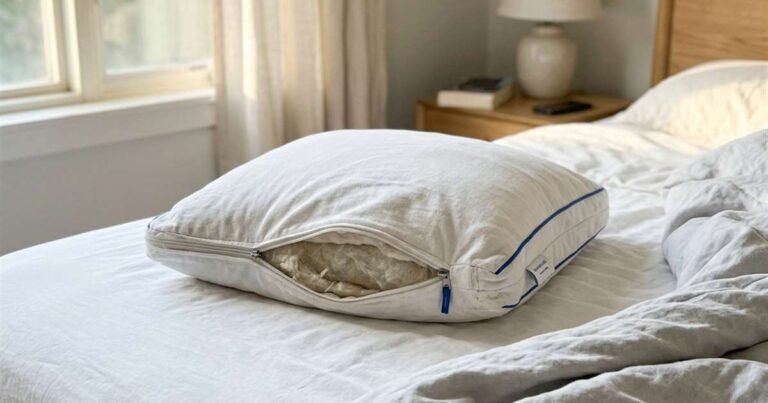
Two things worth flagging about that ranking. First, encasement matters more than fill material in every material-science summary of this topic, a barrier with a pore size under roughly 10 microns blocks the allergen particles (specifically the Der p 1 and Der f 1 proteins mites shed) regardless of what’s inside it, which is why Dust Mite Encasements is worth reading even if you’re not ready to replace the pillow itself. Second, down isn’t automatically disqualified. Research in the Journal of Allergy and Clinical Immunology has found that tightly-woven down-proof fabric casings can bring allergen penetration down to levels comparable to synthetic fills, so a properly encased down pillow is a legitimate option, not just a compromise.
The Encasement Evidence, in More Detail
Two controlled trials anchor most of what’s known about whether encasements actually change allergen exposure in practice. A randomized, double-blind, placebo-controlled trial published in the Journal of Allergy and Clinical Immunology followed 47 children with asthma and confirmed house dust mite allergy for a year. The group using active allergy-control mattress and pillow encasings showed a significant, sustained drop in mite allergen concentrations, and their inhaled steroid dose was reduced by at least half in 73% of that group, compared to 24% in the placebo group.
A separate multicenter randomized trial in patients with allergic rhinitis enrolled 279 patients across three university medical centers and found that impermeable bedding covers, used as part of a structured allergy-control program, did measurably reduce mite allergen exposure. Both trials support the physical mechanism: a tight-enough barrier blocks the allergen.
Where the evidence gets more complicated is at the population level. The Cochrane reviews on this topic, spanning multiple updates from the early 2000s through 2021, pooled data across dozens of trials and consistently concluded that impermeable bedding used in isolation is unlikely to produce a clinically meaningful symptom improvement for asthma or allergic rhinitis, even though allergen levels dropped in most of the underlying trials. That’s a real, published disagreement between the individual mechanistic studies above and the pooled clinical-outcome evidence, and it’s worth sitting with rather than resolving in either direction for marketing purposes.
The Contrarian Reality: Encasements Reduce Exposure, Not Necessarily Symptoms
This is the piece of the hypoallergenic pillow conversation that most bedding sites skip entirely, because it complicates a simple buy-this recommendation. National asthma guidelines, including the NAEPP’s, continue to recommend allergen-impermeable covers as part of a bedroom control plan. The pooled Cochrane trial evidence says that same intervention, used alone, doesn’t reliably move the needle on how a patient actually feels. Both things are documented in the same body of research, and the honest read is that a pillow encasement is one input into a multi-part environmental control plan (which also includes hot-water washing, allergen levels in carpets and upholstery, and, where warranted, acaricide treatment), not a standalone treatment.
Cleveland Clinic allergist Dr. McDonnell frames it directly: hypoallergenic bedding has real benefits, but expecting it to solve allergy symptoms on its own sets up disappointment. Cleaning habits and broader bedroom allergen control matter as much as the pillow itself. If you’re buying a hypoallergenic pillow expecting it to eliminate morning sneezing on its own, the research doesn’t support that as a reliable outcome. If you’re buying it as one piece of a broader plan, encasement plus hot-water washing plus a replacement schedule, the mechanistic studies above support that it’s doing real, measurable work.
Antimicrobial Is a Different Problem Than Hypoallergenic
Antimicrobial pillow marketing (silver or copper treatments) targets bacteria and fungi, not dust mite allergens, and it’s worth not conflating the two when shopping. A silver- or copper-treated pillow can reduce surface bacteria linked to acne breakouts or musty odor, but that mechanism does nothing for dust mite exposure, since mites aren’t bacteria and the treatment doesn’t change the pillow’s porosity to allergen particles. From there, it is worth separating which treatments have real material-science backing from which are marketing add-ons. If dust mites are your actual concern, prioritize the encasement and material choices above over an antimicrobial claim; if skin-surface bacteria or odor is the issue, that’s where antimicrobial treatment earns its place.
Down Alternative vs. Memory Foam: Which Wins for Allergies
Between the two most common non-down fills, solid or molded memory foam edges out down alternative fiber fill for dust mite resistance, for the same reason latex does: a solid block gives mites no internal structure to colonize. Down alternative fiber fill is still a major improvement over natural down and remains fully washable, which matters since foam pillows generally can’t tolerate hot-water washing without breaking down. The tradeoff is airflow. Down alternative fiber circulates air more freely than a solid foam core, so combination sleepers who run warm may find memory foam’s allergy advantage comes with a temperature cost. Down Alternative vs. Memory Foam for Allergies covers the off-gassing question as well, since inexpensive foams can release VOCs that irritate some sensitive sleepers independent of the dust mite question entirely.
Replacement Schedule Matters as Much as Material
A pillow doesn’t have to be visibly old to be an allergen reservoir. Research summarized in the material-science literature on this topic notes that a two-year-old pillow can contain 10 to 20% of its weight in dust mite fecal matter, dead mites, and shed skin cells, regardless of the fill type used. That figure holds even for pillows that looked and felt fine to the sleeper the entire time, since none of that buildup is visible from the outside. Do Anti-Allergy Pillows Really Work? covers the specific replacement window (roughly 18 to 24 months for most fills) and what changes that timeline in either direction.
Washing matters on its own timeline, separate from replacement. Encasements should come off and get washed in hot water on a weekly basis, roughly 130°F, which is the temperature threshold documented to kill dust mites rather than just removing surface debris. A pillow that’s technically hypoallergenic but hasn’t been washed on that schedule is not delivering the allergen reduction the underlying research assumes.
When to See an Allergist
None of the material or encasement choices above are a substitute for a diagnosis. If symptoms are persistent, moderate to severe, or involve asthma, an allergist can confirm dust mite sensitization with a skin-prick or blood test and build an avoidance plan that accounts for your specific triggers, rather than assuming mites are the cause based on symptoms alone. Bedding changes are a reasonable first step for mild, seasonal-feeling symptoms; they are not a replacement for medical evaluation when symptoms are significant or when asthma is involved.
Frequently asked Questions
Do hypoallergenic pillows actually stop dust mites?
Hypoallergenic labels just mean the pillow material itself does not trigger allergies. Dust mites will still colonize a down or loose-fiber pillow over time. You need a dense material like solid latex or memory foam to prevent them from penetrating the core. Adding a zippered encasement is always your best defense.
How often should I wash an anti-allergy pillow?
You only need to wash the pillowcase and zippered encasement weekly in water over 140 degrees Fahrenheit. Washing the actual pillow that often breaks down the supportive fibers quickly. If you use a high-quality encasement with a tight weave, the pillow itself stays completely protected from dust mites and dead skin.
Are down alternative pillows better for allergies than real down?
Down alternative uses synthetic fibers that do not harbor dander like natural bird feathers do. However, the loose cluster design still creates tiny air pockets where dust mites can thrive. Solid foam blocks are far superior for severe allergies because the dense structure leaves nowhere for mites to live.
Allergen claims live and die on materials. Our Pillow Materials section traces what each fill is actually made of.