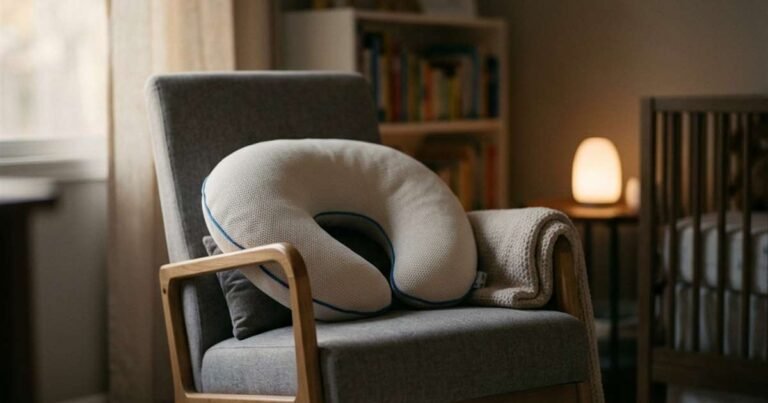
The most important thing to know about nursing pillows before comparing any of them: they are not for sleep. The U.S. Consumer Product Safety Commission documented 154 infant deaths and 64 injuries linked to nursing pillows between 2010 and 2022, most involving infants under three months old. A new federal safety standard took effect in 2026 specifically to address this. This guide covers that safety context first, then compares real specs on three nursing pillows: a structured wraparound design, a softer multi-use C-shape, and a wide-opening option built for C-section recovery.
This is general information, not medical advice. For questions about your own postpartum recovery, feeding positioning, or your baby’s specific needs, talk to your OB-GYN, your baby’s pediatrician, or a lactation consultant.
The Safety Context Every Nursing Pillow Buyer Should Know First
Nursing pillows are designed and regulated specifically as feeding support products, not sleep products, and the distinction matters more than most product marketing communicates. The CPSC’s federal safety standard, effective in 2025, exists because the agency documented 154 infant deaths and 64 injuries associated with nursing pillows between 2010 and 2022, with the majority of these deaths involving the pillow being used in or on a sleep surface such as an adult bed, crib, or sofa. A separate CDC analysis of sudden unexpected infant deaths in Georgia found that a nursing pillow was present in the infant’s sleep space in 5% of cases studied, with 80% of those deaths occurring in infants under four months old and the vast majority involving bed-sharing.
The core safety rules, straight from CPSC guidance: use nursing pillows only for active feeding while the baby is awake and supervised; never use a nursing pillow as a sleep surface, in a crib, or as a “lounger”; and if your baby falls asleep while feeding, or if you feel yourself falling asleep, move the baby to a separate, firm, flat sleep surface such as a crib or bassinet. These aren’t abstract precautions – they reflect a pattern serious enough that federal regulators built a new mandatory product standard around it. If you have questions about safe sleep setup for your specific home or baby, your pediatrician is the right resource.

Nursing Pillow Spec Comparison
| Pillow | Construction | Key Spec | Best For |
|---|---|---|---|
| My Brest Friend Original | Firm wraparound with back support, adjustable strap, foam interior | Flat, level top surface; built-in pocket | Consistent latch positioning, especially in early weeks |
| Boppy Original | Soft C-shaped pillow, no strap | Lightweight (~2.5 lbs), hypoallergenic recycled fiber fill | Versatility across feeding styles and later use once baby can sit |
| Frida Mom Adjustable | Layered, stackable cushioning with wide opening | Firmness adjustable by removing/adding layers; heat-pack pocket | C-section recovery, keeping weight off the incision area |
3 Best Nursing Pillows with Federal Safety Standard
Disclosure: We independently research, analyze and spec-verify every product we recommend. If you make a purchase through our links, we may earn an affiliate commission at no extra cost to you. This financial support helps keep our testing independent. Read our full Review Process and Affiliate Policy.
1. My Brest Friend Original
Best for: Parents looking for the most secure, hands-free structured support during newborn feeding sessions.
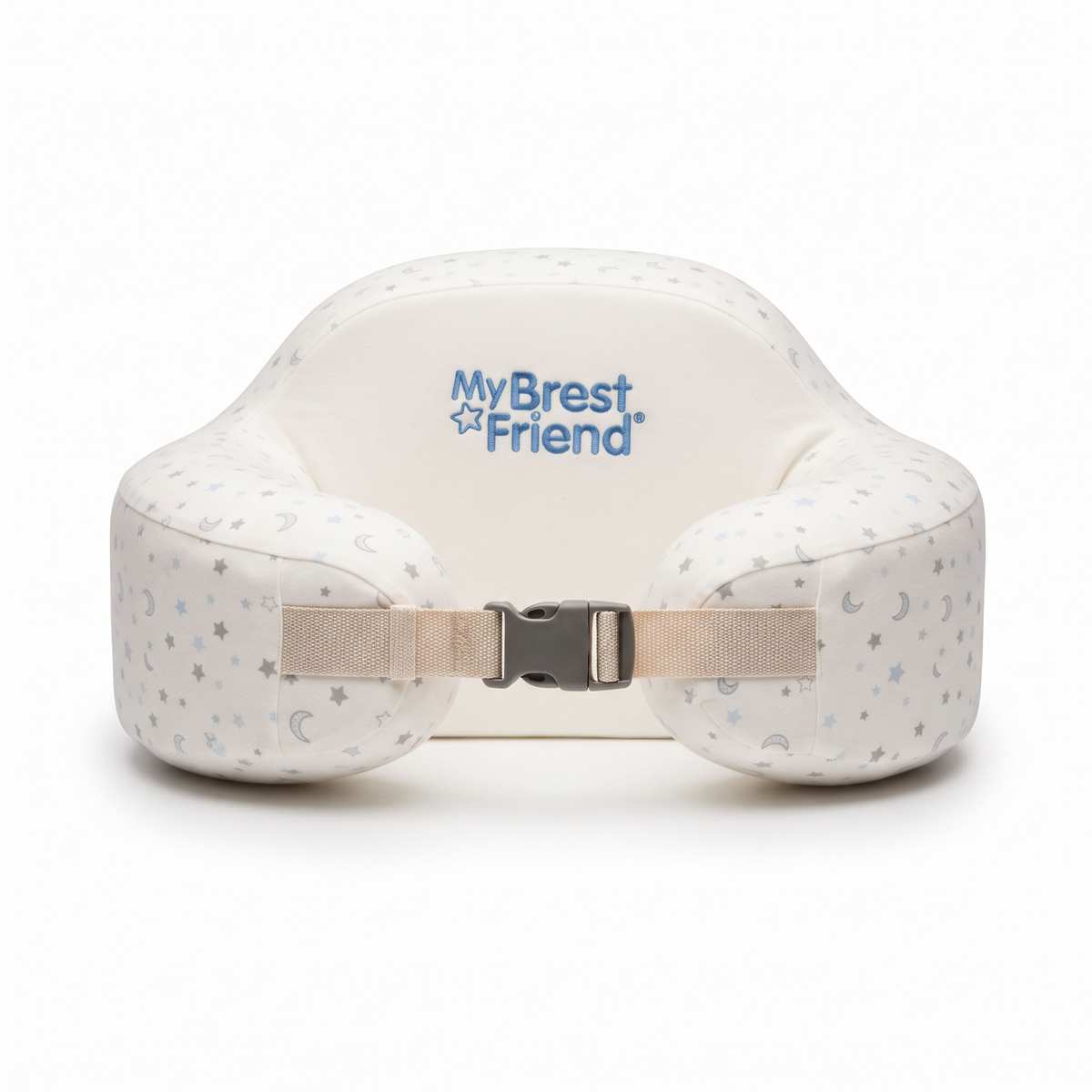
For the most consistent, hands-off-adjustment feeding position, the My Brest Friend Original’s structured wraparound design is the most purpose-built option on the market. Unlike softer C-shaped pillows, it completely encircles the waist and clips securely into place. This completely eliminates the gap between the pillow and your body where infants frequently slip down.
The firm, flat top surface prevents the baby from rolling inward, while the built-in lumbar rest encourages the parent to maintain straight posture rather than hunching over. Because it straps on tightly, you can actually stand up and walk around to grab a burp cloth without dropping the pillow.
- Buckle system keeps the pillow locked tightly against the body to prevent slipping.
- Firm, flat surface provides incredibly stable positioning for a newborn latch.
- Requires two hands to buckle and adjust, which is difficult while holding a crying baby.
- Strictly designed for feeding and cannot double as a baby lounger.
2. Boppy Original
Best for: Parents prioritizing quick, one-handed setup and a pillow that can transition to tummy time support later.
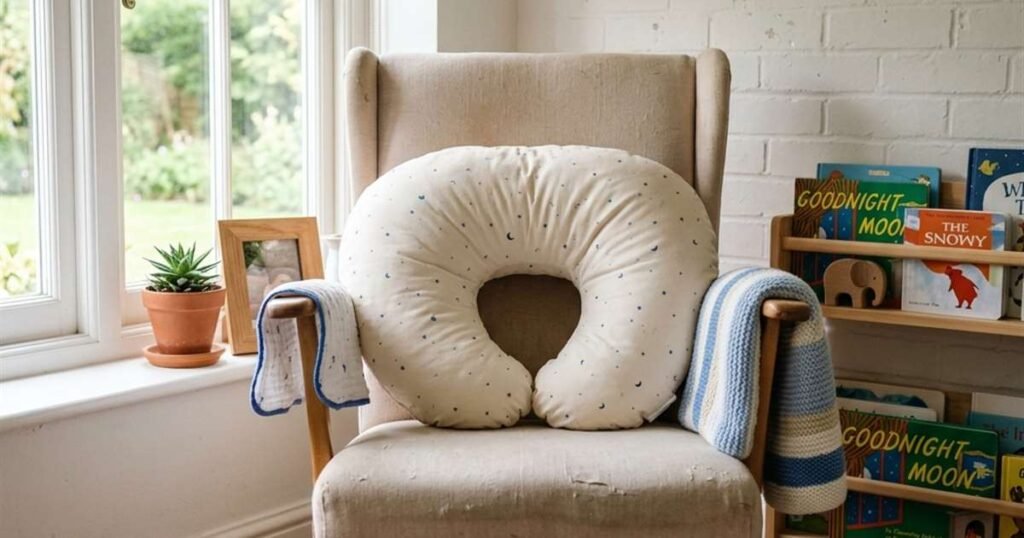
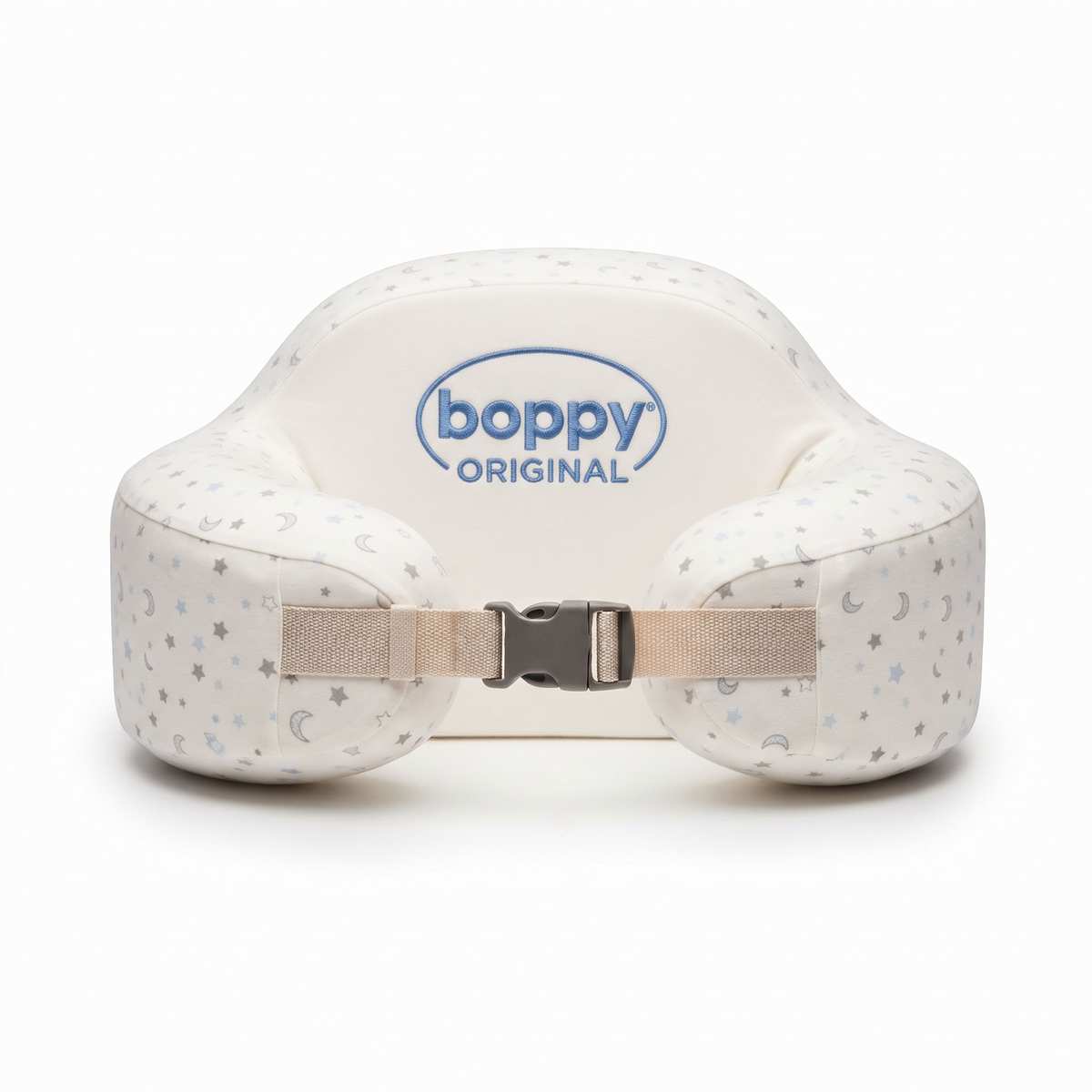
The Boppy Original takes a softer, unstrapped C-shape approach, resting easily on the lap rather than buckling securely to the body. That deliberate lack of a strap trades some positioning consistency for much faster one-handed setup. When you have a frantic, hungry infant in one arm, being able to simply slide the pillow onto your lap with the other hand is a massive advantage.
It also offers broader versatility. The exact same pillow that supports early feeding sessions can later support supervised tummy time and sitting practice as the baby grows, which feeding-specific designs explicitly do not offer. Its recycled hypoallergenic fiber fill is disclosed completely free of BPA and heavy metals.
- C-shape design slides on instantly with one hand.
- Easily transitions into a supervised tummy time or sitting support prop.
- Lack of a back strap means the pillow can slowly slide away from the body during feeds.
- Curved surface can sometimes cause a newborn to roll slightly inward.
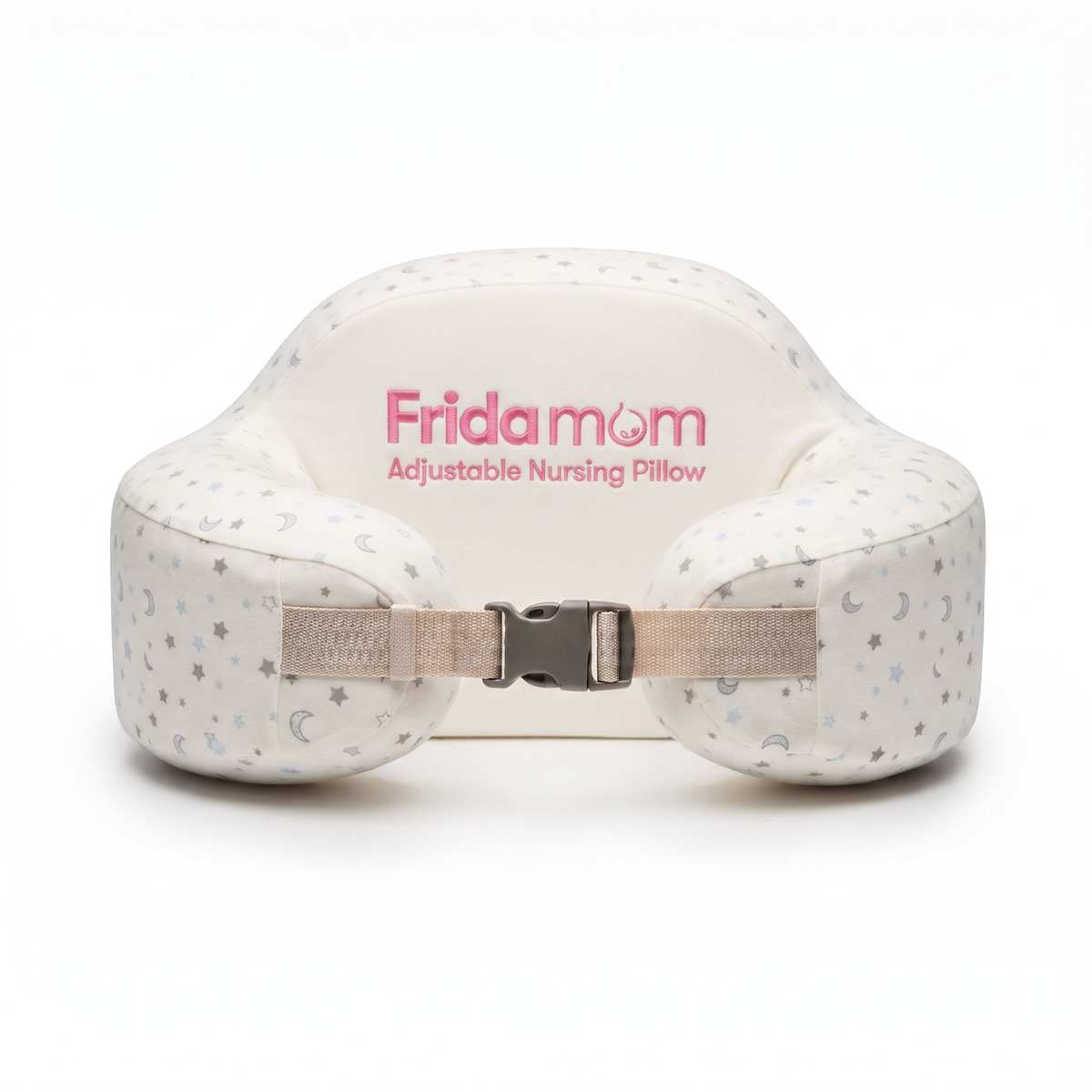
3. Frida Mom Adjustable Nursing Pillow
Best for: Postpartum mothers recovering from a cesarean delivery who need zero pressure placed on their abdomen.
Post-cesarean feeding introduces a specific mechanical problem the two general-purpose pillows above do not directly solve: keeping the baby’s weight entirely off a healing abdominal incision. The Frida Mom Adjustable addresses this perfectly with an exceptionally wide opening and stackable, removable cushioning layers. This lets the pillow’s support sit completely above and around the incision rather than pressing directly against it.
As recovery progresses and sensitivity decreases, you can adjust the firmness. Additionally, a dedicated pocket in the cover doubles as a place to insert a heat pack for the same kind of soothing thermal therapy often used for postpartum cramping.
- Wide center opening completely avoids touching sensitive C-section incisions.
- Stackable internal layers allow you to customize the pillow’s height and firmness.
- Heavier and bulkier than standard C-shaped pillows due to the customizable layers.
- The highest price point of the group.
The Contrarian Reality: “Lounging” Marketing Predates the Safety Rule It Now Violates
Some nursing pillow marketing images and older product descriptions – many still circulating in older blog posts and social content – show babies resting unsupervised on nursing pillows for photos, naps, or “lounging” outside of active feeding. This is precisely the use pattern the CPSC’s 2025 safety standard was built to prevent, and current product labeling and packaging is now required to warn against it explicitly. If a product photo, older review, or hand-me-down pillow’s marketing suggests otherwise, that content predates or ignores the current safety standard – it does not reflect what’s actually safe. A nursing pillow’s only intended use is supporting an awake, supervised baby during active feeding.
The Bottom Line
For the most consistent, hands-off-adjustment feeding position, the My Brest Friend Original’s structured wraparound design is the most purpose-built option. For versatility across feeding styles and beyond the newborn stage, the Boppy Original remains a genuinely useful multi-purpose choice. And for C-section recovery specifically, the Frida Mom Adjustable’s wide opening and layered firmness are built around the one problem general nursing pillows don’t solve. Whichever you choose, the safety rule doesn’t change: supervised feeding only, never sleep, and a firm, flat, separate surface the moment your baby drifts off.
FAQs
How do I decide which nursing pillow is right for me?
You can use our fit finder tool to get a recommendation based on your specific feeding goals. Click a button like u0022Consistent latch positioningu0022 for structured support or u0022C-section recoveryu0022 if you need pressure relief on your incision. Our suggestions come directly from real parent testing. Your body shape might still make a different style work better.
Are C-shaped nursing pillows better than wrap-around ones?
C-shaped pillows offer more flexibility for different sitting positions. If you select u0022Versatile, multi-useu0022 in our tool, you will see a C-shaped option that works for tummy time as well as feeding. They do tend to shift away from your body more easily than wrap-around pillows with straps.
Are nursing pillows medically necessary for breastfeeding?
No. Nursing pillows are entirely optional for breastfeeding. They simply provide elevation to reduce arm and back strain during long feeding sessions. Many parents use rolled blankets or u003ca href=u0022https://brocia.com/best-pregnancy-pillows/u0022 data-type=u0022linku0022 data-id=u0022https://brocia.com/best-pregnancy-pillows/u0022u003estandard bed pillowsu003c/au003e to achieve the same ergonomic support. Mothers recovering from a C-section often find firm nursing pillows provide a helpful physical buffer over their incision site.
Which nursing pillow design is best after a C-section?
A firm structured pillow that clips around the waist works best after a C-section. This design prevents the pillow from shifting and keeps the baby’s weight off the abdominal incision. Soft or U-shaped pillows easily slide down and apply pressure exactly where you want to avoid it. Your individual torso length will dictate how well these rigid pillows actually fit.
Can I use a regular bed pillow instead of a nursing pillow?
Yes. Standard bed pillows work perfectly well for supporting a baby during feeds. You just need to stack two or three pillows to bring the baby up to breast level. This approach saves money and avoids adding bulky specialty items to your home. Regular pillows lack a structured wrap-around design and may shift more easily while you feed.