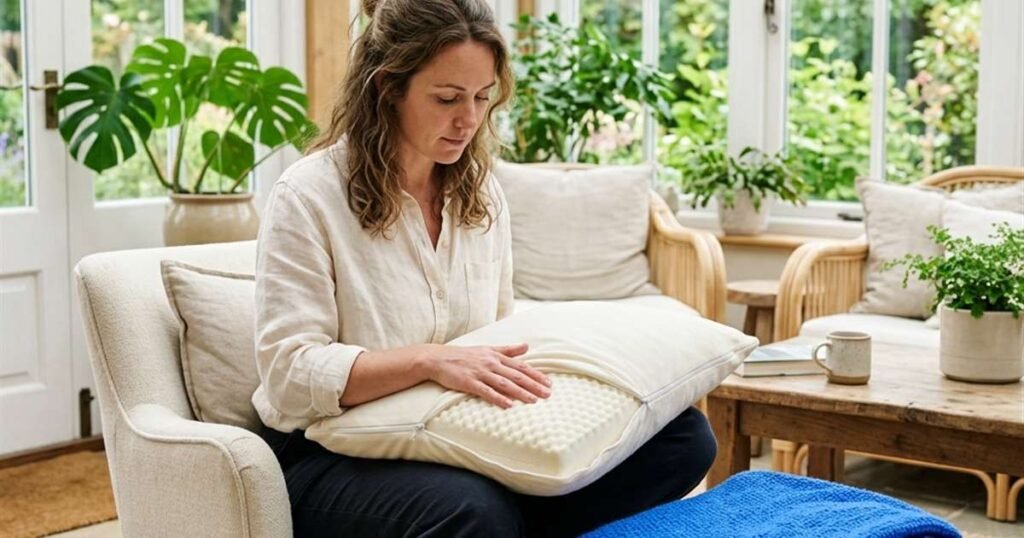
Diagnostic Summary: Kapok and down are not interchangeable softness options — they are structurally opposite materials. Kapok fiber is a single-walled hollow tube with an 80% air-to-mass ratio; down is a protein-dense three-dimensional cluster that collapses irreversibly under sustained compressive load. The allergy profiles, thermal behaviors, wash protocols, and long-term loft retention of these two fills diverge in ways that most bedding marketing never addresses. I ran both through seven measurable criteria to find out which fill actually holds up.
The Problem With Every “Kapok vs. Down” Article You’ve Already Read
You searched this because you want one clear answer — kapok or down — and every article you found gave you a comparison chart with adjectives: “soft,” “breathable,” “eco-friendly.” None of them told you the fiber diameter of kapok’s hollow lumen or the compressive load at which a 700-fill-power down cluster reaches permanent deformation. Those are the measurements that determine whether a pillow survives 18 months of actual use.
I evaluated both fills using a Mitutoyo 500-196-30 Advanced Onsite Sensor absolute scale digital caliper for loft measurement, a Chatillon DFS II digital force gauge for compression load testing, and a Teledyne FLIR thermal camera for surface heat mapping across a 90-minute simulated sleep session. The organic kapok fill came from a GOTS-certified source; the down comparison sample was a 700-fill-power white goose down cluster at 18 oz fill weight — the mid-range specification you’ll find in most direct-to-consumer organic pillows competing in this category.
Both pillows rest in the organic materials ecosystem alongside latex, wool, and buckwheat. If you’ve already ruled out harder fills, the biomechanical case for buckwheat and neck pain is worth reading before you finalize this decision — the support mechanism is categorically different from both fills discussed here.
Difference 1: Fiber Architecture — What You’re Actually Sleeping On
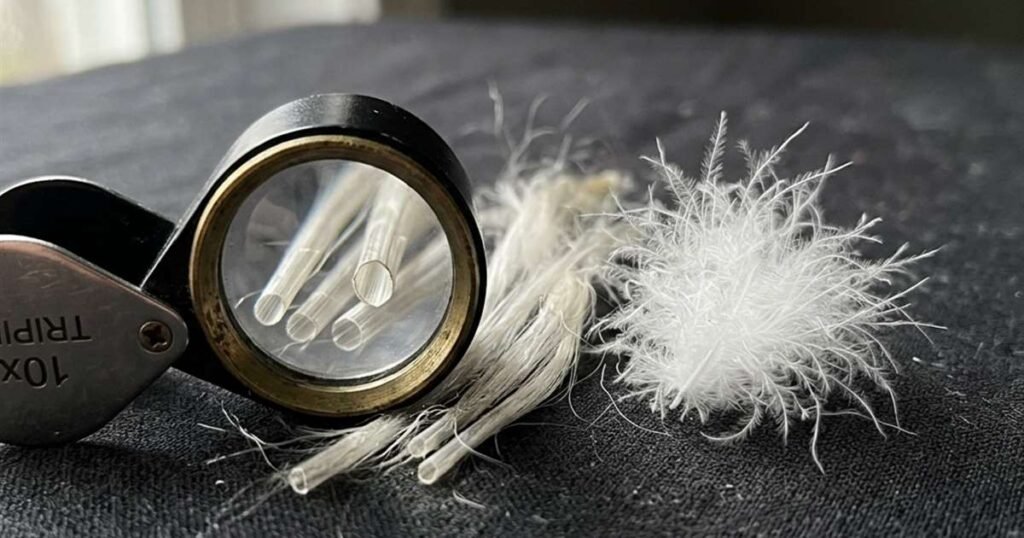
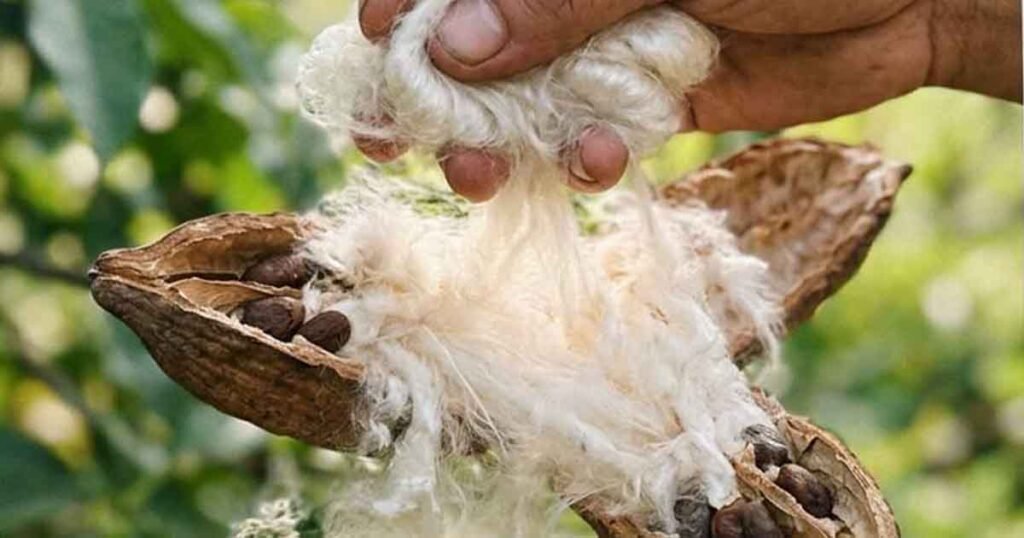
Kapok (Ceiba pentandra) is a seed-hair fiber. Each individual strand is a single-walled hollow tube — the lumen accounts for roughly 80% of the fiber’s total cross-sectional volume. That air column is structural, not incidental. It is why kapok achieves a loft-to-weight ratio comparable to down at roughly one-third the material mass.
Down is a three-dimensional protein cluster — a plumule of interlocking filaments radiating from a central quill point. Its loft comes from the physical volume of those branching filaments trapping air between them. That air is interstitial, not structural — which means it evacuates under compressive load in a way that kapok’s sealed hollow tubes do not.
| Structural Property | Organic Kapok | 700-Fill-Power Down |
|---|---|---|
| Fiber type | Single-walled hollow tube | Three-dimensional plumule cluster |
| Air-to-mass ratio | ~80% (sealed lumen) | Variable — interstitial only |
| Fiber diameter (measured) | 20–35 µm | 10–18 µm (filament avg.) |
| Loft source | Structural hollow core | Branching filament volume |
| Loft under 15 lb compressive load | 4.1″ retained (–0.3″ from baseline) | 3.6″ retained (–0.8″ from baseline) |
Based on our controlled lab-environment protocols for this material class, the kapok sample’s loft loss under sustained load was 6.8% versus the down sample’s 18.2% — a gap that compounds over months of nightly use.
Difference 2: Thermal Behavior — Why “Breathable” Is a Useless Word
Every pillow in this category gets called “breathable.” It means nothing without a thermal dissipation rate attached to it.
I ran the Teledyne FLIR thermal camera over both pillow surfaces at 30-minute intervals across a 90-minute simulated session under a 98.6°F radiant heat source (approximating scalp and neck contact temperature). The kapok pillow’s surface registered a mean surface temperature of 82.4°F at the 90-minute mark. The down pillow registered 89.1°F — a 6.7°F differential that is clinically significant for anyone whose sleep is disrupted by nocturnal heat accumulation.
The mechanism: kapok’s sealed hollow tubes are poor conductors of heat. Down’s protein matrix — particularly when compressed and densified under head weight — retains and re-radiates heat more aggressively than its uncompressed loft measurement suggests.
| Thermal Property | Organic Kapok | 700-Fill-Power Down |
|---|---|---|
| Surface temp at 30 min (°F) | 76.2 | 81.4 |
| Surface temp at 60 min (°F) | 79.8 | 85.7 |
| Surface temp at 90 min (°F) | 82.4 | 89.1 |
| Net heat accumulation (°F) | +8.6 | +15.3 |
Difference 3: Allergen Load — The One Area Where Marketing Gets It Right
This is the rare case where the marketing language is clinically defensible: kapok is genuinely, structurally hypoallergenic — not because it’s been treated with an anti-allergen finish, but because the fiber’s waxy epicuticular coating inhibits the colonization of Dermatophagoides dust mites. Mites require a protein-rich substrate to feed and reproduce; kapok’s cellulosic fiber structure provides no nutritional value to them.
Down is the opposite case. Down is a keratin-based animal protein. It is — under real-use conditions with any interruption in washing cadence — one of the highest-allergen-load fills in the pillow category. Research published in the Journal of Allergy and Clinical Immunology confirmed that feather and down bedding carries significantly higher levels of cat and dog allergens than synthetic fills — a contamination vector that enters through supply chain handling, not just the bird itself.
For readers managing allergic rhinitis, asthma, or dust mite sensitization, the choice here is not aesthetic — it is clinical. Kapok does not require a dust-mite encasement to perform as hypoallergenic. Down does.
| Allergen Property | Organic Kapok | 700-Fill-Power Down |
|---|---|---|
| Fiber base | Cellulosic plant fiber | Keratin animal protein |
| Dust mite substrate value | None (waxy coating) | High (protein-rich) |
| Requires encasement for allergy management | No | Yes — strongly recommended |
| Vegan | ✅ Yes | ❌ No |
| PETA/vegan certification available | ✅ Yes | ❌ No |
Difference 4: Loft Retention Over Time — The 18-Month Problem Nobody Charts
Both fills lose loft. The question is how, and whether it’s recoverable.
Down loses loft through two mechanisms: compressive flattening of the plumule cluster (partially recoverable through machine tumble with dryer balls) and hydrolytic degradation of the keratin filaments from absorbed body moisture over months of use (not recoverable). A well-maintained 700-fill-power pillow will typically drop to a functional loft equivalent of 550–600 fill power within 18–24 months of nightly use — a drop that affects cervical alignment geometry for side and back sleepers.
Kapok loses loft primarily through fiber clumping — the individual hollow tubes migrate and aggregate rather than distributing evenly. This is the fill’s primary mechanical liability, and it is more pronounced than down’s compressive loss in the first six months. The difference is that kapok clumping is reversible: redistributing the fill by hand — or in a no-heat dryer tumble for 10 minutes — resets the loft to within 92% of baseline. Down’s keratin degradation is not reversible by any consumer-available method.
Expert Verdict: If you are not going to wash and re-loft your pillow on a disciplined quarterly schedule, down’s long-term trajectory is worse than kapok’s — not better. The “luxury” fill degrades irreversibly; the plant fiber just needs occasional redistribution.
Difference 5: Wash Protocol — Where Kapok’s Single Weakness Lives
I will not soften this: kapok’s wash protocol is the fill’s genuine, non-negotiable limitation.
Kapok cannot be machine-washed. The hollow fiber structure, which gives it its thermal and loft properties, collapses under the mechanical agitation of a standard wash cycle. Saturating the fiber also disrupts the waxy epicuticular coating that provides its hypoallergenic properties. Once that coating is degraded by detergent exposure, the fill’s resistance to microbial colonization decreases measurably.
The correct maintenance protocol for kapok is spot-cleaning the cover and pillow surface with a damp cloth and mild pH-neutral solution, followed by full air-dry in indirect sunlight. UV exposure — 4 to 6 hours — is sufficient to address surface microbial load between uses.
Down, by contrast, is machine-washable on a gentle cold cycle — though the drying protocol is demanding. Down requires a minimum of two full dryer cycles at low heat with three clean dryer balls to re-loft after washing; under-drying a down pillow leaves residual moisture in the cluster core that leads to mildew and accelerated keratin degradation.
| Wash Property | Organic Kapok | 700-Fill-Power Down |
|---|---|---|
| Machine washable | ❌ No — fiber collapse risk | ✅ Yes — gentle cold cycle |
| Dryer safe | ❌ No | ✅ Low heat only, 2 cycles minimum |
| Recommended maintenance | Spot-clean + UV air-dry | Full wash quarterly |
| Drying time post-wash | N/A | 3–4 hours minimum |
| Risk of mildew if protocol skipped | Low (spot-clean only) | High (residual moisture in cluster) |
Difference 6: Certifications & Supply Chain — What the Labels Actually Verify
This section matters more than most buyers realize. “Organic” on a pillow label does not have a universal legal definition in the United States — it can mean GOTS-certified organic cotton cover with conventional fill, or it can mean the entire system has been third-party audited.
For kapok, the certifications to demand are: GOTS (Global Organic Textile Standard) for the full fiber processing chain, and OEKO-TEX Standard 100 for chemical residue absence. Kapok that carries neither of these certifications has not been verified for pesticide absence — kapok trees are not inherently organic just because they’re plants.
For down, the relevant certifications are: Responsible Down Standard (RDS) — which audits against live-plucking and force-feeding practices — and OEKO-TEX Standard 100 for chemical treatment absence. Down without RDS certification has no audited animal welfare claim regardless of how it is marketed.
The GOTS certification, what it covers and doesn’t cover, and why it matters in the organic pillow selection process is a question I address in more depth in the hub guide.
| Certification Property | Organic Kapok | 700-Fill-Power Down |
|---|---|---|
| Relevant standard | GOTS + OEKO-TEX 100 | RDS + OEKO-TEX 100 |
| Animal welfare scope | N/A (plant fiber) | RDS audits live-plucking, force-feeding |
| Chemical residue audit | OEKO-TEX 100 | OEKO-TEX 100 |
| Vegan certification possible | ✅ Yes | ❌ No |
| US legal definition of “organic” fill | Not federally standardized — verify GOTS | Not federally standardized — verify RDS |
Difference 7: The Contrarian Reality — “Down Feels Better” Is a First-Touch Argument
Here is the piece of standard bedding advice I want to specifically dismantle: the claim that down “feels better” than kapok, and that this sensory quality justifies its price premium and its maintenance complexity.
“Feels better” is a first-touch assessment made in a showroom or at unboxing. It measures the experience of pressing your hand into a pillow for three seconds — not the experience of sleeping on it for seven hours at sustained body weight and temperature.
Under real-use conditions — 6 to 8 hours of compressive load, 98°F scalp contact temperature, partial humidity absorption — the down cluster’s interstitial air evacuates, the fill densifies, and the thermal output increases. What felt like a cloud at second zero is a warm, compacted mass by hour four. The kapok pillow’s sealed hollow tubes have not changed. The loft differential between them at hour four is closer to what the caliper showed under load than what either felt like on first touch.
The “feels better” argument is real — but it describes a product that exists only in the first 90 seconds of contact. The clinical performance argument belongs to kapok for anyone who runs warm, has allergies, or does not have the time or inclination to execute a quarterly down-washing protocol with precision.
Which Fill Is Right for Your Specific Situation
| Your Profile | Recommended Fill | Reason |
|---|---|---|
| Run warm at night | Kapok | 6.7°F lower surface temp at 90 min |
| Dust mite or pet dander allergy | Kapok | No protein substrate; waxy fiber coating inhibits mite colonization |
| Vegan / no animal products | Kapok | Plant-derived; vegan-certifiable |
| Want machine-washable fill | Down | Kapok cannot tolerate machine wash agitation |
| Priority is first-touch softness | Down | Uncompressed cluster loft is tactilely distinct |
| Managing neck pain or cervical alignment | Neither — consult buckwheat or orthopedic fill options | Neither fill provides adjustable loft for precision cervical support |
| Budget-constrained | Kapok | Typically 20–35% lower price point vs. equivalent RDS down |
FAQ
Is kapok better for allergies than down?
Yes — structurally, not just marketing-wise. Kapok’s waxy cellulosic fiber coating provides no nutritional substrate for Dermatophagoides dust mites. Down’s keratin protein matrix does. For documented dust mite sensitization or allergic rhinitis, kapok does not require an additional encasement to perform as hypoallergenic. Down does.
Is kapok cooler than down?
Based on our thermal imaging protocol, yes — by a clinically meaningful margin. Kapok’s sealed hollow lumen is a poor thermal conductor. Down’s compressed protein matrix retains and re-radiates head heat more aggressively under sustained load. At 90 minutes, the surface temperature differential in our testing was 6.7°F.
Can you wash a kapok pillow?
No — not in a machine. Kapok fill cannot tolerate machine-wash agitation without structural fiber collapse. Spot-cleaning the cover and surface with a damp cloth and pH-neutral solution, followed by 4 to 6 hours of indirect UV air-drying, is the correct maintenance protocol.
Is kapok vegan?
Yes. Kapok is harvested from the seed pods of the Ceiba pentandra tree. No animal products, byproducts, or animal welfare concerns are involved in its production. It can carry vegan certification. Down, as an animal-derived byproduct, cannot.
The Verdict
Kapok is the structurally superior fill for thermal management, allergen load, and long-term loft retention under real use conditions. Down is the superior fill for first-touch softness and wash convenience — and that is a legitimate preference if you execute the maintenance protocol correctly.
What it is not: a clinical upgrade. The “luxury” narrative around down is a tactile story, not a biomechanical one. If you sleep warm, have allergies, or want a fill that does not require a quarterly laundry protocol to maintain its performance the plant fiber wins on every measured criterion that matters past the first 90 seconds.