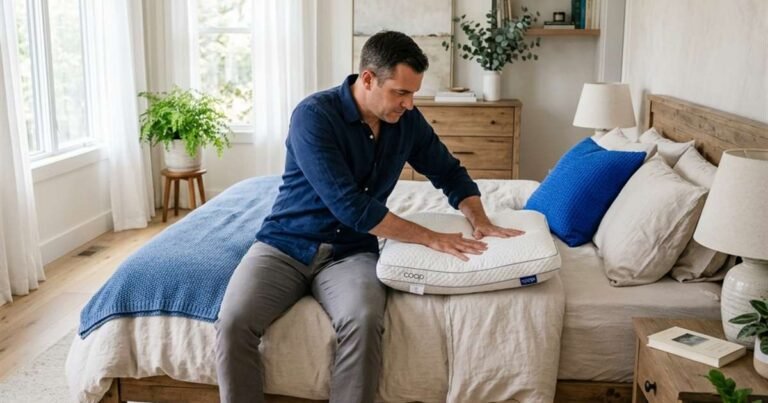
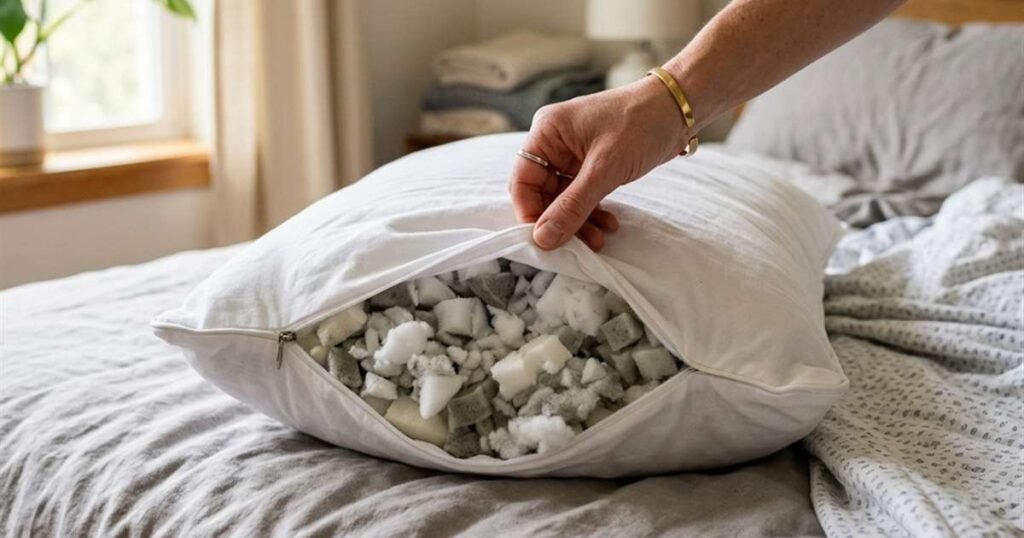
Both pillows share the same structural premise: a blend of cross-cut shredded memory foam and microfiber inside a zippered Lulltra fabric cover, with adjustable fill and an extra half-pound bag included. Both carry CertiPUR-US and GREENGUARD Gold certification. Both ship from a US factory using virgin (non-recycled) foam. And both come with a 100-night trial and a five-year warranty.
If that is where you stopped reading, you would conclude they are essentially the same product at different prices. They are not. Three specific construction differences drive meaningfully different behavior, and those differences map directly to sleep-position and temperature needs. This comparison names them plainly.
Answer two questions about your sleep position and temperature to find out whether the Coop Eden or Coop Original pillow is right for you.
The Three Differences That Actually Matter
1. Firmness designation
Coop rates the Original at medium-firm. The Eden is rated medium-soft softer by design, not by wear. The mechanism behind that difference is the fill composition.
The Original uses cross-cut shredded memory foam combined with microfiber. That combination produces a pillow that Sleep Foundation describes as firm enough to adequately support side sleepers at a 6-inch loft. The memory foam provides structural resistance; the microfiber adds loft without softening the core response significantly.
The Eden uses the same shredded foam-and-microfiber blend but with gel infusion added to the foam pieces. The gel beads are embedded in the foam before the cross-cut process. The result is a fill that has more surface-level give on initial contact without losing the rebound speed of memory foam. Coop’s official description characterizes the Eden as delivering a “luxurious, down-like feel” which translates in material terms to more immediate surface compression before the foam’s elastic response engages.
For sleepers who find the Original too firm or who are transitioning from a down pillow and want comparable initial softness with more durable support underneath, the Eden’s softer density is the functional reason to pay more.
2. Gel infusion and its actual cooling contribution
The gel beads in the Eden’s foam do carry heat away from the contact surface through conduction. That is a real mechanism, not marketing language. Memory foam without gel infusion has relatively low thermal conductivity. It warms near body temperature and holds that heat against the scalp. Gel infusion increases the thermal conductivity of the foam, drawing heat into the fill faster and distributing it more broadly.
The practical limit of this mechanism: gel infusion slows heat buildup; it does not eliminate it. Mattress Nerd’s testers noted the Eden can still sleep warm for people in hot climates or with higher-than-average body heat output. The gel effect is most useful for average-temperature sleepers who notice their current pillow warming over the course of the night. It is not a substitute for the structural airflow of an open-cell latex or polymer-grid pillow like the Purple Harmony.
The Original, by contrast, has no gel component. Sleep Foundation notes the Original has “a high odor potential” on unboxing (the off-gassing scent common to freshly manufactured polyurethane foam) and is a warmer pillow than the Eden. For hot sleepers, the Original is the weaker choice strictly on temperature, though both pillows run warmer than latex or buckwheat alternatives.
3. The gusset
The Eden has a 2-inch fabric gusset sewn around its perimeter. The Original does not.
A gusset is a panel of material connecting the top and bottom surfaces of the pillow at the edges, holding the pillow’s profile rectangular rather than allowing it to taper. Without a gusset, the edges of a pillow slope inward fill migrates toward the center and away from the perimeter. Coop’s own product comparison states the gusset prevents “pillow pinch,” the condition where fill pushes out from under the neck when the sleeper’s head is positioned toward the pillow’s edge.
For side sleepers who position their head slightly off-center, or for anyone who sleeps with their ear near the pillow’s edge, the gusset provides consistent support across the full sleeping surface. The Original’s non-gusseted design concentrates fill in the center and allows the edges to thin under compression.
The gusset also gives the Eden slightly better shape retention over time: the rectangular profile the gusset enforces is mechanically more stable than the pillow pinch the Original’s flat-edge design allows.
| Feature | Coop Original | Coop Eden |
|---|---|---|
| Fill | Shredded memory foam + microfiber | Gel-infused shredded memory foam + microfiber |
| Firmness Rating | Medium-firm | Medium-soft |
| Gel Infusion | No | Yes |
| Gusset | No | (2-inch perimeter gusset) |
| Cover Material | Lulltra (60% polyester / 40% bamboo-rayon) | Lulltra (60% polyester / 40% bamboo-rayon) |
| Adjustable Fill | (+ ½ lb extra bag) | (+ ½ lb extra bag) |
| Made in USA | Yes | Yes |
| Certifications | CertiPUR-US · GREENGUARD Gold | CertiPUR-US · GREENGUARD Gold |
| Trial | 100 nights | 100 nights |
| Warranty | 5 years | 5 years |
| MSRP (Queen) | ~$89 | ~$109 |
What Both Pillows Do and Do Not Offer
Both pillows are fully washable a meaningful practical difference from many memory foam pillows that are spot-clean only. Coop’s care instructions specify cold water, delicate cycle for both the cover and the inner foam core (pin the zipper closed before washing the core), tumble dry low. Coop recommends washing the inner core no more than roughly once a year; the outer cover can be washed more frequently. After washing, the core may take multiple dryer cycles to dry fully do not use the pillow until it is completely dry.
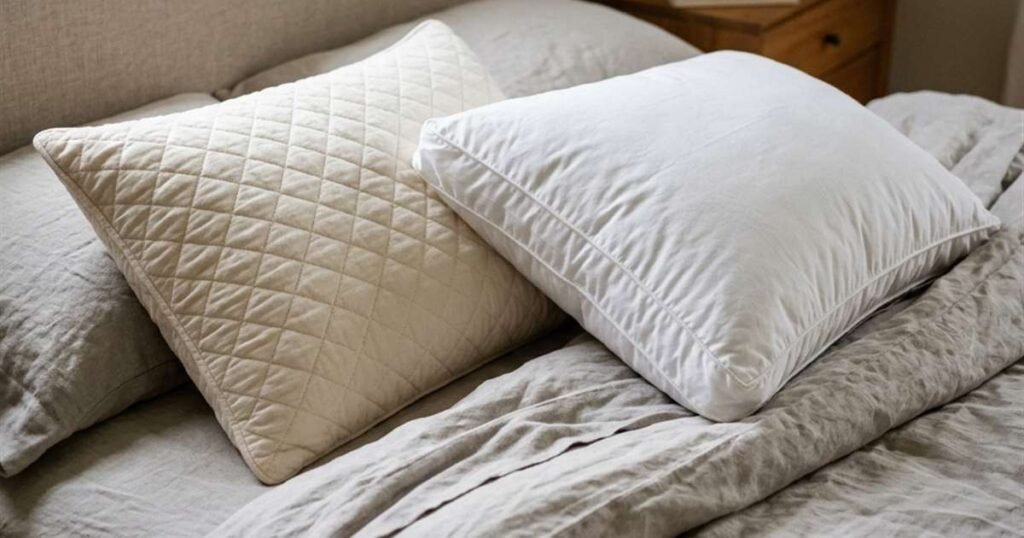
Both pillows use only virgin, freshly manufactured foam Coop’s stated policy is to never use recycled or repurposed foam, which matters for consistency. Foam that contains recycled material can have uneven density across the fill, which creates inconsistent support. Using a single-grade, freshly manufactured foam means the fill behaves consistently from the first night and degrades predictably over the pillow’s lifespan rather than developing lumpy pressure points.
Neither pillow is suitable for sleepers who want to fold or bunch their pillow into a custom shape. The shredded foam-and-microfiber blend has fast rebound the fill springs back rather than holding a manipulated position. If your sleep habit involves folding the pillow in half or punching it into a shape, both Coop pillows will resist that. They adjust through fill level (add or remove), not through molding.
On the question of non-toxic materials: both CertiPUR-US and GREENGUARD Gold certifications are third-party, not self-reported. CertiPUR-US covers content and emissions standards for polyurethane foam testing for volatile organic compound (VOC) levels, banned substances including heavy metals, and formaldehyde. GREENGUARD Gold is a stricter emissions standard designed for environments with sensitive populations (schools, hospitals). A pillow carrying both has passed independent lab testing, not just manufacturer assurance.
The Myth About Gel Memory Foam and Hot Sleepers
The standard marketing claim for gel-infused memory foam is that it sleeps “cool.” That framing sets an expectation the material cannot always deliver, and it has led to a category of frustrated buyers who purchased gel foam specifically for cooling and found limited benefit.
Gel infusion does what physics allows: it increases the thermal conductivity of polyurethane foam, pulling heat away from the contact surface more quickly than non-gel foam. What it cannot do is dissipate that heat out of the pillow. The heat moves from your scalp into the fill and then stays there, warming the surrounding foam material. For average-temperature sleepers who generate moderate scalp heat, the gel buys enough thermal buffering to avoid the “hot face pressed into warm foam” effect for most of the night. For genuinely hot sleepers those who wake damp or regularly run high body temperatures the gel slows the problem rather than solving it.
The structural solution to pillow heat retention is airflow, not conductivity. Open-cell materials (latex, buckwheat, the polymer grid in the Purple Harmony) let heat escape through passive ventilation. Gel-infused closed-cell foam delays the heat transfer timeline. Both the Eden and the Original are closed-cell foam products. The Eden runs cooler than the Original. Neither runs as cool as an open-cell latex or polymer-grid pillow. If temperature is your primary purchase driver rather than softness or edge support, consider whether the Eden’s gel infusion addresses your specific heat pattern or whether a structurally different fill material would serve better.
Which One to Buy
The Original is the right call for: back and side sleepers who want medium-firm support, sleepers who run at average body temperature, and anyone looking to spend the least to access Coop’s adjustable fill system. At ~$89 queen, it is the lower-cost entry into the same core architecture. Consumer Reports has given it top marks for side support, back support, and resilience.
The Eden is the right call for: sleepers who find standard memory foam too firm and want a softer initial feel closer to down, side sleepers whose head position drifts to the pillow’s edge (where the gusset provides support the Original cannot), and those who run moderately warm and want the gel buffer. The ~$20 price difference over the Original pays for gel infusion and the gusset if neither of those features maps to your specific sleep complaint, the Original is the equivalent pillow for less money.
For stomach sleepers: Coop recommends removing roughly one-third of fill for stomach sleeping on the Eden, and similar adjustment on the Original. The Eden’s gusset maintains edge support even at reduced fill, which gives it a small advantage for combination sleepers who shift into stomach position intermittently. Dedicated stomach sleepers who spend most of the night face-down should remove substantial fill from either pillow both arrive overfilled for that position.
FAQ
Is the Coop Eden softer than the Original?
Yes. The Eden is rated medium-soft; the Original is rated medium-firm. The gel infusion in the Eden’s foam pieces provides more immediate surface give on initial contact while retaining rebound speed. Sleepers transitioning from down or soft fiber pillows who want comparable initial softness with more durable, non-compressing support underneath will find the Eden the closer match.
Is the Coop Eden worth the extra money?
For two specific use cases, yes: hot-to-average-temperature sleepers who experience gradual warmth buildup on a standard memory foam pillow (the gel provides measurable thermal buffering), and side sleepers whose head position uses the pillow’s edge (the gusset maintains edge support the Original cannot). If neither of those describes your sleep, the Original is the same structural pillow for roughly $20 less.
Are Coop pillows non-toxic?
Both the Eden and the Original carry CertiPUR-US certification (independent lab testing for VOC emissions, banned substances, and formaldehyde levels in polyurethane foam) and GREENGUARD Gold certification (a stricter emissions standard than standard GREENGUARD). Both use 100% virgin, freshly manufactured foam not recycled or repurposed material. Neither certification covers the full lifecycle or sourcing of raw materials; they cover the finished foam’s chemical content and emissions output.
Can you wash both the cover and the foam on Coop pillows?
Yes, both the Eden and the Original are machine washable on the inner foam core, which is unusual for shredded memory foam pillows. Coop’s instructions specify cold water on a delicate cycle for the core (with the zipper pinned shut), tumble dry low, and full drying before use. The inner core may require multiple dryer cycles to dry completely. Coop recommends washing the core no more than roughly once a year. The outer cover can be washed more frequently on the same cold, gentle cycle.
Which Coop pillow is better for side sleepers?
The Coop Original provides better support for most side sleepers. We found its firmer foam blend holds its shape throughout the night and prevents neck strain. The Eden uses a softer gel-infused foam that compresses faster under weight. You can still use the Eden for side sleeping, provided you overstuff it with extra fill.
Does the Coop Eden actually sleep cooler than the Original?
The Eden sleeps slightly cooler for the first 30 minutes. It uses gel-infused memory foam which pulls initial heat away from your face. That cooling effect fades once the foam reaches body temperature. If you sleep extremely hot, neither pillow replaces a dedicated cooling system like the Eight Sleep pod.
What is the main difference between Coop Original and Eden?
The main difference is firmness and material density. The Original uses standard shredded memory foam for a firmer, more structured feel. The Eden uses softer gel-infused foam mixed with microfiber, creating a plush, down-like sink. Choose the Original for neck support and the Eden for a cloud-like feel.