
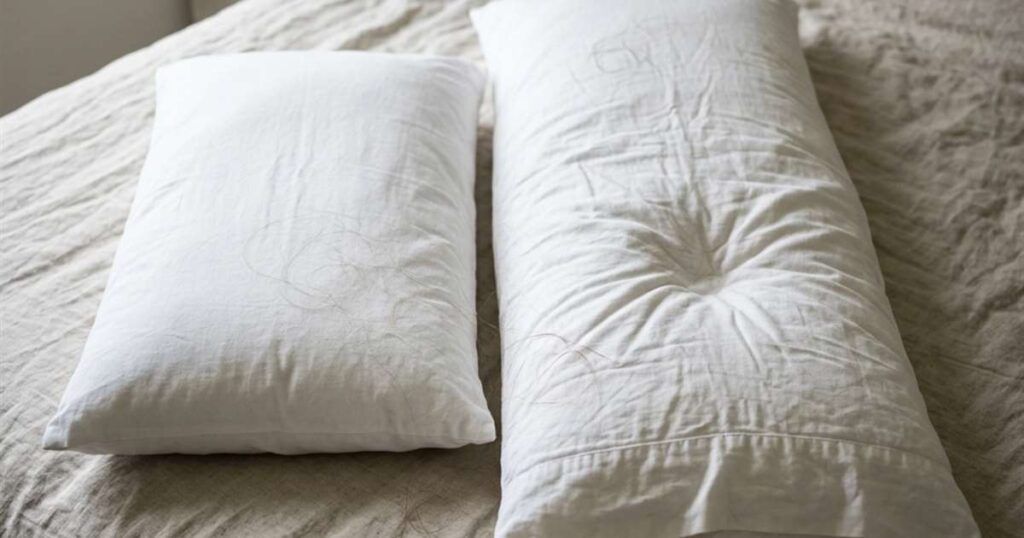
Most people frame this as a “bigger is better” question. It isn’t. The difference between a queen and a king pillow is a single dimension: length. A queen runs 20×30 inches. A king runs 20×36 inches. The width. The measurement that determines how high your head sits. Is identical on both. That 6-inch difference in length is where the decision actually lives, and it has nothing to do with which size mattress you own. See how pillow sizing interacts with mattress dimensions and sleeping position, the pillow size guide is the reference to consult first.
The Specs, Side by Side
Before anything else: the numbers. These are standard industry dimensions from the American National Standards Institute bedding classifications, reflected uniformly by major manufacturers including Parachute, Brooklinen, and Casper.
| Size | Dimensions | Standard bed match | Pillowcase needed |
|---|---|---|---|
| Standard | 20 in × 26 in | Twin, Full | Standard (20 in × 26 in) |
| Queen | 20 in × 30 in | Queen | Queen (20 in × 30 in) or Standard (snug fit) |
| King | 20 in × 36 in | King, Cal King | King (20 in × 36 in) |
| Body | 20 in × 54 in | Any | Body pillowcase |
The queen pillow is 4 inches longer than a standard and 6 inches shorter than a king. None of these sizes changes the fill height, loft is determined by the fill material and density, not the pillow’s footprint.
Why the Length Difference Actually Matters
The 6-inch gap between queen and king is not about sleep comfort. It is about two things: pillowcase compatibility and off-bed use.
Pillowcase fit. A king pillow (20×36 in) will not fit inside a queen pillowcase (20×30 in) without visible bunching and stress on the seams. The reverse works, but looks wrong: a queen pillow inside a king case leaves roughly 3 inches of loose fabric at each end, which folds under during sleep and creates an uneven surface. If your pillow set and your pillowcase set are different sizes, you will notice it every morning. The only clean solution is matching sizes.
A queen pillow fits inside a standard pillowcase (20×26 in) if you don’t mind a snug tuck at the open end. Most people find this acceptable. A king pillow does not fit a standard case at all.
Backrest use. King pillows have become the default choice for sitting up in bed. Reading, watching TV, working on a laptop. Their extra length means they span more of a queen or king headboard horizontally, and two kings side by side fill a king-sized headboard without gaps. Two queen pillows on a queen bed leave about 8 inches of exposed mattress at each side when centered. Neither matters while you’re sleeping flat. Both matter if you use your bed as a second workspace or lounge.
Overhang on a queen mattress. A standard queen mattress is 60 inches wide. Two king pillows placed side by side measure 72 inches total. They will hang off the edges of a queen mattress by 6 inches combined, roughly 3 inches per side, when laid flat. Two queen pillows total 60 inches, which fits exactly. This is the most common complaint from people who buy king pillows for a queen bed without checking the math first.
The Side Sleeper Question
A frequent search query frames this as a position issue: do side sleepers need king pillows? No. The relevant pillow measurement for side sleepers is loft, the compressed height of the fill under head weight, not length. A side sleeper needs enough loft to fill the gap between their shoulder and their ear so the cervical spine stays neutral. That is a fill-density and fill-type question, not a size question.
The reason side sleepers sometimes prefer king pillows is purely behavioral: they tend to fold or scrunch pillows, and a longer pillow gives more material to work with. That is a preference, not a biomechanical requirement.
The science of loft targeting by shoulder width and sleep position, Saatva Latex vs. Avocado Green Pillow covers the same dimensional logic applied to the smaller end of the size range.
Does Pillow Size Affect Sleep Quality?
The research does not support any sleep quality difference tied to pillow length. A 2011 study published in the Journal of Physical Therapy Science examining cervical pillow parameters found that the variables tied to sleep comfort and spinal alignment were pillow height, contour shape, and fill compressibility, not pillow length. Length is a logistical dimension; height is a biomechanical one.
The Myth That a Bigger Bed Requires a Bigger Pillow
Here is where the industry gets this wrong, and it is worth naming directly: pillow manufacturers and bedding retailers routinely suggest that king beds require king pillows and queen beds require queen pillows. This framing sells sets. It is not functional advice.
Pillow size affects pillowcase fit and horizontal bed coverage. It does not change how well the pillow supports your head and neck. A person sleeping on a king bed who sleeps alone, stays in one position, and uses a single pillow has no functional reason to use anything other than a queen pillow. Unless they have king pillowcases, in which case the matching argument applies.
The “match your bed” rule is a linen-closet rule, not a sleep science rule. Conflating the two leads people to buy king pillows for a queen bed, then discover they hang off the edges and require a separate pillowcase purchase. The correct starting point is: what pillowcases do you own, and what do you use the pillow for beyond sleeping?
Pillowcase Math: The Compatibility Grid
This is the single most practical table for anyone buying new pillows or pillowcases. Every combination below is derived from standard industry dimensions.
| Pillow size | Fits Standard case (20 in × 26 in)? | Fits Queen case (20 in × 30 in)? | Fits King case (20 in × 36 in)? |
|---|---|---|---|
| Standard (20 in × 26 in) | Yes (perfect fit) | Yes (loose, 3–4 in extra length) | No (very loose) |
| Queen (20 in × 30 in) | Yes (snug tuck needed) | Yes (perfect fit) | Yes (loose, 3 in extra length) |
| King (20 in × 36 in) | No (will not close) | No (bunches / seam stress) | Yes (perfect fit) |
The “snug tuck” on a queen pillow in a standard case is functional, not ideal. It compresses the fill at one end slightly. Whether that matters depends entirely on where you rest your head. Most people sleep on the center-to-far-end of the pillow, well away from the tucked opening.
What Happens When You Put a King Pillow on a Queen Bed
Two king pillows (each 20×36 in, total 72 in) on a standard queen mattress (60 in wide) produce 12 inches of combined overhang. That is roughly 6 inches per pillow hanging off each side. During sleep this is not a functional problem. A person sleeping on a single pillow in the center of the mattress will barely notice. The overhang becomes a problem when:
Both sides of the bed are in use and each sleeper pushes their pillow toward the edge. The pillow does not have the mattress surface to sit on and gradually slips. Getting up in the middle of the night and knocking a pillow to the floor is the most common version of this complaint. If your bedroom has a tight footprint and the pillow falls off the same side as a narrow gap between the bed and the wall, retrieving it is annoying.
The other scenario is purely visual: a made bed with two king pillows on a queen mattress looks proportionally wrong if you care about that. Bedding design guidelines from brands like Brooklinen specifically note that queen pillows are the size-matched choice for queen beds for this reason.
Quick-Answer FAQ
Can you put a king pillow on a queen bed?
Yes, physically. Two king pillows on a queen mattress will overhang the edges by roughly 3 inches per side. For a single sleeper who keeps one pillow centered, overhang is not a problem. For two sleepers using the full mattress width, it creates a falling-off issue over the course of a night.
Is a king pillow too big for everyday sleep?
Not because of its length. Loft, fill height, determines whether a pillow is “too big” for your neck geometry. A king pillow with low fill can be fine for any sleep position. The length only matters for pillowcase fit and backrest use.
Do king pillows need special pillowcases?
Yes. A king pillow (20×36 in) requires a king pillowcase (20×36 in). It will not fit cleanly inside a queen or standard case.
What dimensions is a queen pillow?
20 inches wide by 30 inches long. The width is identical to a king pillow (also 20 inches). Only the length differs.
Do side sleepers need a king pillow?
No. Side sleepers need adequate loft, fill height, matched to their shoulder width. That is a fill density and material question, not a size-length question. Some side sleepers prefer the extra length for scrunching or folding, but it is not a biomechanical requirement.