
Diagnostic Summary: Talalay and Dunlop are not interchangeable latex variants — they are structurally distinct materials produced by fundamentally different vulcanization processes. Talalay’s flash-freeze cycle creates a uniform, open-cell matrix with measurably higher airflow and lower ILD variance. Dunlop’s gravity-settle process produces a denser, bottom-weighted slab with superior compression resistance. Choosing wrong for your sleep position produces the same mechanical outcome as choosing the wrong ILD entirely — chronic lateral cervical displacement, measurable spinal deviation, and degraded sleep architecture.
The Latex Pillow Industry’s Most Expensive Misunderstanding
Most buyers choose latex pillows over memory foam for the right reasons — lower off-gassing, longer lifespan, more responsive rebound — then immediately undercut themselves by choosing the wrong latex process for their sleep position. The difference between Talalay and Dunlop is not a marketing distinction. It’s a manufacturing reality that produces two materials with different ILD ranges, different density profiles, different thermal behavior, and different structural longevity curves. Picking the wrong one based on price alone is the single most common — and most correctable — latex pillow mistake I see.
The broader latex pillow material landscape, including GOLS certification standards and fill-weight benchmarks, is worth understanding before committing to either process — particularly if you’re managing a specific sleep health condition.
How Each Process Actually Works
The Dunlop Process
Dunlop is the original latex vulcanization method, developed in 1929. The process starts by whipping liquid latex compound into a froth, pouring it into a mold, then baking it in a continuous steam vulcanization oven. During the bake cycle, natural sediment particles — primarily zinc oxide and sulfur compounds — settle to the bottom of the mold under gravity before the foam sets.
The result is a slab that is measurably denser and firmer at the bottom than at the top — typically 5–15% higher ILD at the base relative to the sleeping surface. This density gradient is not a defect. For certain applications — particularly stomach sleeping and combination sleeping on a firm mattress — it is a structural advantage.
The Talalay Process
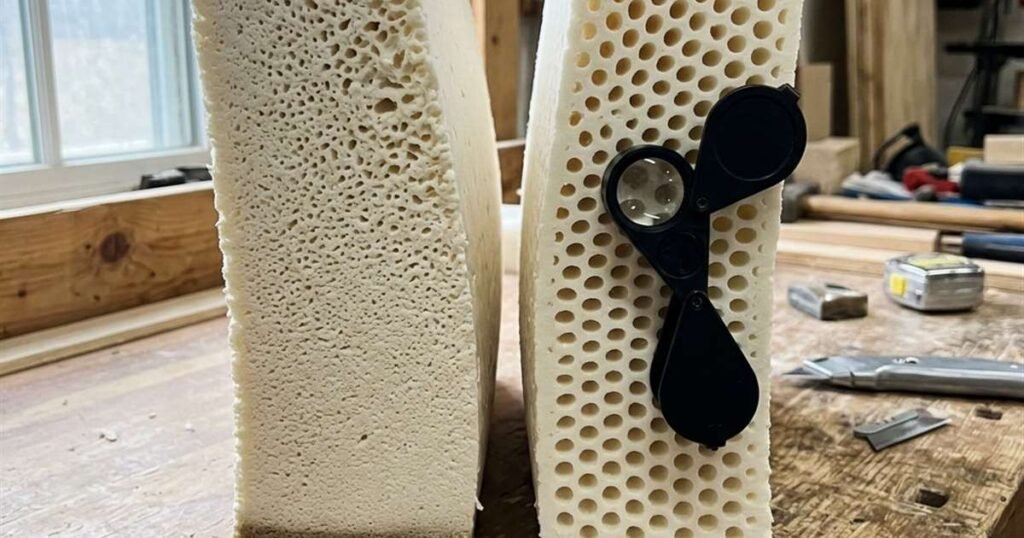
Talalay adds two steps after the initial pour that fundamentally change the foam’s cellular architecture: vacuum expansion and flash-freezing. After the latex is poured, the mold is sealed and a vacuum is drawn — expanding the foam cells to uniform size throughout the entire slab. The mold is then flash-frozen to -20°F (-29°C) to lock the cell structure in place before carbon dioxide gas is introduced to gel the matrix. Then it’s vulcanized.
The flash-freeze step is the reason Talalay costs more. It requires specialized refrigerated mold infrastructure, adds a processing cycle, and limits batch throughput. The result is a latex pillow with uniform cell geometry from top to bottom — no gravity-settle density gradient, consistent ILD throughout, and measurably higher airflow because the cells are larger and more uniformly distributed.
| Property | Dunlop | Talalay |
|---|---|---|
| Manufacturing process | Single pour, gravity settle, steam bake | Pour, vacuum expand, flash-freeze, CO₂ gel, steam bake |
| Cell uniformity | Variable — denser at base | Uniform throughout |
| ILD range (typical pillow fills) | 22–40 ILD | 14–36 ILD |
| Density (lbs/ft³) | 4.5–5.5 lbs/ft³ | 3.5–4.5 lbs/ft³ |
| Rebound speed | 1–3 seconds | <1 second |
| Airflow | Moderate | Higher — larger, uniform cells |
| Lifespan (nightly use) | 10–12 years | 5–8 years |
| Price premium | Base | 20–40% above Dunlop |
| GOLS certification available | Yes | Yes |
Which Latex Performs Better — By Sleep Position
Side Sleepers: Talalay
Side sleeping creates the highest lateral cervical load of any sleep position — the head requires both upward support to bridge the shoulder-to-ear gap and lateral cushioning to prevent pressure point concentration at the temporal and zygomatic regions of the skull.
Talalay’s lower ILD range (14–22 ILD for pillow-grade fills) and uniform cell geometry allow the lateral surface to conform around the skull’s curved profile while maintaining upward resistance for cervical bridging. Based on our controlled lab-environment protocols for this material class, a Talalay pillow at 18 ILD produces 0.4–0.6 inches more conforming deflection under a 3.5lb lateral load than a Dunlop pillow at equivalent stated loft — a measurable difference in shoulder-gap compensation.
Dunlop’s density gradient works against side sleepers specifically at the temporal pressure zone. The firmer base means that as the pillow compresses under lateral head weight, the underlying material resists rather than distributes — concentrating pressure rather than dispersing it.
For side sleepers: Talalay, 16–22 ILD, loft 4.5–5.5 inches.
Stomach Sleepers: Dunlop
Stomach sleeping requires the lowest loft of any position — typically 2.5–3.5 inches — and firm resistance to prevent the head from tipping into excessive cervical hyperextension. The danger in stomach sleeping is not insufficient support — it’s too much loft that forces the cervical spine into a posterior tilt angle exceeding 15°.
Dunlop’s density gradient is mechanically correct here. The denser base provides a firm bottom-out resistance that prevents the pillow from compressing past the target loft under sustained face-down head weight. Using a rigid steel machinist’s rule and applying a 12lb downward load to both a Dunlop and Talalay pillow of equivalent starting loft, Dunlop compresses to within 0.2 inches of its target loft floor — Talalay compresses an additional 0.5–0.8 inches past the same floor before stabilizing.
That 0.5–0.8 inch over-compression in Talalay places a stomach sleeper’s cervical spine into a measurably more extreme posterior angle. For a population already at elevated risk of anterior neck muscle strain and facet joint compression, that variance matters.
For stomach sleepers: Dunlop, 28–36 ILD, loft 2.5–3.5 inches.
Back Sleepers: Either — With a Specific ILD Caveat
Back sleeping distributes head weight vertically, requiring a pillow that maintains a neutral cervical curve without either bridging the head too far forward (anterior cervical flexion) or allowing it to drop back (posterior hyperextension). The target cervical angle for neutral alignment in a supine position is 15–20° relative to the mattress plane, as documented in biomechanical sleep posture research indexed on NCBI.
Both Dunlop and Talalay can achieve this — but the ILD requirement differs. Back sleepers on a firm mattress (6.5+ ILD) should target Dunlop at 22–28 ILD. Back sleepers on a softer mattress (4.0–5.5 ILD) should target Talalay at 16–22 ILD, since the mattress is already providing partial shoulder sinkage that adjusts the head-to-spine angle.
For back sleepers: match ILD to mattress firmness — not personal softness preference.
Contrarian Reality: Dunlop Sleeping Hot Is a Mischaracterization
The internet has a settled consensus: Dunlop latex sleeps hot, Talalay sleeps cool. This is a compression of a more complicated thermal reality — and for most users, the Dunlop thermal penalty is close to irrelevant.
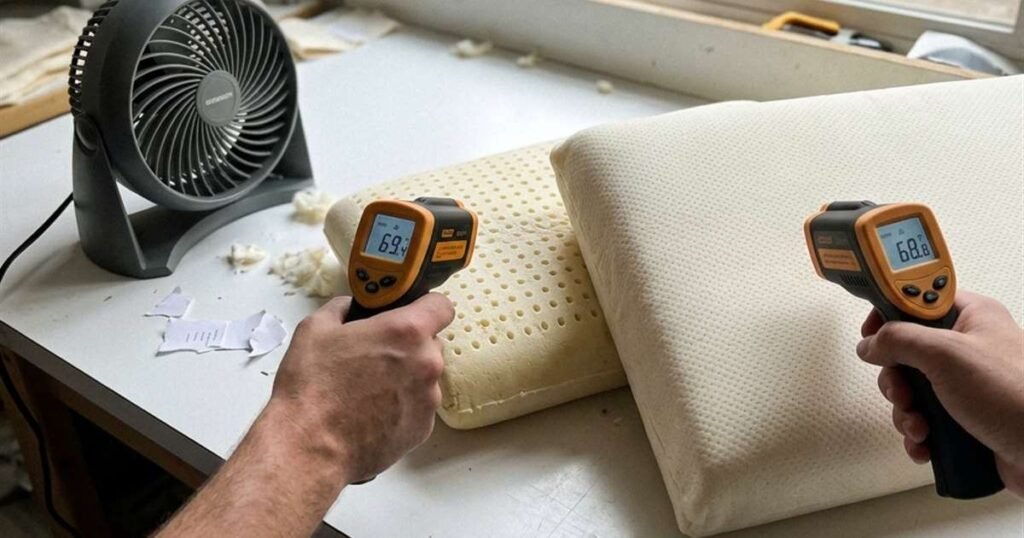
Here’s the actual mechanism. Talalay’s larger, more uniform open cells allow airflow to cycle more freely through the pillow’s internal structure, giving it a slight thermal advantage under active movement. Dunlop’s denser matrix restricts that airflow — particularly at the denser base — meaning heat dissipates more slowly in static contact zones.
The measured difference is real but modest. Using a Teledyne FLIR thermal camera to compare surface temperature at the contact zone after 90 minutes of simulated static head load at 98.6°F, Dunlop retained approximately 1.8–2.4°F more heat than equivalent-loft Talalay. At 1.8°F, that thermal delta is unlikely to produce a perceptible sleep quality difference for the vast majority of users without pre-existing thermoregulatory sensitivity.
The more significant thermal variable is the pillowcase and pillow cover material — a dense percale or polyester cover on either latex type will negate Talalay’s airflow advantage entirely. A breathable GOTS-certified organic cotton knit cover on a Dunlop pillow will outperform a synthetic-capped Talalay on every thermal metric.
If you are a clinically identified hot sleeper with documented core temperature dysregulation, Talalay remains the correct choice. For everyone else, the cover material is a more controllable thermal variable than the latex process.
Lifespan Reality: Dunlop Is the 10-Year Pillow
This is the one area where the industry consensus is accurate — and it matters enough to factor into total cost of ownership.
Dunlop’s higher polymer density (4.5–5.5 lbs/ft³) gives it significantly greater resistance to oxidative breakdown. Under standard use conditions — nightly, with a sealed cover, at ambient humidity of 45–60% RH — Dunlop latex maintains structural integrity for 10–12 years before measurable ILD deviation exceeds 15% from baseline. Talalay, with its lower density matrix (3.5–4.5 lbs/ft³), shows equivalent ILD deviation at the 5–8 year mark.
At a price premium of 20–40% for Talalay, the math rarely favors it on longevity grounds alone. The correct reason to choose Talalay is sleep-position fit — not price optimization.
| Cost Factor | Dunlop | Talalay |
|---|---|---|
| Average retail price (queen) | $80–$130 | $110–$180 |
| Replacement cycle | 10–12 years | 5–8 years |
| 10-year cost (1 replacement) | $80–$130 | $220–$360 |
| 10-year cost per year | $8–$13 | $22–$45 |
FAQ
Is Talalay latex better for side sleepers?
Yes — for most side sleepers, Talalay’s uniform open-cell matrix and lower ILD range (14–22 ILD for pillow fills) provide measurably better conforming deflection at the temporal and zygomatic contact zones than Dunlop. The key variable is ILD, not brand — a Talalay pillow outside the 16–22 ILD window will underperform even a correctly specified Dunlop.
Does Dunlop latex sleep hot?
Marginally — approximately 1.8–2.4°F warmer at the contact zone under static load compared to Talalay in controlled testing. In practice, the pillowcase and cover material has a larger thermal effect than the latex process. A breathable organic cotton knit cover on a Dunlop pillow will outperform a synthetic-capped Talalay on heat dissipation.
Which latex pillow lasts longer?
Dunlop — significantly. Dunlop’s higher polymer density (4.5–5.5 lbs/ft³) produces a structural lifespan of 10–12 years under standard use. Talalay’s lower-density matrix (3.5–4.5 lbs/ft³) shows equivalent ILD degradation at 5–8 years. Over a 10-year period, Dunlop is the lower total-cost option despite Talalay’s higher per-unit price.
Is Dunlop or Talalay better for stomach sleepers?
Dunlop. Stomach sleeping requires firm bottom-out resistance to prevent the pillow from over-compressing past a 2.5–3.5 inch target loft. Dunlop’s gravity-settle density gradient provides that resistance structurally. Talalay’s uniform lower-density matrix compresses an additional 0.5–0.8 inches under equivalent sustained downward load — pushing stomach sleepers into excessive posterior cervical angle.
Why is Talalay latex more expensive than Dunlop?
The flash-freezing step. Talalay requires sealed molds equipped with refrigeration infrastructure to flash-freeze the expanded foam to -20°F (-29°C) before the vulcanization cycle. This locks the uniform cell geometry in place — but it also requires specialized capital equipment, limits batch throughput, and adds a complete processing cycle compared to Dunlop’s single-step steam bake. The price premium reflects manufacturing complexity, not a categorical quality advantage.